Uplift and Nurture Through Action, Service and Development — Courtney Clavon of Chime
Courtney Clavon, co-lead of AfroChime at Chime, on building a Black ERG that drove Juneteenth as a company holiday, paid ERG leaders, and built lasting impact.

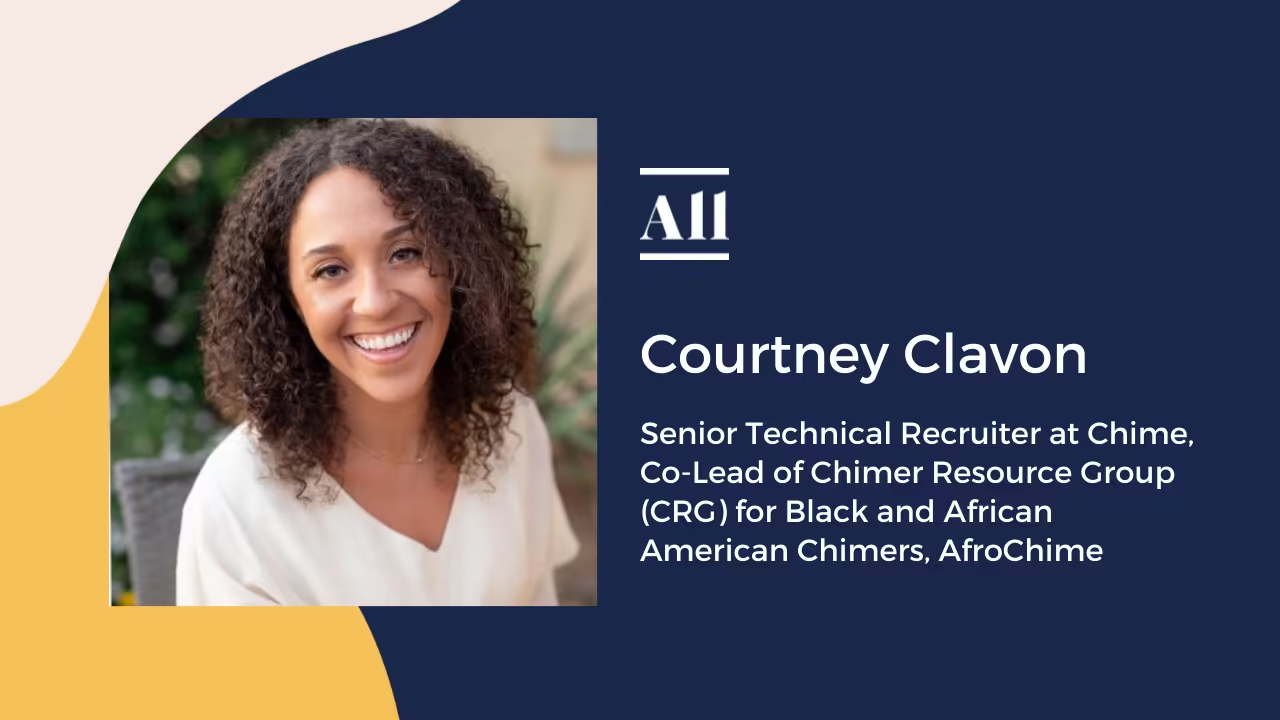
Courtney Clavon on building AfroChime at Chime
Courtney Clavon (she/her/hers) is a Senior Technical Recruiter at Chime and co-lead of AfroChime, Chime's Chimer Resource Group (CRG) for Black and African American employees. Her recruiting work centers on sourcing, interviewing, and hiring to grow Chime's technical and operational teams. Her ERG leadership grew from that same commitment to bridging the gap between diversity and opportunity in tech.
Chime is among a small group of companies that compensates CRG leaders for their work, a structural decision that sets it apart from most organizations where ERG leadership is uncompensated volunteer labor. AllVoices spoke with Clavon about how AfroChime was built, what it has accomplished, and what ERG leaders everywhere need from the organizations they serve.
What prepared you for your role as a Senior Technical Recruiter at Chime?
I've been working as a Technical Recruiter for nearly eight years, and throughout that time, I've worked with many different people from all walks of life. Throughout my career, I've witnessed various forms of bias, whether it be towards me or my candidates, and it always fueled me to want to make a difference, not only for myself but for my community and other underrepresented groups in tech. With joining Chime, our leadership was already bought in and the ERGs were established, so it was only natural for me to take my passion for bridging the gap between diversity and tech in recruiting and take it to AfroChime.
Clavon's path from observing bias in recruiting to actively addressing it from within is a model worth taking seriously. Recruiting is where organizational diversity either enters the pipeline or gets filtered out. People who have experienced that filter firsthand, and who have the skills and credibility to work inside the system, are among the most effective change-makers in a company's DEI infrastructure. The relationship between sourcing decisions and intersectionality at work shows up first in recruiting, before it shows up anywhere else.
How did you become co-lead of AfroChime?
Last year was a lot, to say the least, for many people due to the pandemic, but it was especially hard for the Black community. With my outspoken nature, I was approached by leadership on what we could do to empower the AfroChime community and they were looking for ways to support employees. I had been new to Chime early in 2020, but I was given a platform to use my voice and educate on topics of systemic oppression, anti-racism, and I joined Chime ready to speak up. I was empowered to be unapologetically myself and the other leads of AfroChime had asked me to join them in building community because I was already chiming in, so I jumped at the opportunity to lead.
Clavon's path into leadership reflects a pattern common to effective ERGs: the people who become co-leads are often the ones who were already doing the work informally before there was a title. Organizations that formalize that kind of grassroots energy into actual leadership structures capture something that cannot be recruited or assigned. The co-lead model also distributes the workload in a way that reduces burnout risk, which matters enormously when ERG leaders are doing this alongside full-time jobs.
What are the goals of AfroChime?
Our mission is to uplift and nurture the Black community at Chime through action, service, and development opportunities, and to champion anti-racism efforts across the company. We are committed to growing a resilient and thriving Black community that seeks to educate, embolden, inspire and develop employees within Chime, and we do that through a five-pillar structure of Diversity, Equity, Belonging, Education, and Community. In each of these areas, we look at how every part of Chime continues to be an inclusive and equitable place through education, empowerment, and we also devote a lot of time to giving back to our community to achieve a greater social impact.
The five-pillar structure distinguishes AfroChime from ERGs that rely on a single activity type. Organizations that build around multiple pillars, including education, community, development, and belonging alongside diversity and equity, tend to have better retention in the ERG itself and stronger outcomes in terms of actual policy change. Programming that spans multiple dimensions of the employee experience reaches more members and creates more touchpoints for impact.
How do you define ERGs and what they are not?
Oftentimes I think some companies may see ERGs as the end all be all, but inclusivity and belonging doesn't stop at employee resource groups. What I like about Chime is that we're focused on improving diversity and inclusion from end-to-end through the employee experience. ERGs are about community and giving your employees a platform to use their voice, especially when there are many underrepresented groups that never had one.
ERGs are a vehicle, not a destination. Organizations that check the ERG box and consider their inclusion work done are, in many cases, using the presence of the ERG as a substitute for the harder structural work it was designed to support. The most effective ERGs are ones where leadership treats them as infrastructure for continuous improvement, not as a program that shows commitment. Building a culture of listening requires mechanisms beyond ERGs: reporting channels, pulse surveys, direct feedback loops between HR and every level of the organization.
What has AfroChime accomplished, and how do you measure impact?
In AfroChime, we've done a lot of great work to educate and empower our community plus our allies. We showed the benefit of making Juneteenth a Forever Chime holiday, and it successfully became one of our days off starting in 2020. We also led an Anti-Racism workshop to educate Chimers on how to be actively anti-racist vs. non-racist, showed Black history through the Lens of Black Superheroes, reflected on Black Lives Matter and what needs to change, and established community safe spaces for AfroChimers. The biggest way we've been able to measure our impact is through listening to our community. We try to engage with them in all of our conversations and planning processes because this is an evolutionary opportunity for all of us. In AfroChime, we all identify as Black, but we all come from a variety of backgrounds and experiences, so there's so much to consider when sharing the Black experience and we couldn't do any of it without listening and learning.
Juneteenth as a company holiday, driven by ERG advocacy and adopted company-wide starting in 2020, is the kind of outcome that justifies investment in these programs. The measurement approach AfroChime uses, listening to the community and engaging members in planning, produces better programming than any internal survey designed by leadership without that input. See the questions that build genuinely inclusive culture for a starting point on structuring that community listening.
How are CRG leaders recognized and compensated at Chime?
We call our ERGs CRGs (Chime Resource Groups) and at Chime, our CRG leaders are compensated monthly, which was an executive decision that recognized our hard work. We also have Values Awards and recognition often throughout the company through our All Hands meetings, Chimer shoutouts, and various CRG celebrations.
Monthly compensation for CRG leaders is still unusual at most organizations. Chime's decision to pay ERG leaders reflects an understanding that this work, which shapes recruiting, retention, culture, and employee experience, is real work that generates real organizational value. ERGs run entirely on uncompensated volunteer time, drawn disproportionately from employees in marginalized groups who are already navigating a workplace that may not fully see them, are a structural problem. Chime treats it as one.
What advice do you have for people looking to start or lead an ERG?
If you're going to start an ERG, have a plan and a vision. You may not have many people in your organization who identify with a certain group, but align with your executive team to understand their views on diversity and what their plan is to grow your organization with diversity in mind. From there, when you are deciding to lead it, stand together: never alone. ERGs can only be successful with support, so make sure you feel that others are bought in to your vision, because you can't do this alone, and nobody should have to.
Standing together is not just a motivational statement. It is a structural principle. ERGs led by a single person, without co-leads, succession planning, or distributed ownership, are a flight risk away from collapse. The most durable ERGs are the ones where the mission outlasts any individual leader.
What is your call to action for company leaders?
Listen to their experiences and advocate across the company for them. Pay your ERG leaders because the work that they're doing is providing your employees with a place of belonging. Provide them with resources to execute on their ideas and give them a seat at the table. This work shouldn't go unnoticed and they should also be celebrated, so if you can't pay them, please find creative ways to celebrate their success.
Pay, resources, and a seat at the table: Clavon's ask is specific and practical. Leaders who want to demonstrate that ERG work matters need to demonstrate it with something more durable than applause. Budget, protected time, and access to decision-makers are the signals that tell ERG leaders whether the organizational commitment is real. Psychological safety for ERG leaders includes safety from the experience of doing significant organizational work and watching it get treated as optional.
What is your proudest moment?
Making Juneteenth a Forever Chime holiday. At the time, I wasn't a lead of AfroChime yet, but I always knew the importance of this day. Juneteenth is a day where my father would yell across the house: It's Juneteenth! and dance, so the day has always been special to me. Being mixed, I often celebrated Independence Day and Juneteenth, but I realized later in life that many people had never heard of Juneteenth before. With the platform I was given at Chime to use my voice, I shared with leadership the importance of giving Chimers the day off and how important the day was to the Black community, and before I knew it, our leadership team too understood the importance and gave the day off to all Chimers.
The Juneteenth holiday decision started with a single employee using the platform she had been given to tell her story. That is what meaningful access looks like in practice: not just being in the room, but being heard when you are. The ERG gave Clavon the platform. Chime's leadership listened and acted. Both parts had to work for the outcome to happen.
Where Black ERG leadership stands in 2025 and 2026
Clavon's interview was conducted in fall 2021, in the period of heightened corporate commitment to racial equity following 2020. Four years later, the environment has become more complicated, but the structural arguments she makes have only become stronger.
ERG compensation is moving from exception to expectation
Chime was early to compensate CRG leaders. By 2025, a growing number of technology and finance employers offer monthly stipends, career framework credit, or formal time allocations for ERG leadership. The shift reflects a recognition that building equity programs on uncompensated volunteer labor, disproportionately drawn from already-marginalized employees, is itself a structural inequity. Great Place To Work research on Black ERGs shows that organizations where Black ERGs have executive backing, dedicated budgets, and compensated leaders retain Black employees at significantly higher rates than organizations where ERGs operate on goodwill alone.
AfroChime's model remains a standard for Black ERG programming
The five-pillar structure, co-lead model, member-input programming, and direct policy advocacy that Clavon describes have since become recognized best practices in the ERG field. The emphasis on listening to the community before designing programs, rather than designing programs and hoping the community shows up, is the approach that produces durable impact rather than one-time events. AllVoices helps HR teams create the confidential reporting and feedback infrastructure that gives every employee, including ERG leaders, a safe way to raise concerns and be heard. See how AllVoices works for organizations building more accountable, employee-centered workplaces.

.svg)
.svg)