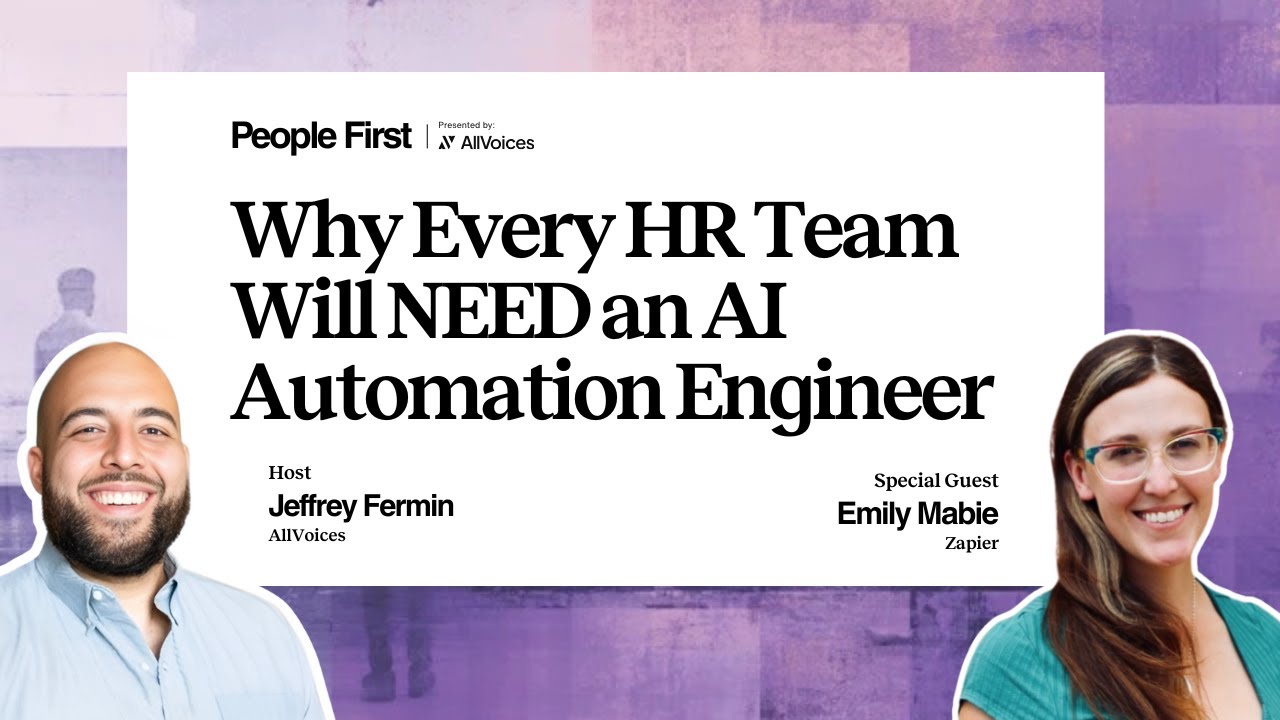

A complete breakdown of the People First interview with Zapier’s Emily Mabie
AI is reshaping work faster than most HR teams can keep up with. Tools are changing. Employee expectations are shifting. And People teams are sitting at the center of it all. In this episode of People First, Jeffrey Fermin talks with Emily Mabie, Zapier’s first AI Automation Engineer for HR, about what this new role looks like and why it is becoming essential inside modern People teams.
If you don’t have twenty minutes to watch the full episode, this breakdown covers every major theme, insight, example, and actionable takeaway from the conversation.
The rise of the AI Automation Engineer in HR
When Emily introduces herself, she makes something very clear: her role is new. Not just at Zapier. Across the entire HR industry. It sits at the intersection of learning design, workflow automation, data, and people strategy.
Her day to day blends:
• Building automations that remove tedious HR work
• Teaching HR teams how to understand and scale those workflows
• Supporting internal Zapier workflows across onboarding, performance, and feedback
• Running live workshops to help customers create their own HR automations
The goal of the role is simple: help HR teams move from “this is overwhelming” to “this is working.”
Not by installing random tools, but by designing systems that remove tedium so HR can focus on meaningful human work.
AI should support HR, not replace it
Emily makes one point repeatedly: AI should support human-first HR. It should not make disciplinary or performance decisions, drive firings, or replace judgment.
Examples she gives include:
• AI can flag patterns that suggest attrition risk
• AI should never make a firing decision
• AI can pull context, summarize data, and prepare drafts
• Humans remain responsible for interpretation and final judgment
Her advice to HR teams is to set clear boundaries. Define what AI can do and what it should never do. Communicate those boundaries transparently so employees trust the technology.
Practical ways AI is supporting People teams right now
HR leaders hear a lot of abstract talk about AI. Emily anchors it in real examples that Zapier is using today.
Role-specific performance review chatbots
Zapier built 56 performance review chatbots, each tailored to a different role family.
These chatbots use competency frameworks, examples, and level expectations to help employees:
• Write clearer performance reviews
• Reduce recency bias
• Organize evidence from six months of work
• Improve the quality of long-form review notes
Managers have their own mirrored versions to support coaching and consistent performance conversations.
An automated goal-setting system for 800 employees
Goal setting is one of the highest-impact practices in performance management, but most people struggle with it. Zapier uses AI to help employees draft goals through a short conversational flow. After each conversation, the system:
• Stores the data in a central table
• Identifies patterns employees struggle with
• Flags friction points where users drop out
• Surfaces insights HR would never catch manually
• Reduces the time employees spend drafting goals
This gives thousands of people a smoother experience and gives HR far better visibility into how goal setting is working across the company.
Why HR is ready for automation right now
Jeff asks why Zapier leaned so heavily into AI for HR. Emily shares two big reasons.
HR systems have never talked to each other
HR teams operate dozens of tools. ATS platforms, HRIS systems, performance tools, learning systems, feedback platforms, spreadsheets, and siloed databases. Manually moving data between these systems creates a crushing workload.
Zapier’s entire product philosophy is about making apps talk to each other. Adding AI unlocks even more efficiency because AI steps can connect logic, interpret data, and make recommendations.
HR is in a moment where staying manual is too expensive. AI gives teams a chance to finally escape the operational drag that has slowed the function for years.
Zapier’s internal “AI fluency mandate” changed everything
Emily explains a pivotal moment in Zapier’s culture. The CEO challenged the entire company to become fluent in AI. It wasn’t optional. Everyone was expected to learn, experiment, and apply AI to their work.
The results:
• AI fluency jumped to 97 percent of employees
• The People team became experimental and hands-on
• Teams identified inefficiencies they didn’t see before
• Zapier recognized how many companies were struggling with HR complexity
• Demand began pouring in from customers asking for help
This internal mandate pushed Zapier far ahead in HR automation thinking. It also inspired the creation of the AI Automation Engineer role.
Will every HR team eventually have an AI Automation Engineer?
Jeff asks whether roles like Emily’s will become common.
Emily’s answer is yes. The title may differ, but the function is essential. HR already has people who are naturally curious, detail-oriented, and willing to experiment with tools. These early adopters often become the internal problem solvers who build spreadsheets, manage workflows, and keep processes running.
Companies that succeed with AI will be the ones that:
• Identify these internal champions
• Give them dedicated time and space to explore
• Allow them to lead automation efforts
• Support them through governance and ethical frameworks
• Build systems that earn trust, not break it
She emphasizes that automation must be designed by people who understand HR challenges. AI is powerful only when paired with deep context and responsible decision making.
The future of HR at the intersection of people, data, and automation
Emily closes with her north star for the role. AI should:
• Enhance trust
• Support human dignity
• Reduce tedious work
• Create more space for connection
• Improve the quality of work, not just the speed
The goal is not novelty. The goal is better work.
When HR uses AI in ways that make people feel supported and empowered, it raises the quality of the entire employee experience.
Closing Thoughts
AI automation is no longer theoretical for HR teams. It is already transforming onboarding, performance management, feedback collection, and goal setting. The companies that thrive in this next era of work will be the ones that invest early in internal champions, give them ownership, and use AI to augment human work.
Emily’s role at Zapier is not an experiment. It is a preview of what People teams everywhere will need.