
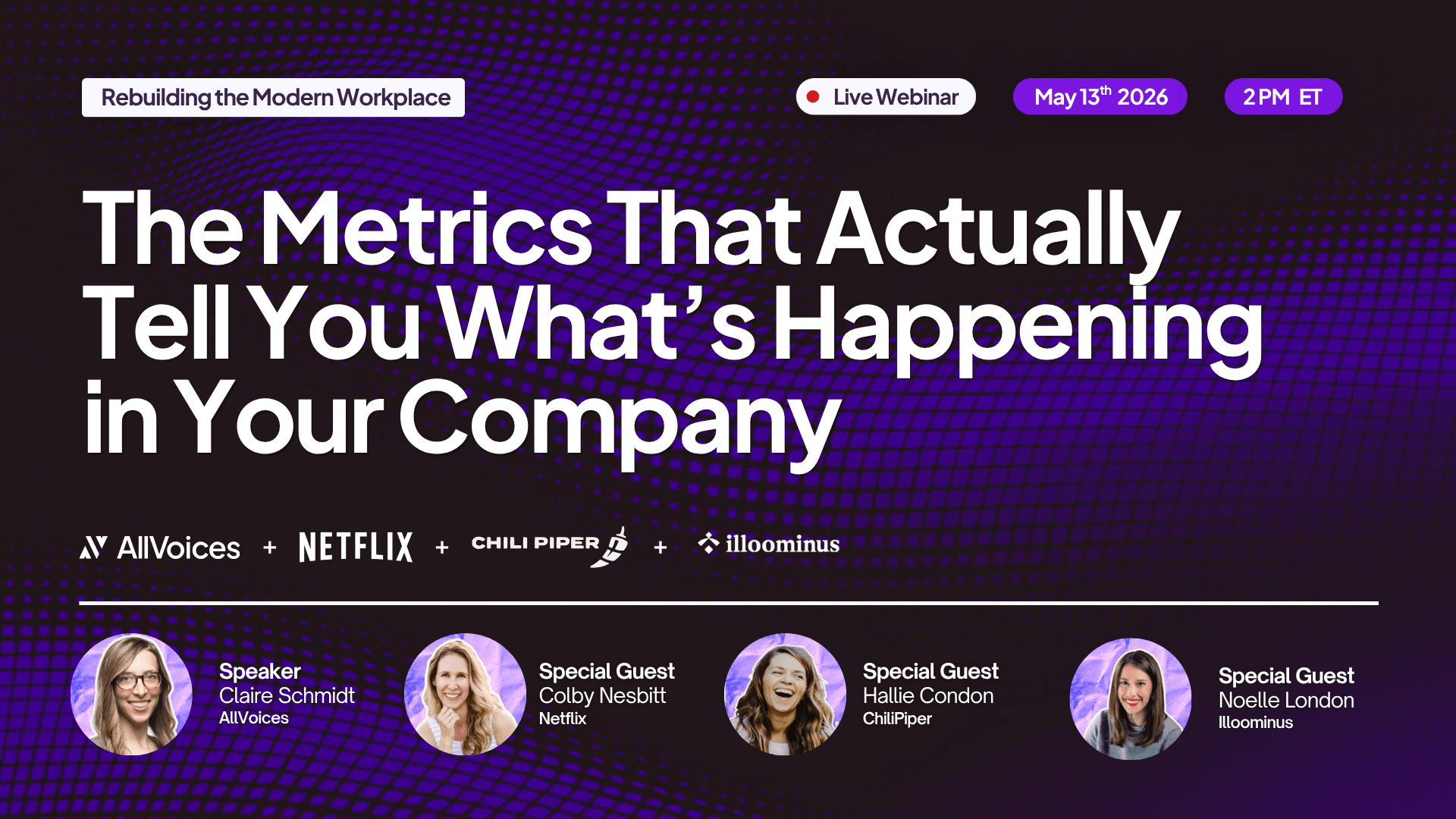
A recap of our conversation with Colby Nesbitt (Netflix), Hallie Condon (Chili Piper), Noelle London (Illoominus), and Claire Schmidt (AllVoices)
Most HR teams aren't measuring the wrong things on purpose. They're measuring what's easy to measure, because that's what's always been on the dashboard.
Retention. Time to hire. Headcount. Engagement scores.
The numbers HR has been reporting up to leadership for two decades. The problem, as the panel got into about three minutes in, is that those numbers don't actually tell you what's happening inside your company anymore. They tell you what already happened. By the time they show up on a slide, the decisions that produced them are months old.
That was the framing for session two of Rebuilding the Modern Workplace, our webinar series for HR leaders figuring out what to keep, what to throw out, and what to build next. Host Rebecca Taylor sat down with three of the sharpest people-data minds we could get in one room, plus our founder, to get into exactly that.
The short version: most HR dashboards are reporting lagging indicators that look like leading ones, and almost nobody is being honest about it.
Below is the full breakdown, with the strongest moments from every panelist pulled out so you can actually use them.
The HR Metrics That Sound Important But the Business Doesn't Care About
Rebecca opened with the question that set the tone for everything that followed: what are the metrics that scream HR but the business honestly doesn't care about?
Hallie didn't soften it.
"If you Google what metrics I should be looking at as a leader in HR, time to hire is the number one metric that's irrelevant. It tells you how well a process works. But from a board perspective, what we actually care about is, did the person you hire work out?"
— Hallie Condon, Chili Piper
Then she went after the metric most HR teams build their entire dashboard around.
"Retention. There's a validity issue. Especially in our current job market, if you are unable to leave, that might signal on a dashboard that your company is doing great, you're retaining employees. But you're retaining employees because they literally have no other option."
— Hallie Condon, Chili Piper
This is the part most HR teams skip. Retention as a standalone number tells you almost nothing about whether your culture is healthy. In a tight job market, retention is a sign of strength. In a frozen job market, it's a sign that you've trapped a workforce that wants out. Same number on the dashboard. Opposite story underneath.
Hallie's bigger point: if a company genuinely believes it's employee-first, retention is a strange thing to optimize for.
"If somebody wants to leave because the relationship has run its course, or because there's no growth opportunity, or because the culture isn't the right fit, the best thing is for them to leave. Focusing on retention as a gold star metric puts you in a position where you're optimizing for the wrong thing."
— Hallie Condon, Chili Piper
Colby took the spicy take even further and went straight at one of the most sacred numbers in HR.
Why Headcount Stopped Being a Useful Productivity Metric
"The metric I'm questioning more and more is that headcount no longer means much. It used to be a helpful proxy to understand productivity. When Wall Street looked at a company growing in headcount, they saw that as growing market share. Now Wall Street rewards companies doing reps. I'm not saying that's a good thing. I'm just saying that's what's happening."
— Colby Nesbitt, Netflix
The old logic was simple. More bodies, more output, more market share. The new logic, accelerated hard by AI, is that one person can now produce what an entire team used to produce. Wall Street has noticed, and it's pricing companies accordingly.
Colby was careful to say this isn't a "people don't matter" argument. It's the opposite.
"Treating headcount like people are interchangeable bodies is not very humane. We were using it as a proxy for productivity. And especially with AI, we're really stretching out the range in what can be produced by a single person. So that person metric doesn't really make a lot of sense anymore. Now what's harder is that we actually have to measure how people create value in a business."
— Colby Nesbitt, Netflix
If you want to go deeper on this, Colby's piece on people analytics being in a midlife crisis is the source material. Worth reading before your next executive review.
Why Engagement Scores Keep Lying to You
The next thread of the conversation hit on something every HR leader has felt at some point: how do you know employees are even telling you the truth?
Claire's answer is essentially the founding story of AllVoices.
"Part of why I started AllVoices is I was seeing people honestly reviewing their workplaces on places like Glassdoor because they could do so anonymously. And yet, once that information makes its way out to the public, it's so much harder to act on. That person may have already left. I wondered if there was a way to make it feel safe for people to speak up internally, at the first sign of something going wrong."
— Claire Schmidt, AllVoices
The lag between "an employee is unhappy" and "HR finds out" is where most cultural problems compound. By the time the exit interview happens, the decision is already made. By the time the quarterly engagement survey lands, the disengagement is six months old.
"The more information you're getting from employees in real time, the better. You can run analytics on it. You can figure out what should drive strategy. But if you're creating a culture where people feel safe to speak up, you're getting the benefits of those insights and taking action on them. I don't think you can have a worse culture than the opposite, which is nobody really tells you anything, people quit, they're not honest about why, and you repeat the cycle with the next employee."
— Claire Schmidt, AllVoices
A quarterly pulse survey isn't a feedback loop. It's a postmortem.
HR Has Been Treating Data Like It's Objective. It Isn't.
The next question landed harder than the panel expected: are there metrics or numbers HR teams should be hiding from leadership?
Colby's answer wasn't really about hiding anything. It was about how HR has been handing leaders numbers without context for so long that the numbers themselves have started doing damage.
"Data gives us a false sense of precision and security. It's a number, so it must be objective. But it's not at all objective. There's so much subjectivity in what you choose to analyze, how you present it, how you contextualize it, what benchmark you choose. You can put a number forward and people take it as gospel."
— Colby Nesbitt, Netflix
He used the Wells Fargo example to drive it home. When the bank tied number of customer accounts to performance bonuses, employees fraudulently opened accounts for customers who didn't exist. The metric was supposed to be a proxy for customer satisfaction. It became a proxy for fraud.
This is Goodhart's law in action. When a measure becomes a target, it stops being a good measure. And it's quietly happening inside HR dashboards every day.
How to Stress-Test a Metric Before Putting It on a Slide
Colby's framework for evaluating any metric before you report it up:
- Can this be gamed? If yes, assume it will be. Wells Fargo didn't intend for employees to open fake accounts. It happened anyway.
- Do you have a second metric pulling in tension with this one? Time to fill should always be reported alongside quality of hire. Engagement alongside attrition risk. One metric on a slide is a trap.
- Is the benchmark you're using actually comparable? Most external benchmarks aren't. Internal benchmarks over time are almost always more useful.
"Always use multiple metrics that get at things from a different direction. Time to fill versus quality of hire. Those things may be in tension with each other, and that's a good thing. That's why we need to measure both."
— Colby Nesbitt, Netflix
One of the only times he'd actually withhold something? Surveys with abysmal participation.
"If the participation rate is abysmal, where you have a quarter of employees responding, I would still talk about the survey. I'd say, we asked some questions and we only got participation from a minority of folks. This is what we heard, but we want to hear from more of you. You can't assume a small proportion responding represents the whole. It would be very easy to cherry pick those statistics and take them out of context."
— Colby Nesbitt, Netflix
Most HR dashboards skip this discipline entirely. Low response rate? Report it with the caveat. Don't bury the response rate to make the number look bigger.
The Unstructured Data Revolution HR Has Been Sleeping On
A great question came up in the chat: with AI, every data point doesn't have to fit into a tidy labeled field anymore. Is that wrecking HR metrics, or improving them?
Noelle's whole company is built on this shift, and she didn't hedge.
"This is the most exciting part about AI and what we're able to do with data to better understand workforces. There's so much data in your systems that's already existing and not being touched. Right now we have the opportunity to bring that data together. It's not just a retention metric. It's not just a metric around one incentive. It's a whole lot harder to hide when you can bring multiple metrics together in one place."
— Noelle London, Illoominus
Her example landed hard. Take a manager you've been trying to evaluate for two years. The engagement survey on its own won't tell you anything useful, because nobody on that team feels safe answering honestly. But layer engagement with voluntary attrition of high performers, slips in performance scores, comparison against other managers at the same level, and tenure patterns. Suddenly that manager has nowhere to hide.
"When you start to pull those metrics together, it's harder for a manager to hide. We're able to bring models and indexes together on things like burnout, on manager effectiveness, that typically would have been really hard to calculate on your own."
— Noelle London, Illoominus
This is the actual unlock. Not "AI replaces the engagement survey." It's "AI lets you connect the engagement survey to seven other data sources you were already collecting and finally see the pattern." For more on this shift, how AI is changing HR data strategy is worth reading alongside this recap.
The Metric Every HR Team Should Track and Almost None Are
Colby's biggest spicy take of the session came when the conversation turned to what HR teams should be paying more attention to. His answer was almost embarrassingly simple.
"I'm gonna go super basic. It's dollars. I say that with deep love and humility. I worked in people data for years before I ever put a dollar value, a dollar symbol on a slide. And everything changed when I started doing that."
— Colby Nesbitt, Netflix
Here's why it matters. HR teams have been operating on the assumption that the metrics speak for themselves. Attrition speaks for itself. Time to hire speaks for itself. Engagement scores speak for themselves.
They don't. Dollars do.
"You'll be extremely unpopular with certain people. But if you put forward a proposal and say, here's how much this L&D program is going to cost, and here's how much we expect it to make us, you put your skin in the game, and it changes everything. You gain so much credibility when you can talk about HR and put it on the same level as any other business unit that's asked to answer for its budget."
— Colby Nesbitt, Netflix
This is the line. The HR teams getting real strategic influence inside their companies aren't the ones with the prettiest engagement dashboards. They're the ones putting a dollar sign next to every initiative, every retention rate, every quality-of-hire slip. That's the language the rest of the C-suite speaks. If you want a deeper read on this, becoming a more data-driven HR department sits right next to it.
The Other Hidden Culture Metric: Who You Promote
Colby followed it up with a second insight that should be on the wall of every HR leader's office.
"When we think about measuring culture, we immediately go to engagement surveys. And that's one way. But the best measure I've found of what your culture is is who you promote. The profiles of who is promoted is the most public way of saying this is what we value, this is what we tolerate. You can ask all the questions, espouse your values on the wall, but if it's opposite of who you're promoting, it doesn't matter."
— Colby Nesbitt, Netflix
Read your last 20 promotions. Now read your stated company values. If the two don't line up, no engagement survey is going to save you. Promotions are the culture audit you didn't know you were running.
Internal Mobility Is the Underrated Metric of 2026
Noelle's pick for the metric HR isn't paying enough attention to right now: internal mobility.
The economic context matters here. Promotion budgets are tight. Salary adjustments are smaller. The career ladder of the 2010s, where high performers got a new title and a 12% raise every 18 months, isn't running the way it used to. Which means HR has a new problem: how do you keep your best people growing when you can't promote them up?
"If you're not gonna have promotions, if you're not gonna have the career ladders moving the way that they are, how do you make sure that when you've got high potentials, you're moving them across the organization into their next roles? When you've got strong skill sets, are they concentrated in some roles? Have you not got them in critical roles? The movement inside of organizations is really interesting, and something you all should be paying a lot more attention to."
— Noelle London, Illoominus
Then she flipped it. Internal mobility isn't just a growth metric. It's a flight risk metric, a manager quality metric, and a workforce planning metric all at the same time.
"How do we make sure there aren't individuals leaving a manager to get out of a situation they don't want to be in, and they're moving to a different part of the organization? If all my good people are leaving who are high potentials, and all my bad people are staying because we're not managing performance and giving feedback, that's a whole different answer that we want to dig into."
— Noelle London, Illoominus
Healthy retention and unhealthy retention look identical on a dashboard. Same number. Completely different stories.
Negative Feedback Is a Signal, Not a Problem
Claire's spicy take of the session probably reframed how a lot of viewers will think about employee feedback going forward.
"I actually don't believe that negative feedback or people voicing concerns is a bad thing. I think it's a really good thing. We all remember 2022 when everyone was quiet quitting. They just quietly disengaged. And there's nothing more frustrating than someone who's phoning it in. They're probably answering really positive things on any survey they're getting, or maybe they're not even participating. Someone who's sharing feedback is, by definition, engaged, and does want to see some type of change happen. We have to embrace that, even if it might be uncomfortable to see or hear."
— Claire Schmidt, AllVoices
The instinct most HR teams have is to interpret a spike in HR case management volume or critical survey responses as a sign of cultural decline. The reframe is that those signals are evidence of engagement. The cultural decline is the quiet one. The apathy is the warning.
"Otherwise you just have toxic positivity. And dishonesty. Or even worse, sometimes you have just apathy. People are like, I don't care enough because no one's gonna do anything about it. That's also just not what you're looking for."
— Rebecca Taylor, AllVoices
One of the strongest lines of the entire session came from the chat: negative feedback openly shared is a sign of psychological safety, and should be encouraged. If your employees are willing to tell you what's broken, you have something. If they've gone silent, you have a much bigger problem than the loud complainers.
The Qualitative vs. Quantitative Trap (And Why It's a False Choice)
Someone watching raised a question every people analytics person runs into: qualitative problems being solved with quantitative metrics. Things like trust, relationships, psychological safety. How do you handle that?
Colby called the binary itself a trap.
"I think it's a false dichotomy. Everything is a proxy for something else. We're trying to measure people's motivation, their attitudes, their intentions. There's no way to see those directly. We can't peek at someone's brain. So no matter if we're using a survey or behavioral data, we're trying to approximate something we can't directly observe."
— Colby Nesbitt, Netflix
His most useful example: when an employee leaves and tells you in an exit interview that they left because of compensation, that's the stated reason. But the behavioral data from the six months before they resigned might show they had five different managers in twelve months, never got a promotion, and watched their role get restructured twice. The stated reason is "compensation." The actual reason is everything else.
"They may say they left because of compensation. But really, they had five different managers in the last twelve months and no one understood what they were trying to do. It's more complicated than that."
— Colby Nesbitt, Netflix
Noelle reframed the whole conversation in a way that should land hard with anyone trying to get executive buy-in for people data.
"What we have to do is move from something being an HR metric into this being operational metrics for any organization. What is the operational structure that's making sure you're getting the best work out of your teams?"
— Noelle London, Illoominus
Stop calling it HR data. Start calling it operational data. Executives don't want to look at an engagement survey, but they'll absolutely look at a span-of-control analysis that shows where information is bottlenecked in the org chart.
Promotions Are a Culture Metric. Here's How to Stop Botching Them.
Another strong question opened one of the best practical exchanges of the session: how do leaders more intentionally incorporate behaviors and competencies into promotion decisions, so employees understand that how you show up matters as much as what you deliver?
Colby's framework was sharp.
"Make those expectations clear and include them in the process. Then it comes down to how you challenge people. One of the best practices I've seen is requiring managers to make the hypothetical devil's advocate case against the promotion. Of course a manager wants to say great things about their employee. Encouraging that pressure testing opens the door to more honest feedback. And ultimately, it comes down to whether people actually hold the line. That will say more than any part of the process itself."
— Colby Nesbitt, Netflix
The "devil's advocate" requirement is brutally effective. It forces a manager to articulate the gap between performance and behavior, instead of glossing over the rough edges of a high performer who's a culture problem.
Hallie added something Chili Piper has been running: organizational network analysis as part of the promotion process.
"Our promotion process used to include peer feedback. But that puts people in a really awkward position. They know they're being asked for peer feedback because this person is up for promotion, so they don't want to give negative feedback and be the reason this person doesn't get promoted. Using ONA lets us look historically at how peers have viewed working with them over a period of time, instead of just this one particular instance."
— Hallie Condon, Chili Piper
History matters. Consistency matters. Anyone can have a bad quarter. The pattern across years is what tells you who someone actually is.
The Other Promotion Check Nobody Talks About
One of the most underrated promotion signals is employee relations data. Has this person ever been named in an investigation? As a complainant, as a respondent, as a witness? Are there patterns in their team's case volume? The right ER KPIs are the ones that catch this before it shows up in a calibration meeting.
This is the part most promotion processes still don't touch, because the ER data lives in one system, the performance data lives in another, and the promotion calibration lives in a spreadsheet. Connecting them is exactly the kind of unstructured-to-structured data integration Noelle was talking about, and it's exactly where most organizations have their biggest blind spot.
What HR Should Stop Measuring (And What to Start)
Pulling everything from the session together, here's the practical scorecard.
Stop reporting these in isolation:
- Time to hire. Useful for process diagnostics. Useless as a quality signal.
- Retention as a single number. Healthy retention and trapped retention look identical on the dashboard.
- Headcount growth as a productivity proxy. With AI, this proxy has broken.
- Engagement scores reported without participation rates and demographic cuts.
- External benchmarks picked because they make your number look better.
Start tracking these:
- Dollar value of attrition, hiring, L&D, and program investments. Speak the language of the rest of the business.
- Who gets promoted. The most public culture audit your company runs.
- Internal mobility patterns by team, by manager, and by skill set.
- Manager effectiveness composites built from voluntary attrition of high performers, engagement, span of control, and performance distribution.
- Relationship-building speed for new hires. How quickly are they forming trusted connections with key stakeholders?
- Behavioral signals before voluntary exits, not just stated reasons in exit interviews.
- Participation patterns in voluntary programs, surveys, and tooling. Silence is a signal.
- Real-time employee sentiment from channels where employees actually feel safe speaking up.
The Bigger Picture: HR's Job Just Changed
The thread running through the entire session was this. HR's job is no longer to report on what happened last quarter. HR's job is to build the internal intelligence system that tells you what's about to happen, and to translate that intelligence into business decisions executives will act on.
That requires three shifts that almost no HR team is fully running yet.
Stop reporting metrics in isolation. Every number needs a partner number in tension with it. Time to hire alongside quality of hire. Engagement alongside attrition risk. Retention alongside voluntary departures of high performers.
Put a dollar sign on everything. Cost of attrition, ROI of L&D, value of internal mobility, cost of culture debt. The C-suite speaks dollars. HR has to learn the dialect.
Build channels that surface the truth in real time. Glassdoor reviews, exit interviews, and quarterly surveys are all lagging indicators. By the time they tell you something, the decision is already made and the employee is already gone. The companies getting ahead are the ones building infrastructure for real-time employee voice inside the building, so the signal arrives early enough to act on.
This is the work AllVoices was built for. Modern employee relations infrastructure, real-time sentiment, and the kind of AI-powered case intelligence that surfaces patterns no quarterly engagement survey is ever going to catch.
If you want to see what your workforce is actually feeling before friction becomes fire, book a demo. We'll show you what that looks like inside your organization.
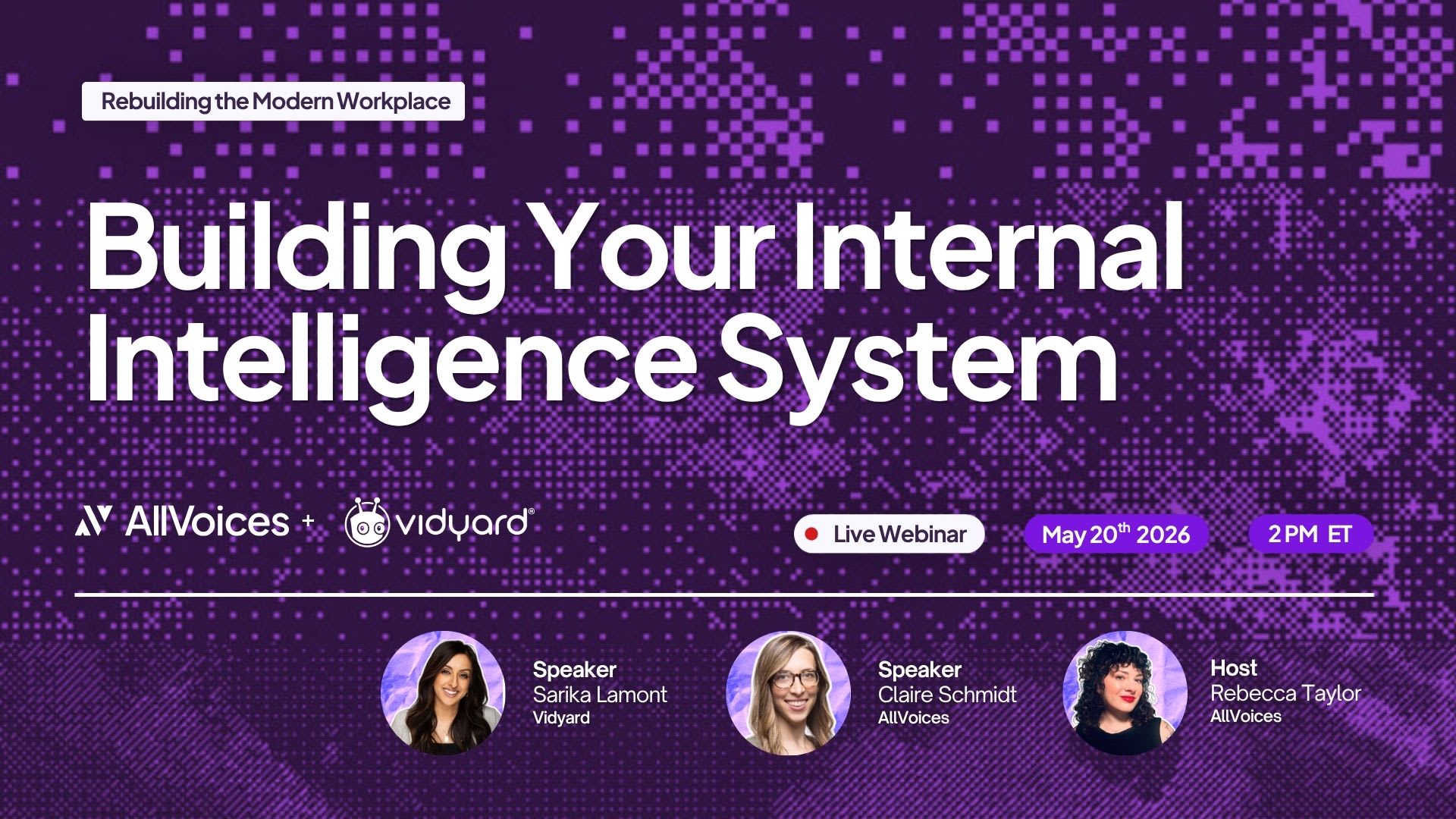
Catch the full session on demand and register for next week's conversation in the Rebuilding the Modern Workplace series, where we're going deeper on how to build your internal intelligence system, with Sarika Lamont from Vidyard.
Finding the HR Metrics That Actually Matter
Got more questions? Email us at support@allvoices.co and we'll respond ASAP.
Stay up to date on Employee Relations news
Sign up to our newsletter
.svg)
.svg)



Got more questions? Email us at support@allvoices.co and we'll respond ASAP.