Meet Smitashree Menon, Founder of theboardIQ
Smitashree Menon, Founder of theboardiQ, on removing bias from board selection, the future of HR leadership, and what an excellent feedback culture requires.

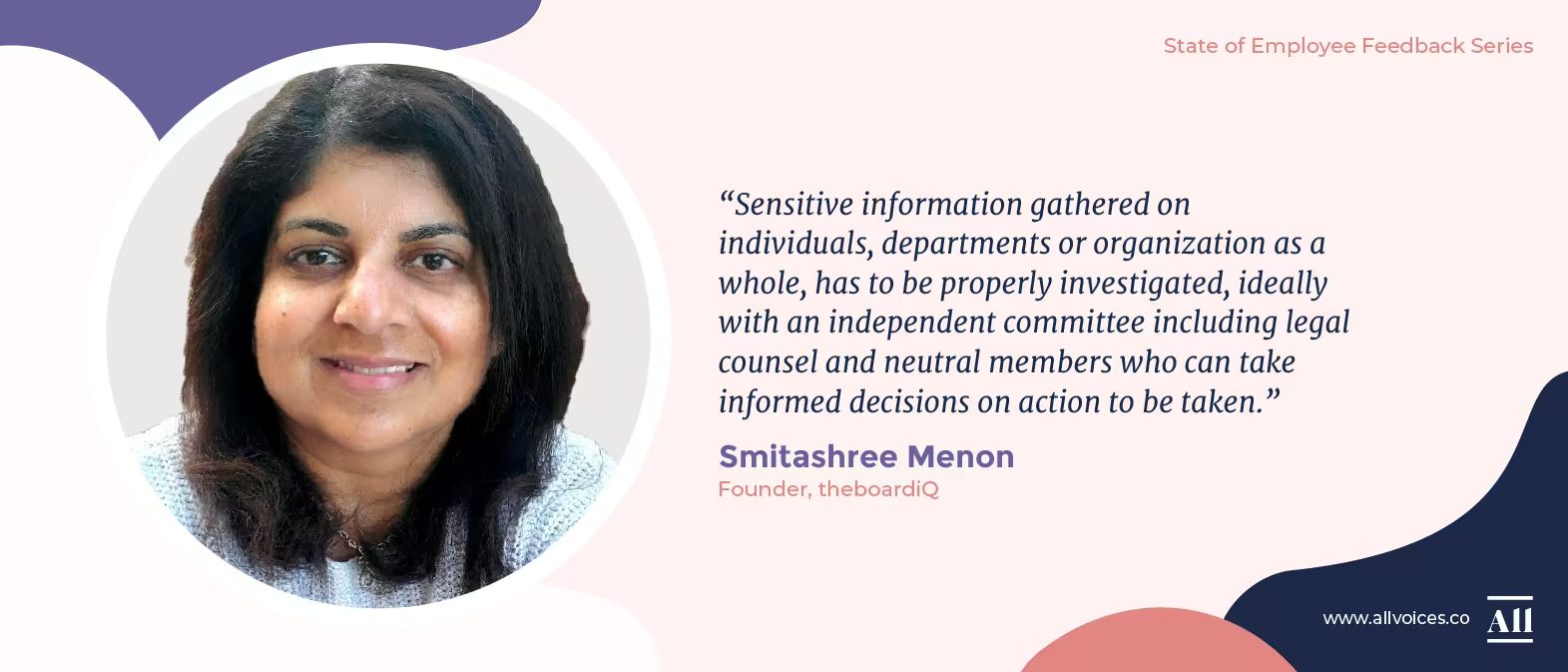
Smitashree Menon is the Founder and CEO of theboardiQ, a technology platform that uses AI and machine learning to remove algorithmic and unconscious bias from the search, discovery, and selection of diverse talent onto boards and executive roles. With more than two decades of people leadership experience across Motorola, MetLife, and Positive Moves, and educational partnerships with Stanford University's Graduate School of Business, Menon built theboardiQ at the intersection of inclusion, technology, and organizational transformation.
This conversation, part of the AllVoices State of Employee Feedback Series, was originally published in 2021. Her analysis of what the HR function needs to become with a specific focus on removing structural bias from leadership pipelines. Both have grown more relevant, not less, in the years since.
Smitashree Menon on HR's transformation and the feedback gap
Menon sees the HR function stretched across too many competing priorities to do any of them as well as the organization needs. Her perspective is structural: the problem is not effort but design.
What does the state of the HR industry look like today?
Menon describes an HR function that has accumulated responsibilities faster than it has received resources, reaching a breaking point that makes genuine change possible.
"HR is cluttered with tasks, often split between serving the internal organisation with organisational development, leadership support, culture creation, payroll, lay-offs, training, planning, developing the employee experience, and what-not, whereas the other part of the job is to serve external audiences, manage recruitment marketing and job advertising, building up employer brand, joining recruitment events, running hiring days at educational institutes, and more, while trying to keep up with legislative changes, new technical tools and software, and who knows what else. This is all too much for any individual, even HR teams as a whole are struggling to find time and resources to manage this all and more. It's time for HR to change. HR needs to find their real purpose again, and to prove their worth to the top management to have access to the right resources."
The overload she describes has a direct cost that shows up in employee relations. When HR teams are spread across compliance, culture, employer branding, and operations simultaneously, the work that suffers most is the work requiring depth: listening to employees, investigating concerns, and acting on the feedback that sits below the surface. Understanding the real impact HR has on employee feedback starts with acknowledging that bandwidth is the first structural barrier.
What are the most common challenges when managing employee feedback and reporting?
Menon identifies three distinct layers where feedback analysis must operate simultaneously. Governance risks emerge when any layer is mishandled or conflated with another.
"There are basically three layers of segmentation of feedback and reporting during annual or periodic employee opinion polls / pulse surveys: a) at the organizational / company level; b) at the business unit / department level and c) at the immediate manager / supervisor level. It is imperative that HR leaders analyze the results and provide actionable recommendations at these three levels without any negative repercussions on any employee / associate / worker. Communication of results at the organizational level on all actions being taken throughout the year, brings about transparency and trust among employees. Sensitive information gathered on individuals, departments or organization as a whole, has to be properly investigated, ideally with an independent committee including legal counsel and neutral members who can take informed decisions on action to be taken."
Her emphasis on independent investigation committees matters. When sensitive feedback surfaces, how it is handled either builds or destroys employee trust in the system. A workplace where psychological safety is real requires that employees see their concerns handled with rigor, confidentiality, and genuine independence from the chain of command.
What advice do you have for organizations looking to improve their feedback culture?
"Communication, transparency and accountability are key for organizations to thrive. Boards, CEOs and leadership teams need to embrace the culture of always listening and practicing empathy with their employees, associates, workers and even customers. Cases in point, the CEO of a leading ride-sharing company being the driver for a full day to experience how well the app works and gather customer feedback; or the CEO of a leading retail company spending at least 2-3 days on the shop-floor every month to understand worker related issues or another CEO and his leadership team taking turns to sell in stores to understand how their products and services are being perceived and experienced by customers."
The examples she cites share a common principle: leaders who want honest feedback must put themselves in positions where they experience what employees experience. Surveys and dashboards show you what employees are willing to report through official channels. Proximity shows you what they are not. For HR teams developing meaningful KPIs for employee relations, that gap between reported feedback and actual employee experience is one of the most important things to measure.
How Menon sees the future of HR leadership
Menon's vision for the future HR leader is specific and demanding: a practitioner with business acumen, data fluency, fearlessness, and the credibility to operate independently across complex organizational politics.
What does the future HR leader look like?
"The future of HR is one where employee experience is seen by the leadership team as more critical than customer experience — employee experience driven by critical thinking and business acumen — where your visioning, coaching and execution skills as an HR leader are unparalleled. You are adding value with every HR initiative that you introduce in the organization and are able to present the ROI impacting the top line and bottom line of the financials of the company. You are data-driven — you are able to articulate and implement a compelling employer / employee value proposition to differentiate yourself from the competition. You are making a difference in ensuring gender pay equity and reducing the CEO-median pay ratios with concerted compensation planning and execution. You are fearless, independent and a trusted advisor."
How does Menon see her own role evolving over the next three to five years?
"The role over the next 3-5 years is one where one can create impact and relevance in four core areas — inclusion, technology innovation, transformation and sustainability. A role where you are a thought leader and enabler of solutions that foster positive change in bringing about inclusion and equality. A role where you are a creator of a platform (or tools, processes or systems) that is a game changer in the People space."
Her four pillars (inclusion, technology, transformation, and sustainability) align with the structural issues employee relations teams navigate today. Inclusion without the right data tools stays an aspiration. Technology without inclusion guardrails creates new forms of the bias it was meant to reduce. The work of reducing unconscious bias in hiring and leadership selection sits precisely at the intersection where Menon built her practice.
Where inclusive leadership and HR technology stand in 2025 and 2026
Menon's interview was conducted at a moment when conversations about board diversity and HR technology were accelerating but still largely aspirational. The four years since have brought both real progress and persistent structural gaps.
AI is reshaping how leadership pipelines are built
The approach theboardiQ was pioneering in 2021, using AI and machine learning to surface diverse leadership candidates and remove algorithmic bias from selection, has since become a mainstream governance concern. As of 2025, the majority of large employers now report using AI-assisted tools in at least some part of their talent acquisition or leadership assessment process, according to SHRM's 2026 State of AI in HR research. The challenge Menon identified: selection processes built on historical networks reproduce the same representation gaps. AI alone does not solve this without deliberate design.
The feedback and trust gap has not closed
Menon's core argument holds up: HR stretched too thin cannot do deep listening. When employees do not trust that their feedback will be heard, acted on, and kept confidential, they stop sharing it. According to AllVoices research on anonymity and reporting, employees are significantly more likely to report concerns when they trust the channel is genuinely anonymous. The systems Menon called for in 2021 (independent investigation processes, layered feedback analysis, and leadership proximate to employee experience) are exactly what separates organizations with real feedback cultures from those running feedback theater. See how AllVoices supports HR teams building that kind of structured, accountable feedback infrastructure.

.svg)
.svg)