
Measuring Progress and the Feelings of Belonging with Carissa Begonia

Episode 23
About This Episode
In this episode of Reimagining Company Culture, we’re chatting with Carissa Begonia, Founder of CONSCIOUSXCHANGE. Carissa has over 15 years of experience working on both the operations and the human side of business at some of the country’s largest retailers including Zappos, Macy’s, Saks 5th Avenue, and Ross Stores.
About The Guest
Carissa is a first generation Filipina-American daughter of immigrants. She is a leadership and business coach specializing in helping BIPOC leaders and entrepreneurs pursue meaningful careers, build their own values-driven businesses, and design a life of purpose. Carissa is the former head of Diversity, Equity, and Inclusion (DEI) of Zappos and has over 15 years of experience working on both the operations and the human side of business at some of the country’s largest retailers including Macy’s, Saks 5th Avenue, and Ross Stores. As a DEI consultant, Carissa supports organizations in developing and operationalizing their equity strategy at a personal, interpersonal, and systemic level through emotional intelligence and with an anti-racist, anti-oppression lens. Carissa is the co-founder of Green Mango International, a 501 (c)(3) non-profit organization supporting educational opportunities for underserved school children in the Philippines and as well as the co-founder of AARISE - Asian American Racialized Identity and Social Empowerment for AAPIs, a program and community focused on justice and liberation for all centering Asian American activist history, AAPI experiences, emotional processing and somatic healing.
Episode Breakdown

In this episode of Reimagining Company Culture, we talked with Carissa Begonia, founder of CONSCIOUSXCHANGE. Carissa has over 15 years of experience working at the intersection of operations and human sustainability, and she has one of the clearest mental models we have heard for how People teams should be measuring belonging, not just describing it.

Belonging sits at the center of most employee engagement conversations today, and for good reason. McKinsey's research on why employees leave found that 51 percent of people who quit cited a missing sense of belonging as a factor, and 54 percent said they did not feel valued by their organization. Those numbers turn belonging from a soft metric into a retention problem with a dollar figure attached.

Why Measuring Belonging Is Harder Than It Sounds

Belonging is easy to define and hard to measure. It is the subjective sense that you are welcome, valued, and able to show up as yourself at work. Measuring it usually starts with one or two questions on an annual survey, which is where most programs stall. One question across 40,000 employees tells you almost nothing about the experience of specific teams, roles, and identity groups.

Carissa's point in the conversation was that the question itself is less important than what you do with the results. Teams that run a belonging question, watch the score dip, and respond with a mandatory training are signaling that they want the number to move without actually changing anything about how people experience the workplace. That signal is worse than not measuring at all.

Research supports the investment when it is done well. BetterUp's Value of Belonging at Work report found that high belonging is linked to a 56 percent jump in job performance and a 50 percent drop in turnover risk. Those numbers only materialize when the measurement drives real change.

Belonging also turns out to be a leading indicator for other workforce metrics that executives already track. Qualtrics reports that high-belonging workplaces see almost three times higher well-being scores among employees. Well-being, in turn, feeds into attrition risk, healthcare costs, and manager time spent on conflict. When a CHRO can tie a belonging program to one or two of those downstream metrics, the conversation with finance gets easier.

None of that math works if the measurement program is thin. Running two items once a year gives you a number you cannot defend and cannot act on. Running a tight, segmented, quarterly program gives you something your CFO, your ELT, and your front-line managers can all use.

Designing a Belonging Measurement Program That Actually Works

What are the right questions to ask about belonging?

Start with three kinds of items. First, a core identity item like "I can be myself at work." Second, a team item about whether the person's input is taken seriously. Third, a voice item about whether they feel safe raising concerns. Together these three cover the experiential, relational, and power dimensions of belonging.

How often should you measure it?

Quarterly is a reasonable default for the core items. Annual is too slow to catch a shift after a layoff, a restructure, or a leadership change. Running the same questions every month tires people out and erodes the signal. Find a cadence that lets you see patterns without burning through goodwill.

What Actually Works When You Are Building the Program

Principle 1: Segment the data from day one

An aggregate belonging score hides more than it reveals. Segment by role level, location, tenure, and, where it is safe and consented to, demographic group. Most belonging problems show up in specific segments, not across the whole population. Gallup's culture of belonging research makes the same point: team-level variance is often larger than organization-wide variance.

Principle 2: Pair survey data with behavior data

Belonging surveys tell you how people feel. Case data tells you what they do about it. Look at retaliation concerns, repeat grievances, and voluntary turnover alongside the survey trend. When the two data sources agree, you have a strong signal. When they disagree, the qualitative data is usually closer to the truth.

Principle 3: Act visibly, then remeasure

The fastest way to degrade a measurement program is to collect data and never explain what changed as a result. Every cycle needs a short, public update: here is what we heard, here is what we are doing, here is what we are not doing and why.

Carissa also made a practical point about the people closest to the data. Front-line managers rarely see aggregate survey results and almost never see the qualitative narrative behind them. Closing that loop by giving managers a short, digestible read on their team is often the single highest-impactful move a People team can make. It respects the manager's role, and it turns survey results into something actionable instead of an annual HR ritual.

Using employee relations case data alongside survey indicators is also one of the cleaner ways to catch early belonging drift without waiting for the next survey cycle. Combining the two signals produces faster insight than either one alone.

Where Employee Relations Fits

ER teams sit on top of the richest qualitative dataset in the company, and most of it never makes it into the belonging conversation. A well-run HR case management system can surface the patterns that survey data misses, for instance whether reports of exclusion cluster by manager, by shift, or by a specific site. Pairing that with a structured ER operating model gives the People team a clearer picture of where belonging is breaking down.

ER drill-down: connect intake themes to survey movement

When belonging scores dip, the team should be able to answer a simple question within two weeks: what did we hear in the case data over the same period? If no one is running that analysis, the survey score becomes a vanity metric. ER leaders who map case themes to survey movements give their CHRO a cleaner story and a faster path to action.

Frequently Asked Questions About Measuring Belonging

Is a single belonging question enough for a small company?

Probably not. Even small companies have enough variation across teams that a single item hides meaningful differences. Three to five items cost little more and give you something actionable.

How do you avoid belonging fatigue from over-surveying?

Rotate question sets, keep each survey under five minutes, and communicate what changed between cycles. Most fatigue is not about frequency, it is about the gap between being asked and seeing anything happen.

Can you measure belonging without demographic data?

Yes, but you will miss the patterns that matter most. If your legal or privacy context prevents demographic collection, segment by team, tenure, and location. Those proxies are imperfect, but they beat a single aggregate number.

What does a healthy belonging score look like?

There is no universal benchmark, but most organizations with a strong culture see 75 percent or higher agreement on core belonging items among a representative sample, with smaller gaps between identity groups than among peers in their sector.

How long does it take to see belonging scores improve?

Real, sustained movement usually takes two to four quarters of consistent effort. Short-term bumps right after a high-visibility program are common and usually fade unless the underlying manager behavior changes.

The Bottom Line for HR Leaders

Carissa's framing is a useful corrective for HR leaders who treat belonging as a number to be managed. The number is a signal. The work is the management, coaching, policy, and case resolution that follows. Teams that confuse the two end up chasing a survey score instead of changing the experience that produces it.

The good news is that the research is on your side. Organizations that invest seriously in belonging see it in performance, retention, and the volume of preventable case work that never needs to be opened. The investment is not free, but the alternative is a culture that quietly erodes while the dashboard still looks green.
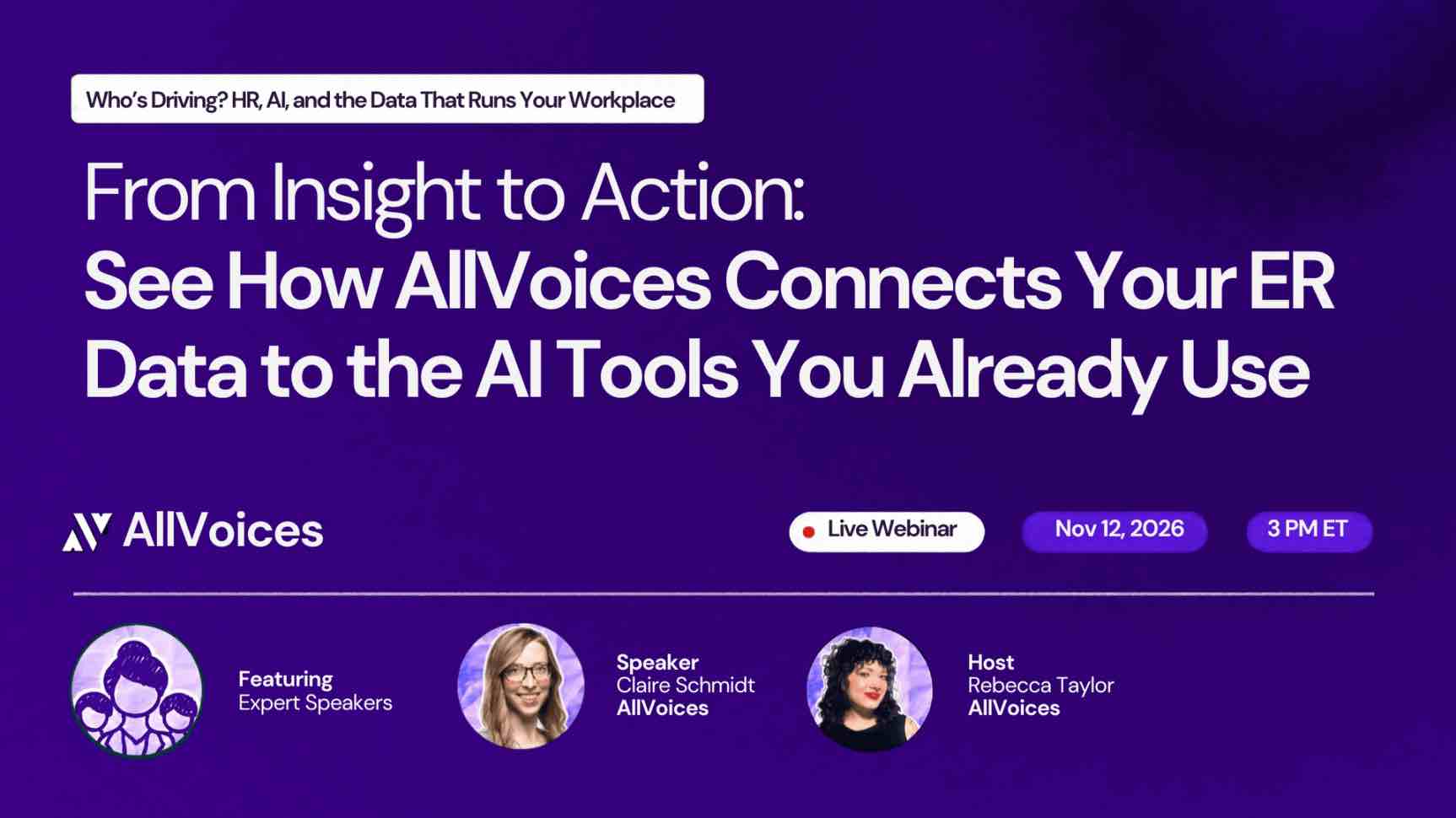
See how AllVoices pairs case data with pulse measurement to give People teams a full view of belonging.

Want to learn more?
See the power of AllVoices today
Thank you! We look forward to meeting you soon
Oops! Something went wrong while submitting the form.
Frequently asked questions

Got more questions? Email us at support@allvoices.co and we'll respond ASAP.

No items found.
Frequently asked questions

Got more questions? Email us at support@allvoices.co and we'll respond ASAP.

No items found.
Measuring Progress and the Feelings of Belonging with Carissa Begonia
Episode 23
About This Episode
In this episode of Reimagining Company Culture, we’re chatting with Carissa Begonia, Founder of CONSCIOUSXCHANGE. Carissa has over 15 years of experience working on both the operations and the human side of business at some of the country’s largest retailers including Zappos, Macy’s, Saks 5th Avenue, and Ross Stores.
About The Guest
Carissa is a first generation Filipina-American daughter of immigrants. She is a leadership and business coach specializing in helping BIPOC leaders and entrepreneurs pursue meaningful careers, build their own values-driven businesses, and design a life of purpose. Carissa is the former head of Diversity, Equity, and Inclusion (DEI) of Zappos and has over 15 years of experience working on both the operations and the human side of business at some of the country’s largest retailers including Macy’s, Saks 5th Avenue, and Ross Stores. As a DEI consultant, Carissa supports organizations in developing and operationalizing their equity strategy at a personal, interpersonal, and systemic level through emotional intelligence and with an anti-racist, anti-oppression lens. Carissa is the co-founder of Green Mango International, a 501 (c)(3) non-profit organization supporting educational opportunities for underserved school children in the Philippines and as well as the co-founder of AARISE - Asian American Racialized Identity and Social Empowerment for AAPIs, a program and community focused on justice and liberation for all centering Asian American activist history, AAPI experiences, emotional processing and somatic healing.
Episode Transcription

In this episode of Reimagining Company Culture, we talked with Carissa Begonia, founder of CONSCIOUSXCHANGE. Carissa has over 15 years of experience working at the intersection of operations and human sustainability, and she has one of the clearest mental models we have heard for how People teams should be measuring belonging, not just describing it.

Belonging sits at the center of most employee engagement conversations today, and for good reason. McKinsey's research on why employees leave found that 51 percent of people who quit cited a missing sense of belonging as a factor, and 54 percent said they did not feel valued by their organization. Those numbers turn belonging from a soft metric into a retention problem with a dollar figure attached.

Why Measuring Belonging Is Harder Than It Sounds

Belonging is easy to define and hard to measure. It is the subjective sense that you are welcome, valued, and able to show up as yourself at work. Measuring it usually starts with one or two questions on an annual survey, which is where most programs stall. One question across 40,000 employees tells you almost nothing about the experience of specific teams, roles, and identity groups.

Carissa's point in the conversation was that the question itself is less important than what you do with the results. Teams that run a belonging question, watch the score dip, and respond with a mandatory training are signaling that they want the number to move without actually changing anything about how people experience the workplace. That signal is worse than not measuring at all.

Research supports the investment when it is done well. BetterUp's Value of Belonging at Work report found that high belonging is linked to a 56 percent jump in job performance and a 50 percent drop in turnover risk. Those numbers only materialize when the measurement drives real change.

Belonging also turns out to be a leading indicator for other workforce metrics that executives already track. Qualtrics reports that high-belonging workplaces see almost three times higher well-being scores among employees. Well-being, in turn, feeds into attrition risk, healthcare costs, and manager time spent on conflict. When a CHRO can tie a belonging program to one or two of those downstream metrics, the conversation with finance gets easier.

None of that math works if the measurement program is thin. Running two items once a year gives you a number you cannot defend and cannot act on. Running a tight, segmented, quarterly program gives you something your CFO, your ELT, and your front-line managers can all use.

Designing a Belonging Measurement Program That Actually Works

What are the right questions to ask about belonging?

Start with three kinds of items. First, a core identity item like "I can be myself at work." Second, a team item about whether the person's input is taken seriously. Third, a voice item about whether they feel safe raising concerns. Together these three cover the experiential, relational, and power dimensions of belonging.

How often should you measure it?

Quarterly is a reasonable default for the core items. Annual is too slow to catch a shift after a layoff, a restructure, or a leadership change. Running the same questions every month tires people out and erodes the signal. Find a cadence that lets you see patterns without burning through goodwill.

What Actually Works When You Are Building the Program

Principle 1: Segment the data from day one

An aggregate belonging score hides more than it reveals. Segment by role level, location, tenure, and, where it is safe and consented to, demographic group. Most belonging problems show up in specific segments, not across the whole population. Gallup's culture of belonging research makes the same point: team-level variance is often larger than organization-wide variance.

Principle 2: Pair survey data with behavior data

Belonging surveys tell you how people feel. Case data tells you what they do about it. Look at retaliation concerns, repeat grievances, and voluntary turnover alongside the survey trend. When the two data sources agree, you have a strong signal. When they disagree, the qualitative data is usually closer to the truth.

Principle 3: Act visibly, then remeasure

The fastest way to degrade a measurement program is to collect data and never explain what changed as a result. Every cycle needs a short, public update: here is what we heard, here is what we are doing, here is what we are not doing and why.

Carissa also made a practical point about the people closest to the data. Front-line managers rarely see aggregate survey results and almost never see the qualitative narrative behind them. Closing that loop by giving managers a short, digestible read on their team is often the single highest-impactful move a People team can make. It respects the manager's role, and it turns survey results into something actionable instead of an annual HR ritual.

Using employee relations case data alongside survey indicators is also one of the cleaner ways to catch early belonging drift without waiting for the next survey cycle. Combining the two signals produces faster insight than either one alone.

Where Employee Relations Fits

ER teams sit on top of the richest qualitative dataset in the company, and most of it never makes it into the belonging conversation. A well-run HR case management system can surface the patterns that survey data misses, for instance whether reports of exclusion cluster by manager, by shift, or by a specific site. Pairing that with a structured ER operating model gives the People team a clearer picture of where belonging is breaking down.

ER drill-down: connect intake themes to survey movement

When belonging scores dip, the team should be able to answer a simple question within two weeks: what did we hear in the case data over the same period? If no one is running that analysis, the survey score becomes a vanity metric. ER leaders who map case themes to survey movements give their CHRO a cleaner story and a faster path to action.

Frequently Asked Questions About Measuring Belonging

Is a single belonging question enough for a small company?

Probably not. Even small companies have enough variation across teams that a single item hides meaningful differences. Three to five items cost little more and give you something actionable.

How do you avoid belonging fatigue from over-surveying?

Rotate question sets, keep each survey under five minutes, and communicate what changed between cycles. Most fatigue is not about frequency, it is about the gap between being asked and seeing anything happen.

Can you measure belonging without demographic data?

Yes, but you will miss the patterns that matter most. If your legal or privacy context prevents demographic collection, segment by team, tenure, and location. Those proxies are imperfect, but they beat a single aggregate number.

What does a healthy belonging score look like?

There is no universal benchmark, but most organizations with a strong culture see 75 percent or higher agreement on core belonging items among a representative sample, with smaller gaps between identity groups than among peers in their sector.

How long does it take to see belonging scores improve?

Real, sustained movement usually takes two to four quarters of consistent effort. Short-term bumps right after a high-visibility program are common and usually fade unless the underlying manager behavior changes.

The Bottom Line for HR Leaders

Carissa's framing is a useful corrective for HR leaders who treat belonging as a number to be managed. The number is a signal. The work is the management, coaching, policy, and case resolution that follows. Teams that confuse the two end up chasing a survey score instead of changing the experience that produces it.

The good news is that the research is on your side. Organizations that invest seriously in belonging see it in performance, retention, and the volume of preventable case work that never needs to be opened. The investment is not free, but the alternative is a culture that quietly erodes while the dashboard still looks green.

See how AllVoices pairs case data with pulse measurement to give People teams a full view of belonging.

Want to learn more?
See the power of AllVoices today
Thank you! We look forward to meeting you soon
Oops! Something went wrong while submitting the form.
Frequently asked questions

Got more questions? Email us at support@allvoices.co and we'll respond ASAP.

No items found.
Frequently asked questions

Got more questions? Email us at support@allvoices.co and we'll respond ASAP.

No items found.


