Redesigning Our Talent Systems for the Future with Yulkendy Valdez

Episode 11
About This Episode
In this episode of Reimagining Company Culture, we’re chatting with Yulkendy Valdez, Co-Founder and Managing Partner of Forefront. Yulkendy, recently named a Latino 30 Under 30 honoree, is a social impact change-maker with a diverse set of both corporate and nonprofit experience. Tune in to learn about Yulkendy’s thoughts on initiating social impact strategy, understanding Gen Z-er’s and Millenials in the workplace, returning to work in a way that feels psychologically safe and more!
About The Guest
Yulkendy is a social entrepreneur, storyteller, and public speaker. As the Co-Founder and Managing Partner of Forefront, she helps businesses and their leaders enable their culture competency and inclusive leadership skills to meet the demands of the emergent workforce. Yulkendy brings a diverse set of both corporate and nonprofit experience to the table. She’s worked with Bank of America, EY, Puma, and Innosight Consulting as well as the International Institute of St. Louis and Betty Jean Kerr People’s Centers. While working in social impact, Yulkendy’s work focused on community based projects ranging from financial equity for low-income immigrants to affordable health care. Yulkendy has received numerous fellowships including the Resolution Project, Young People For, Opportunity Nation Leaders Program, Future Founders Fellowship, Net Impact Racial Equity Fellowship, Harvard Kennedy School Public Policy Leadership Conference, StartingBloc, and PPIA Indiana University. She is a proud alumni of Babson College, #1 school for entrepreneurship. More recently, she was named one of the Latino 30 Under 30 honorees by El Mundo Boston and a top millennial in Boston by Get Konnected. With roots in her hometown of St. Louis, Missouri, Yulkendy has traveled to over 30+ countries for both work and for fun.
Episode Breakdown

On this episode of Reimagining Company Culture, we sat down with Yulkendy Valdez, Co-Founder and Managing Partner of Forefront. Yulkendy helps businesses build the cultural competency and inclusive leadership skills the emergent workforce expects. She has worked across Bank of America, EY, Puma, and Innosight, alongside community-based work on financial equity and affordable healthcare. Most recently she was named one of the Latino 30 Under 30 honorees by El Mundo Boston.

Yulkendy argued that most companies are still recruiting and managing for a workforce that no longer exists. The talent systems built in the early 2010s assumed five-year tenures, traditional career ladders, and a workforce that traded autonomy for stability. The current workforce, especially Gen Z and younger millennials, optimizes differently. They want meaning, mental health support, manager development, and a clear sense that the company will invest in them as quickly as they are investing themselves. Companies that have not redesigned for that workforce are losing them.

That conversation matters because the next five years of workforce planning will be defined by who can hire and retain workers under 35, and most HR teams are still running playbooks built for a different era.

Why Old Talent Systems Are Failing

The clearest signal is in the Gen Z and millennial data. Deloitte's 2025 Gen Z and Millennial survey finds that 89 percent of Gen Zs and 92 percent of millennials consider purpose important to job satisfaction. Half of Gen Zs want their managers to actively mentor them, but only 36 percent say it is happening. Roughly six in ten of both groups are already using generative AI in their work, and a similar share believe AI skills will be required for career advancement.

Those numbers describe a workforce that wants different things from a talent system: meaning, mentorship, AI fluency, and a manager who treats development as part of the job rather than as an extra. The old talent system was built around hiring funnels and annual reviews. The new one needs to be built around continuous development, meaningful work, and trust.

Companies starting to redesign do three things differently. They use AI to scale the personalization their teams cannot otherwise deliver. They invest disproportionately in manager development. And they make psychological safety a measurable property of the system, not a sentiment.

What Gen Z Actually Wants From Work

Why is meaning the top driver for the youngest workforce?

Because the alternative paths to meaning, like religious community or stable long-term institutions, are weaker for this generation than they were for previous ones. Work fills more of the meaning vacuum, and that raises the bar for what work has to provide. Companies that supply the meaning win disproportionately.

How does psychological safety differ for younger workers?

The threshold for what counts as unsafe is lower. Younger workers expect to disagree publicly without career consequence. They expect manager feedback to be specific and frequent. They expect company missteps to be acknowledged in plain language. Companies built around the older norm of executive opacity will keep losing this workforce to companies built around the newer norm.

What Actually Works: A Framework for Modern Talent Systems

Design principle one: use AI to scale personalization

The old talent system used standardization to scale. The new one uses AI to scale personalization. Tools like GPT for HR and Vera AI for employee relations let small people teams maintain personalized career touchpoints, intelligent triage of concerns, and consistent quality across thousands of employee interactions.

Design principle two: invest in manager development as the highest-leverage move

The Gallup finding that managers account for 70 percent of variance in engagement holds across generations, but the cost of a bad manager is higher with younger workers because they leave faster. Train managers in feedback delivery, career coaching, and mental health support. Reward the ones who do it well in the same forums you reward revenue performance.

Design principle three: instrument psychological safety as a system property

Use engagement surveys to track psychological safety items quarterly by team. Pair survey signals with always-on intake. Hold leaders accountable for psychological safety scores the same way you hold them accountable for retention. The companies that do this produce talent systems that the youngest workforce stays inside.

Where Employee Relations Fits

Modern talent systems depend on the ER infrastructure that catches what the engagement survey misses. The complaint about a manager who is undermining a junior contributor. The pattern of younger employees leaving for vague reasons. The cluster of feedback that suggests one team is operating outside the company norms. AI for HR programs increasingly use ER signals as the leading indicator that a team is drifting from the talent system the company wants to run.

How does ER tooling change talent system design?

By giving HR teams a structured view of where the system is breaking down. Patterns in the case data inform talent management decisions, surface gaps in talent acquisition assumptions, and protect the employee engagement the system depends on. Without that visibility, redesign work runs on intuition.

Frequently Asked Questions About Modern Talent Systems

What is the single biggest mistake companies make with Gen Z?

Treating their feedback expectations as entitlement instead of as a system requirement. The companies that adapt their feedback systems to match expectations get loyalty. The companies that complain about expectations get attrition.

Should we still run annual performance reviews?

Yes, as a documentation moment. No, as the primary feedback channel. Continuous feedback handled well makes the annual review a summary, not a surprise. The annual review still matters for legal documentation and compensation calibration. It does not work as the main coaching tool.

How do we redesign hiring for the new workforce?

Be specific about meaning, growth, and manager quality in the job description. Stop hiding behind generic language. The candidates you want will read carefully. The candidates you do not want will not. For more on tying these threads together, see our piece on the synergy between DEI and employee experience.

What role does AI play in the modern talent system?

It removes the bottleneck on personalization. AI cannot replace manager judgment, but it can extend the reach of a small people team to deliver the kind of attentive employee experience that used to require a much larger headcount. Used well, AI is the unlock for retention at scale.

How long does a talent system redesign take?

Two to three years for a full transition. Hiring funnels move first. Manager training takes a year to compound. Promotion and retention metrics take 24 to 36 months to reflect the new design. The companies that started in 2022 are starting to see the results now.

The Bottom Line for HR Leaders

Yulkendy's framing puts the right pressure on talent system design. The companies that lead the next decade will be the ones that built for the workforce that exists, not the workforce of the early 2010s. That means systems built for purpose, mentorship, AI fluency, and psychological safety as measurable properties.

The investment is not small. The return is the only durable answer to a labor market that will keep getting more competitive for the talent companies most need. The HR teams that lead this shift inside their companies will define the next era of workforce strategy.

The teams that wait will spend the next five years explaining their attrition numbers to executives who started asking why other companies are not having the same problem.
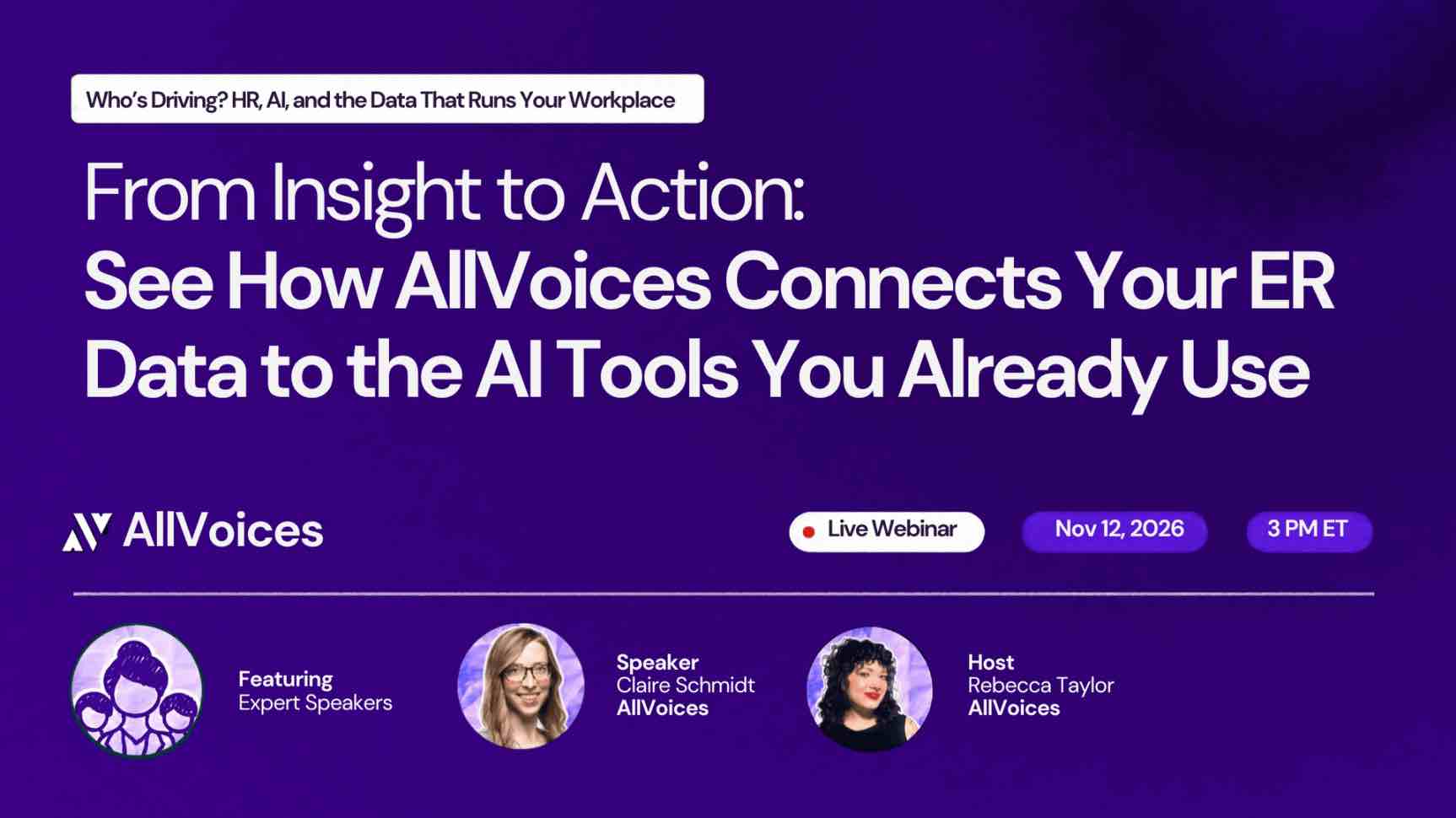
See how AllVoices helps HR teams use AI and listening infrastructure to redesign talent systems for the workforce that exists today.

Want to learn more?
See the power of AllVoices today
Thank you! We look forward to meeting you soon
Oops! Something went wrong while submitting the form.
Frequently asked questions

Got more questions? Email us at support@allvoices.co and we'll respond ASAP.

No items found.
Frequently asked questions

Got more questions? Email us at support@allvoices.co and we'll respond ASAP.

No items found.
Redesigning Our Talent Systems for the Future with Yulkendy Valdez
Episode 11
About This Episode
In this episode of Reimagining Company Culture, we’re chatting with Yulkendy Valdez, Co-Founder and Managing Partner of Forefront. Yulkendy, recently named a Latino 30 Under 30 honoree, is a social impact change-maker with a diverse set of both corporate and nonprofit experience. Tune in to learn about Yulkendy’s thoughts on initiating social impact strategy, understanding Gen Z-er’s and Millenials in the workplace, returning to work in a way that feels psychologically safe and more!
About The Guest
Yulkendy is a social entrepreneur, storyteller, and public speaker. As the Co-Founder and Managing Partner of Forefront, she helps businesses and their leaders enable their culture competency and inclusive leadership skills to meet the demands of the emergent workforce. Yulkendy brings a diverse set of both corporate and nonprofit experience to the table. She’s worked with Bank of America, EY, Puma, and Innosight Consulting as well as the International Institute of St. Louis and Betty Jean Kerr People’s Centers. While working in social impact, Yulkendy’s work focused on community based projects ranging from financial equity for low-income immigrants to affordable health care. Yulkendy has received numerous fellowships including the Resolution Project, Young People For, Opportunity Nation Leaders Program, Future Founders Fellowship, Net Impact Racial Equity Fellowship, Harvard Kennedy School Public Policy Leadership Conference, StartingBloc, and PPIA Indiana University. She is a proud alumni of Babson College, #1 school for entrepreneurship. More recently, she was named one of the Latino 30 Under 30 honorees by El Mundo Boston and a top millennial in Boston by Get Konnected. With roots in her hometown of St. Louis, Missouri, Yulkendy has traveled to over 30+ countries for both work and for fun.
Episode Transcription

On this episode of Reimagining Company Culture, we sat down with Yulkendy Valdez, Co-Founder and Managing Partner of Forefront. Yulkendy helps businesses build the cultural competency and inclusive leadership skills the emergent workforce expects. She has worked across Bank of America, EY, Puma, and Innosight, alongside community-based work on financial equity and affordable healthcare. Most recently she was named one of the Latino 30 Under 30 honorees by El Mundo Boston.

Yulkendy argued that most companies are still recruiting and managing for a workforce that no longer exists. The talent systems built in the early 2010s assumed five-year tenures, traditional career ladders, and a workforce that traded autonomy for stability. The current workforce, especially Gen Z and younger millennials, optimizes differently. They want meaning, mental health support, manager development, and a clear sense that the company will invest in them as quickly as they are investing themselves. Companies that have not redesigned for that workforce are losing them.

That conversation matters because the next five years of workforce planning will be defined by who can hire and retain workers under 35, and most HR teams are still running playbooks built for a different era.

Why Old Talent Systems Are Failing

The clearest signal is in the Gen Z and millennial data. Deloitte's 2025 Gen Z and Millennial survey finds that 89 percent of Gen Zs and 92 percent of millennials consider purpose important to job satisfaction. Half of Gen Zs want their managers to actively mentor them, but only 36 percent say it is happening. Roughly six in ten of both groups are already using generative AI in their work, and a similar share believe AI skills will be required for career advancement.

Those numbers describe a workforce that wants different things from a talent system: meaning, mentorship, AI fluency, and a manager who treats development as part of the job rather than as an extra. The old talent system was built around hiring funnels and annual reviews. The new one needs to be built around continuous development, meaningful work, and trust.

Companies starting to redesign do three things differently. They use AI to scale the personalization their teams cannot otherwise deliver. They invest disproportionately in manager development. And they make psychological safety a measurable property of the system, not a sentiment.

What Gen Z Actually Wants From Work

Why is meaning the top driver for the youngest workforce?

Because the alternative paths to meaning, like religious community or stable long-term institutions, are weaker for this generation than they were for previous ones. Work fills more of the meaning vacuum, and that raises the bar for what work has to provide. Companies that supply the meaning win disproportionately.

How does psychological safety differ for younger workers?

The threshold for what counts as unsafe is lower. Younger workers expect to disagree publicly without career consequence. They expect manager feedback to be specific and frequent. They expect company missteps to be acknowledged in plain language. Companies built around the older norm of executive opacity will keep losing this workforce to companies built around the newer norm.

What Actually Works: A Framework for Modern Talent Systems

Design principle one: use AI to scale personalization

The old talent system used standardization to scale. The new one uses AI to scale personalization. Tools like GPT for HR and Vera AI for employee relations let small people teams maintain personalized career touchpoints, intelligent triage of concerns, and consistent quality across thousands of employee interactions.

Design principle two: invest in manager development as the highest-leverage move

The Gallup finding that managers account for 70 percent of variance in engagement holds across generations, but the cost of a bad manager is higher with younger workers because they leave faster. Train managers in feedback delivery, career coaching, and mental health support. Reward the ones who do it well in the same forums you reward revenue performance.

Design principle three: instrument psychological safety as a system property

Use engagement surveys to track psychological safety items quarterly by team. Pair survey signals with always-on intake. Hold leaders accountable for psychological safety scores the same way you hold them accountable for retention. The companies that do this produce talent systems that the youngest workforce stays inside.

Where Employee Relations Fits

Modern talent systems depend on the ER infrastructure that catches what the engagement survey misses. The complaint about a manager who is undermining a junior contributor. The pattern of younger employees leaving for vague reasons. The cluster of feedback that suggests one team is operating outside the company norms. AI for HR programs increasingly use ER signals as the leading indicator that a team is drifting from the talent system the company wants to run.

How does ER tooling change talent system design?

By giving HR teams a structured view of where the system is breaking down. Patterns in the case data inform talent management decisions, surface gaps in talent acquisition assumptions, and protect the employee engagement the system depends on. Without that visibility, redesign work runs on intuition.

Frequently Asked Questions About Modern Talent Systems

What is the single biggest mistake companies make with Gen Z?

Treating their feedback expectations as entitlement instead of as a system requirement. The companies that adapt their feedback systems to match expectations get loyalty. The companies that complain about expectations get attrition.

Should we still run annual performance reviews?

Yes, as a documentation moment. No, as the primary feedback channel. Continuous feedback handled well makes the annual review a summary, not a surprise. The annual review still matters for legal documentation and compensation calibration. It does not work as the main coaching tool.

How do we redesign hiring for the new workforce?

Be specific about meaning, growth, and manager quality in the job description. Stop hiding behind generic language. The candidates you want will read carefully. The candidates you do not want will not. For more on tying these threads together, see our piece on the synergy between DEI and employee experience.

What role does AI play in the modern talent system?

It removes the bottleneck on personalization. AI cannot replace manager judgment, but it can extend the reach of a small people team to deliver the kind of attentive employee experience that used to require a much larger headcount. Used well, AI is the unlock for retention at scale.

How long does a talent system redesign take?

Two to three years for a full transition. Hiring funnels move first. Manager training takes a year to compound. Promotion and retention metrics take 24 to 36 months to reflect the new design. The companies that started in 2022 are starting to see the results now.

The Bottom Line for HR Leaders

Yulkendy's framing puts the right pressure on talent system design. The companies that lead the next decade will be the ones that built for the workforce that exists, not the workforce of the early 2010s. That means systems built for purpose, mentorship, AI fluency, and psychological safety as measurable properties.

The investment is not small. The return is the only durable answer to a labor market that will keep getting more competitive for the talent companies most need. The HR teams that lead this shift inside their companies will define the next era of workforce strategy.

The teams that wait will spend the next five years explaining their attrition numbers to executives who started asking why other companies are not having the same problem.

See how AllVoices helps HR teams use AI and listening infrastructure to redesign talent systems for the workforce that exists today.

Want to learn more?
See the power of AllVoices today
Thank you! We look forward to meeting you soon
Oops! Something went wrong while submitting the form.
Frequently asked questions

Got more questions? Email us at support@allvoices.co and we'll respond ASAP.

No items found.
Frequently asked questions

Got more questions? Email us at support@allvoices.co and we'll respond ASAP.

No items found.