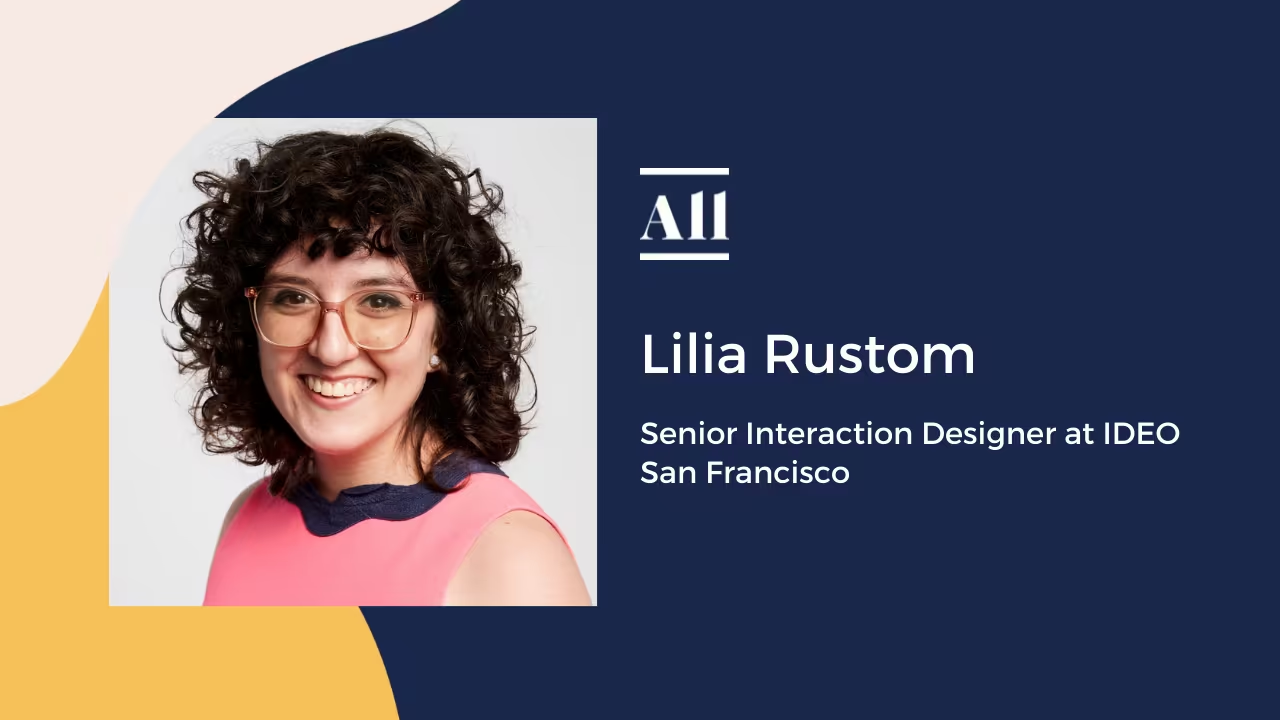
Committing to Social Impact — Lilia Rustom of IDEO
Lilia Rustom on founding Horizon at IDEO, an ERG for visa holders and immigrants: how to build an ERG that changes internal policies from the inside.

Why most ERGs do not address immigration, and why that is a gap
Immigration processes in the United States are among the most stressful experiences an employee can navigate while simultaneously holding down a full-time job. H-1B renewals, green card timelines, EAD extensions, dependent visa complications: these are not HR edge cases. They affect a significant portion of the workforce at technology and knowledge-economy companies, where the percentage of employees on employment-based visas can be substantial.
Yet most ERGs are not built to address this. They focus on race, gender, sexual orientation, disability, or religion, categories that map to existing DEI frameworks. Immigration status and visa challenges rarely appear on that list, which means employees navigating those challenges often do so without peer support, institutional knowledge, or a formal place to ask questions.
Lilia Rustom saw that gap at IDEO and decided to close it. In March 2021, she and her co-lead Nazlican Goksu founded Horizon, an ERG built specifically for visa holders and immigrants at IDEO. The community grew from 30 founding members to 52 within the first year, launched four action groups, and successfully changed internal policies affecting immigrant employees. Rustom was a Senior Interaction Designer at IDEO at the time of this interview. She has since moved on and serves as Lead UX Designer at Cricut, an IDEO alum.
Her conversation with AllVoices is a practical guide to starting an ERG that does not just build community. It changes the conditions people work in.
Lilia Rustom on founding Horizon at IDEO
Rustom spoke with AllVoices about what drew her to IDEO, why an ERG for immigrants was necessary, and how Horizon's four action groups translated community needs into operational change.
What drew you to IDEO and what has kept you there?
Rustom's path to IDEO started with an undergraduate fascination. She first heard about the firm while studying graphic design in Beirut and was drawn to the combination of social impact and iterative design thinking.
Working at IDEO has been my dream job since I first heard about it in undergrad when I was studying graphic design in Beirut. I was drawn by the commitment to social impact, and the process of designing with the users, prototyping and iterating again and again. Since joining IDEO, I have worked on such a diverse range of projects in different industries, which helped me gain experience, develop my craft as well as grow my business knowledge and leadership skills. I find it so rewarding to work on projects that have an impact on healthcare, education, food equity, entertainment, transportation and mobility among other domains.
The through-line from this answer to ERG leadership is direct. Both require comfort with iteration, user-centered thinking, and long-term commitment to improving systems that affect people. Rustom applied a designer's instinct to a community problem, and built something that worked.
How did Horizon come to exist at IDEO?
Horizon emerged from IDEO's 2020 decision to create a formal equity and belonging leadership team, which then launched a company-wide call for ERG applications.
In 2020, IDEO launched a new change management leadership team focused on equity and belonging and to steward IDEO's external commitments to DEI. This team is led by two Black women, Lauren Collins and Ariana Allensworth. This leadership team launched and still manages IDEO's Employee Resource Group program. In March 2021, they sent out a company-wide call for applications and I, along with my co-lead Nazlican Goksu, raised our hand to launch an ERG focused on immigrants and visa holders at IDEO. That's how Horizon was born. Horizon is a multicultural community that spans across different countries, time zones, cultures, races, and native languages, and while we might be going through different immigration journeys, Horizon is our constant, it's what we'll always have in common. It's where our ideas meet to dream and create a better future for immigrants and visa holders at IDEO.
The framing of Horizon as "our constant" across different immigration journeys names what every successful ERG does at its best: creates a shared identity that holds across the things that divide. Different visa types, different countries of origin, different timelines. The ERG is the common ground. This kind of community design is what makes intersectionality at work more than a framework word.
Why did IDEO need an ERG specifically for visa holders and immigrants?
Rustom's answer names something most HR programs do not: the invisible labor of navigating immigration while holding a full-time job, and how that labor falls harder on some employees than others.
Immigration processes in the US can be very daunting, often confusing, and overall frustrating. Our American coworkers who have never been through the immigration process often struggle to relate and understand what their visa-holder coworkers are going through, and how an immigration process can affect much more than a person's job, but more often than not their family, their mental health, and their whole life overall. While working at IDEO, we have heard many horror stories over the years from several coworkers going through the immigration process, and we've decided it was time to take action and do something about it internally.
A denied renewal, a delayed EAD, an unexpected policy change: any of these can disrupt an employee's entire life in ways that extend well beyond their job. Most managers have no frame of reference for what that experience involves. Horizon was designed to change that, both by educating colleagues and by creating the institutional knowledge employees need to navigate these processes with less chaos.
What are the four action groups inside Horizon?
Rustom describes a structure that goes well beyond most ERG designs. Horizon is organized around member needs, with each group responsible for a specific kind of outcome.
Within Horizon, we have activated the community to lead 4 different action groups, leading to 4 goals. In Dawn, we create rituals to celebrate "firsts" — like getting a new visa, getting a green card, moving to the US… But we also celebrate our community's members and their achievements. In Golden Hour, it's the "magic hour" where we meet together to collectively create beauty at the intersection of our cultures. We host a speaker series where we get inspired by external artists and designers who are part of different cultures and use their identity to create at the intersection of their cultures. In Twilight, we learn from external expertise. We host external speakers to educate our community about a variety of technical topics — 401K, Social Security, US healthcare system, taxes and international taxes, US Real Estate, Judiciary system, etc. In Sunrise, we find opportunities for change inside IDEO and work collectively to better support and improve the experience of visa holders and immigrants. We work with several stakeholders, from legal, to finance, to talent and recruiting, in order to change policies internally.
Sunrise, the action group focused on changing internal policies, is the rarest and most important part of this structure. Most ERGs build community within the existing system. Sunrise was designed to change the system. That kind of structural ambition requires both internal credibility and executive sponsorship, which Horizon deliberately built from the start. Inclusive onboarding and meeting practices are one starting point for organizations that want to extend this kind of systemic thinking into everyday operations.
What did Horizon accomplish in its first year?
When we first launched Horizon, we started with a group of 30 people. Over the course of the year, our ERG has grown to having 52 members today. Our soft measure of success is the growth of our community, the feedback that we constantly hear from members, and the presence of a safe space where members are not afraid to ask questions and share about what the current struggles they're going through. Our more tangible measure of success is the launch of 4 different initiatives within the action group called Sunrise, where we have successfully improved operational systems, redesigned a few policies, and added a few benefits.
Four policy changes in the first year of a brand-new ERG. That is a high bar, and it was made possible by the Sunrise structure, which connected ERG leaders directly to legal, finance, talent, and recruiting stakeholders. When ERGs have access to the people who can actually change things, they can move faster than anyone expects. Psychological safety in this context means employees trusting that their input will be taken seriously rather than thanked and archived.
How does executive sponsorship work at IDEO?
Each ERG at IDEO has been matched with an ERG Advocate, a senior leader who advises us, represents us, and connects us with the leadership team. Nazlican and I selected our advocate based on a similar lived experience, where they understand what it means to be a visa holder and immigrant in the US. We have weekly meetings with our advocate where we report back with updates and progress about the action groups, but they also help us set a strategic plan of action and support us in achieving Horizon's goals.
Selecting an advocate based on lived experience rather than seniority or availability is a meaningful choice. An executive who has personally navigated the U.S. immigration system brings a different quality of engagement than one who is supportive in principle but has no personal frame of reference. For HR teams designing ERG governance, lived experience alignment is a selection criterion worth adding to your executive sponsor criteria.
How are ERG leaders recognized and compensated at IDEO?
ERG leaders at IDEO have a protected amount of time to dedicate to their respective ERGs, and they receive a bi-annual bonus as a thank you for their efforts and commitment to the work being done in the community.
Protected time plus financial compensation. That combination is still rare at most organizations, and it is part of why IDEO was able to attract leaders willing to build something as structurally ambitious as Horizon. Compensation signals that ERG work is real work, not a volunteer activity the organization benefits from without acknowledging.
What advice do you have for people starting a new ERG?
Change is community-driven. If you're hoping to start a new ERG, talk to other employees in your organization who have a similar identity or lived experience. You might be surprised by how many employees relate to your experience and will join your efforts to make change happen. When you first start, it's important to have a plan. Brainstorm some goals you would like to see happen in the next year, craft a plan of how you'll get there with the help of people you've recruited, and come up with actionable items that you can follow through. Once launched, spread the word about your ERG on all the company's communication channels, invite people from all seniority levels and all disciplines to join, because the range of experiences will bring in a much richer perspective. As an ERG leader, it's important to make the experience personable to each member. Reaching out to individuals personally, addressing them on a first-name basis, and asking them how you are doing and how you can serve them better is such a powerful tool to build trust and help them feel safe to open up, and eventually volunteer to lead action groups.
The detail about reaching out personally, by first name, and asking how you can serve rather than what you can ask of them, is an ERG leadership practice that directly affects psychological safety and member participation. It shifts the dynamic from recruitment to relationship, which is the only foundation on which trust-based communities grow. See how AllVoices helps HR teams build the infrastructure for employee voice across communities like Horizon.
Where immigrant and visa holder ERGs stand in 2025 and 2026
Rustom's interview was published in early 2022. The immigration landscape in the U.S. has changed significantly since then, in ways that make the work Horizon was doing even more necessary.
Employment-based immigration has become more complex and uncertain
Since 2024, HR teams managing visa holder employees have faced a rapidly shifting compliance environment. According to Duane Morris LLP's 2026 employment immigration analysis, USCIS has significantly increased evidentiary requirements for H-1B petitions, introduced stricter scrutiny of petition signatures, and made changes to work authorization timelines that have created unexpected disruptions for dependent visa holders. Employees on H-4 and L-2 visas now face new uncertainty about work authorization continuity. An ERG like Horizon's Twilight action group, which provides education on exactly these topics, is no longer a nice-to-have. It is a retention and wellbeing resource your visa holder employees need.
Immigration uncertainty is a real workplace wellbeing issue
The 2025 H-1B and immigration trends analysis from NEIRO notes that visa holders at U.S. employers are facing the most uncertain immigration environment in years. That uncertainty does not stay outside the workplace. Employees worried about visa status, family stability, or an unexpected denial are not fully present at work, and most managers have no training for how to support them. ERGs that create safe spaces for these conversations, connect employees to resources, and advocate for internal policy changes are doing work that directly affects performance and retention. The questions you use to build an inclusive culture should include asking how your organization supports employees navigating complex personal circumstances, immigration included.

.svg)
.svg)