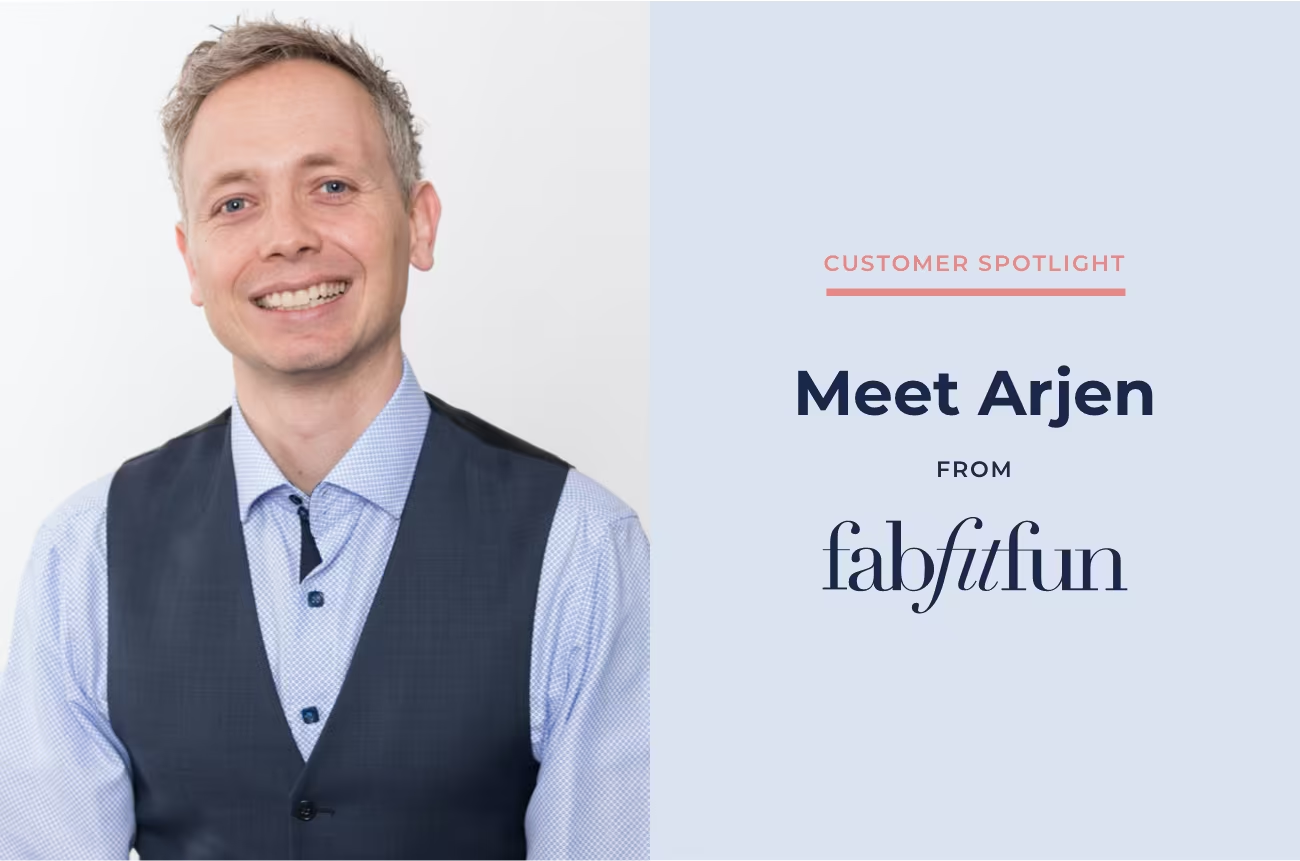
Customer Spotlight: Arjen Mackaaij, FabFitFun
Arjen Mackaaij on building feedback culture at FabFitFun: how HR leaders at fast-growing companies create accountability, belonging, and psychological safety.

What people-first HR looks like at a fast-growing company
FabFitFun built a subscription box company into a multi-faceted lifestyle membership brand, from a blog started in 2010 to seasonal boxes shipped globally, in under a decade. That kind of growth is a stress test for people operations. Hiring velocity, culture dilution, leadership development gaps, and the difficulty of maintaining any kind of feedback culture when the org chart doubles every year: these are the problems that define HR in a hypergrowth environment.
Arjen Mackaaij was SVP of People at FabFitFun when AllVoices sat down with him for this conversation. He brought 12+ years of HR leadership experience to the role, with a background spanning generalist HR, learning and development, corporate training, culture and change management, and a stint in management consulting he eventually left because, as he puts it, he knew he was "the people guy." Since this interview was published, Mackaaij has moved on to serve as Chief People Officer at Front, a customer communications platform.
His perspective on what makes a people function genuinely effective, and what makes it performative, is still one of the more honest takes available from a senior HR leader in the direct-to-consumer tech space.
Arjen Mackaaij on people strategy at FabFitFun
Mackaaij spoke with AllVoices about the culture at FabFitFun, how feedback becomes a growth tool rather than a threat, and what he had seen change and stay stuck in HR's response to the #MeToo movement.
What draws someone to a career in People rather than product or finance?
Mackaaij's answer is one of the more self-aware things a senior HR leader could say. He does not describe HR as a calling. He describes it as the thing he kept getting pulled back to, regardless of what else he tried.
In college — a long time ago — I was doing business administration, and while we were all there for business, I noticed some of my friends were more drawn to products and the company's branding. Others were more interested in companies as profit-making machines, focusing more on the financial mechanics. None of those really drew me. What really got me out of bed, especially in college, was the people topic. I would ponder about a group of people, doing something amazing, what motivates them, how they are organized, what attracts them, and that always inspired me. So I did a masters in HR in Holland, and then I started my career in HR as a Generalist, doing all kinds of HR business partner: I did Employee Relations for a small warehouse. I did learning & development including being a corporate trainer. I handled culture and change management and a bunch of other topics. Then I dabbled in management consulting for a while, but even during this time, I always got drawn back to the People topics. At some point I knew for certain, I'm the people guy, so that is what I should pursue.
The breadth of Mackaaij's background, ER, L&D, training, culture, and change management, is exactly what makes senior HR leaders effective at companies where growth creates complexity. Specialists solve specific problems. Generalists who have worked across the full HR function understand how those problems connect.
What makes FabFitFun's culture distinctive?
Mackaaij identifies two specific qualities that stood out to him from his first day on site: unusual energy and an organizational openness to ideas from anywhere in the company.
One: the passion. I know that sounds cliche, but everybody who seems to apply here, including myself, always comments on how energetic and passionate everyone is about what they're doing. It's also what drew me — when I interviewed, I sat there at the West Hollywood headquarters waiting for my meeting, and all kinds of stuff was happening: something was being filmed that day, people were having animated discussions, I noticed people were really passionate — definitely the opposite of a library. There is definitely a passion for what we do and for growing our business.
Secondly, there is a disproportionate openness to new ideas that is more than I've seen at other companies. Just like "what if we tested something like this or I think this could be a good option," and people will say "OK, let's do it!" which feels invigorating. Anyone can also have a good idea — whether you are the CEO or an Assistant, it really doesn't matter.
The second point is the more operationally significant one. An organization where ideas are evaluated on merit rather than title creates a different feedback dynamic than one where the org chart determines whose voice gets heard. That structural openness is one of the foundations on which honest feedback from direct reports becomes possible.
How do you build and maintain a positive culture during rapid growth?
Mackaaij is direct about the fact that FabFitFun was still working on this when he sat down for this interview. His answer is more useful precisely because it does not pretend the problem is solved.
One: create a culture of feedback, learning, and growth. And to be completely transparent we still have room to grow here. Like many companies in the area, I noticed when I started that feedback was a scary thing, because you have to make yourself vulnerable; it's scary for the manager as well as the employee. We're really putting effort into building a more open feedback culture that is also centered around growth & development. If we're getting feedback, like with a pulse survey, this is not to reprimand anybody — the aim is to know what we need to do to grow as an organization, and what you could do to grow as a person. It is important that you change that mindset, from being scary, to a growth mindset.
The reframe from "feedback as judgment" to "feedback as growth data" is the central cultural shift every people team is trying to make. It requires consistency over time, not a single all-hands message. The way you respond to the first difficult pieces of feedback you receive publicly sets the tone for everything that follows. Teams use employee survey questions to make feedback less threatening and more useful across the org.
How has the #MeToo movement changed HR?
Mackaaij's read on #MeToo is neither dismissive nor performative. He names both real change and real limits, which is the more honest version of this conversation than most HR leaders offer publicly.
A lot. I definitely think there is a lot more willingness to speak up in this moment, which is great. Companies are also realizing this is a new dawn and a new day, and as a company you need to be far more aware and cognizant of these types of dynamics at your company. You can't just turn a blind eye. Overall, I think it has had a positive impact; it's made the topic more discussable and more open, and there is more accountability than there used to be. Other related topics are also making it more to the forefront, e.g. female representation on boards — this is more in the representation realm, but I think that the MeToo movement was a catalyst for these topics as well. That being said, I think there is still a ways to go though.
"Still a ways to go" was accurate when Mackaaij said it in 2019. It remains accurate today. Having the hard conversations at work requires both cultural openness and structural infrastructure: reporting channels, investigation processes, and follow-up communication that makes those conversations safe to initiate.
What trends did you see coming in the future of work?
I think there is already a trend towards operating virtually with teams working around the globe and some working remote or working different hours. I think this will allow companies to tap new talent pools because physical proximity doesn't matter as much anymore. I also see an increasing interest in engagement and what drives motivation in a sustainable way.
He was right on both counts. The pandemic accelerated distributed work well beyond what most organizations had planned for, and the question of sustainable engagement became the defining challenge of the post-pandemic HR function.
How should founders establish a safe workplace from the start?
Firstly, by modelling the right behaviors right from the start and managing their direct reports to do the same. If they can make themselves vulnerable, be thankful for any and all feedback, and model giving direct feedback in a quality way that will set the tone for the org.
Vulnerability from the top is not soft leadership philosophy. It is a structural intervention. When a CEO thanks someone publicly for critical feedback, it changes the calculus for everyone watching. That signal, that honesty is rewarded not punished, is what makes employee feedback systems actually work. AllVoices is a leading employee relations platform that helps HR teams manage ER cases, workplace investigations, anonymous reporting, and employee feedback. The impact HR has on employee feedback culture starts with the tools and signals you put in place before a problem surfaces.
What is one of your biggest career challenges?
This is more a personal challenge, but realizing that a management consulting career wasn't for me (and my family), and then making the switch back to HR. I think I tried to make it work for a while — the company I worked for was fantastic with amazing colleagues. However, the constant travel and working pressure was hard. Sometimes you have to be honest with yourself and realize that some things are not for you. In the same vain I learned a lot about my own strengths, and less talents, in the past few years. I have embraced that I won't be good at everything — rather I want to use my strengths because I believe that will make me happier and more successful in the end.
How can managers identify and improve an unhealthy culture?
By aligning on who you truly want to be, even if it is aspirational. Don't try to be the perfect company or pursue things that just sound great. Rather, focus on what your ideal image is of how people will work together that will make the company successful. Align on this first with the leadership team and get everyone's commitment (this is also possible at team level) and then figure out how to get there.
Start with what you want to be, not what you want to avoid. That distinction is the difference between values that guide decisions and values that decorate walls. The alignment step is the part most organizations skip, which is why culture work so often stalls at the slogan stage.
What do you find most rewarding?
Seeing engaged employees that enjoy their work, and are using their strengths to be successful. Then seeing the company thrive.
Where Arjen Mackaaij's predictions stand in 2025 and 2026
This interview was published in December 2019, three months before COVID-19 changed every assumption about how and where work happens. Several of Mackaaij's predictions proved prescient. Others are more complicated in retrospect.
Virtual and distributed work became the new default
Mackaaij predicted that physical proximity would matter less and that companies would tap new talent pools through virtual work. The pandemic compressed that transition from a gradual trend into an overnight requirement. By 2022, most knowledge-work companies had adopted hybrid or distributed models permanently, and talent acquisition had genuinely gone global for roles where geography was no longer a constraint. The engagement question Mackaaij raised, what drives motivation sustainably rather than in a burst of remote novelty, turned out to be the central challenge of the 2022-2024 period. Gallup's State of the Global Workplace reports through 2025 consistently showed that engagement remained the primary driver of retention, productivity, and wellbeing outcomes across all work models.
The feedback culture challenge intensified
Mackaaij described feedback as "a scary thing" at FabFitFun in 2019. Six years later, the infrastructure for employee feedback has matured significantly: pulse surveys, anonymous reporting platforms, continuous feedback tools. But the cultural challenge he named is still central. According to Gallup's State of the Global Workplace 2026 report, global employee engagement dropped to 20% in 2025, a five-year low, down from a peak of 23% in 2022. Only 1 in 5 employees worldwide is engaged at work, and a key driver of disengagement is the perception that feedback goes nowhere. The tools exist. The willingness to act on what those tools surface is still the limiting factor. See how AllVoices works to help HR teams close the loop between what employees report and what actually changes.
Accountability post-#MeToo has proven uneven
Mackaaij noted in 2019 that #MeToo had created more accountability than before, with the caveat that "there is still a ways to go." That caveat remains accurate. Research from the UCLA Williams Institute (2024) and ongoing SHRM data show that rates of workplace harassment reporting remain far below actual incidence rates, meaning most misconduct still goes unreported. The structural gap is not awareness. It is the absence of reporting channels employees actually trust to be safe and act on reports. That is the problem AllVoices was built to address.

.svg)
.svg)