Meet C-suite Trusted Ally and Change Agent, Elad Levinson
HR change management consultant Elad Levinson on why employee disengagement keeps deepening and what organizations need to redesign to fix the gap.

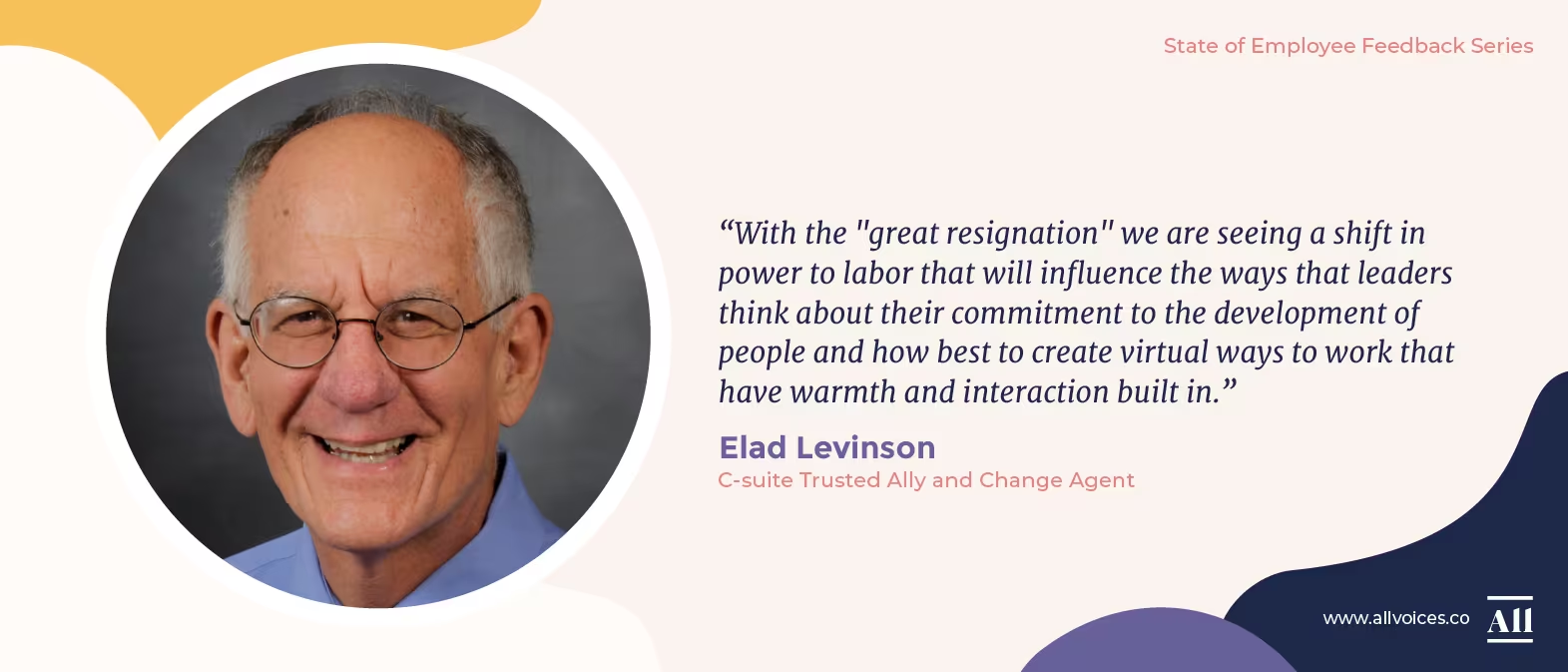
After 45-plus years working as a leadership coach and organizational consultant, Elad Levinson has watched the same change management failures play out in different industries decades apart. His view in 2022, that companies treat employees as commodities and then act surprised when those employees disengage, has only become more relevant. Gallup's 2025 data shows just 32% of employees are engaged at work, and global manager engagement has slipped from 30% to 27%.
Levinson serves as Senior Organization Effectiveness Consultant at 4128Associates and is the head lecturer for Praxis You's Thriving on Change course. His career spans senior HR and organizational effectiveness roles at Agilent, Stanford University, ICANN, and several startups. His specialty is applying neuroscience and cognitive science to the questions HR leaders actually face: how to design organizations that adapt, how to build leadership pipelines that hold up under pressure, and how to turn change from a stressor into a real competency.
This conversation, part of the AllVoices State of Employee Feedback series, was originally published in 2022. Levinson's framework on what HR needs to become has aged remarkably well. The 2025 and 2026 update at the end of this post connects his earlier observations to current research.
Why HR is at a turning point
Levinson opens with a clear-eyed read of an industry he has studied for over four decades. The labor market shift, the cynicism it produced, and the design choices it forces on HR leaders are themes he returns to throughout the conversation.
What is the state of the human resources industry today?
There is a fundamental shift to focus on DEI, Talent management and Employee Engagement. With the "great resignation" we are seeing a shift in power to labor that will influence the ways that leaders think about their commitment to the development of people and how best to create virtual ways to work that have warmth and interaction built in. My assertion is that for way too long companies have treated staff as a commodity, thereby encouraging a reciprocal move on employees' part of disengagement and lack of loyalty. The exceptions are worth studying. Why do we see so few companies embrace the best practices of parallel organizational architecture to free staff to innovate? The rationale is therefore for understanding that we are in a period of transformation in the world of work and act accordingly to enter into a deep period of reflection and encouragement of thinking that is in alignment with the best thinking and outcomes of the truly successful organizations both fiscally and emotionally.
Levinson's framing places the disengagement crisis in its actual context. It is not a new problem caused by remote work or generational change. It is the predictable response to decades of treating people as line items. Companies that built genuine cultures of listening outperformed peers on retention and engagement long before the great resignation made the gap visible.
What HR leaders get wrong about employee feedback
When asked about the most common challenges in managing employee feedback and reporting, Levinson reframes the question. The technical challenge is real, but the deeper problem is the trust deficit that decades of distance have built between leadership and the workforce.
What are the most common challenges you face when managing employee feedback?
A long history of organizations caring little or not at all about people has bred a cohort of skeptical or cynical staff who generally believe that leaders are too far removed from them to comprehend what their experience is and or take it seriously. The push for profit has also turned humans into commodities which any conscious human does not like and will have negative consequences. What I see is an amazing opportunity to transform the easy organizations to think about, plan for and strategize about VUCA level change patterns.
If you place the experience of change at the heart of the organizational people strategy and assume rapid, fundamental and disruptive events- at worst everyday is a black swan and at best the company is responding as if change were natural and the best response is to embrace, plan for and train to adapt.
I am a strong advocate for models of organizational design that make full use of employees' hearts, minds and interests to create structures that enable input, influence and impact from all sides and parts of the organization. Hence, a hub and spoke model that encourages bottom up, multi stakeholder democratic principles is to be highly valued and implemented.
Two practical points stand out:
- Employees are skeptical of feedback channels because their lived experience tells them those channels do not change anything.
- The fix Levinson points to is structural rather than cultural. You can train managers in active listening for years without moving the needle if employees do not see input change outcomes.
AllVoices research found that 84% of employees had at least one concern they did not share with HR in the past year, with retaliation fear and doubt that the company wants honest feedback as the top reasons.
How to actually improve employee feedback culture
Levinson's five recommendations are unusually concrete for an industry that often defaults to abstractions. Each one names a specific organizational design choice that either supports or works against a feedback culture.
What advice do you have for organizations looking to improve their employee feedback culture?
a. Place change as a competency in the center of all learning and development.
b. Make everyone an influencer by adopting organizational designs that are participation centric and offer real impact from every level about operations and other critical process oriented matters.
c. Develop a pipeline of High Potential leaders who demonstrate the skills of new ways to work such as emotional and social intelligence, team problem solving and decision making and a learning/adaptive mindset.
d. Confront actions and behavior that are regressive and aversive while formally recognizing examples of the new ways of working.
e. Think and act as if HR were more about strategic interventions that free staff to be their best selves, give their unique genius and force people to be both assertive and cooperative.
His five points cluster into three core moves any HR leader can put into practice:
- Make change capability a baseline skill in your L&D curriculum, not a niche project skill
- Distribute real decision authority so employee input changes outcomes, not just tone
- Build a leadership pipeline trained for adaptive work, including conflict and emotional skill
The first item is the most consequential and the most under-implemented. Most learning and development programs treat change management as a niche skill for project leads, not a baseline competency for the entire workforce. Building strong leadership skills throughout the pipeline is part of that, but the deeper shift is treating adaptability itself as the core skill.
The future of HR according to Levinson
Asked about where HR is headed, Levinson is direct. The future will require either a fundamental rethink or it will deliver consequences that show up in attrition, recruiting, and reputation. There is no middle path that he sees as viable.
What is the future of HR?
I believe that the future will either be a radical rethinking of how to integrate the full human race or it will be the same old same old which will decrease competitiveness, talent attraction and ultimately reputational nightmares. We are at a major transformational crossroads. Human beings have been turned into assets and liabilities when we are truly thinking, feeling, creating agents of change. I only want to work with those who have given up giving lip service to "soft skills development", learning and adaptation. It is time to break the ties that bind us to old outdated ways of thinking and acting and to make full use of neuroscience applied as it holds answers to motivation and wise action.
The reputational risk Levinson names has become more concrete since 2022. Glassdoor reviews and external employee networks now travel quickly, and candidates research how organizations actually treat people before accepting offers. The cost of treating people as commodities is no longer an internal-only problem. It compounds in the talent market.
How Levinson sees his own role evolving
When asked about the next 3-5 years, Levinson offers a self-description that doubles as a job description for what he believes HR organizations actually need.
How do you see your role evolving over the next 3-5 years?
As a wise elder whose 50 plus years experience will be valued because it has been pressure tested in a wide variety of settings and with a diversity of people. I like to be a provocateur of change with a big skill set in how to initiate, sustain and influence change in a positive direction for the future. I would love to be the "CPO" Chief Provocateur Officer who has the accountability and responsibility to build a new foundation rooted in sound social, economic and psychological science while retaining what is good about the current system and organization.
Without developing a creative, constructive and curious conflict embracing work culture there is no chance for real innovation. All change is stressful, all change requires adaptation and all change rubs many the wrong way. Therefore it is imperative to skill-up and embed tools and mindset that makes conflict creative and constructive.
Levinson's conflict-embracing framing is one of the most useful pieces of advice in the conversation. Most organizations treat conflict as a failure mode and try to suppress it. The data on team performance suggests the opposite: teams that surface and work through disagreements outperform teams that paper over them. Conflict management skills for managers are the practical implementation of what Levinson is describing at the cultural level.
Where Levinson's framework stands in 2025 and 2026
Levinson published this conversation in 2022. The years since have stress-tested his predictions in ways that mostly confirm them. The data on engagement, manager capability, and organizational adaptability has caught up with what he was already describing.
Engagement has continued to decline
According to Gallup's 2025 State of the Global Workplace research, employee engagement sits at 32%, with global manager engagement at 27%, down from 30% the previous year. The disengagement Levinson described in 2022 has not corrected. It has deepened. Organizations that treated remote and hybrid work as a temporary disruption to ride out have not closed the gap with organizations that redesigned around it.
Manager training has the biggest payoff in 2026
Gallup's research finds that 70% of team engagement variance is attributable to the manager, and that trained managers see performance lifts of 20-28%. Yet less than half of managers say they have received formal training in their role. Levinson's insistence that change be placed at the center of learning and development is, in 2026, a recommendation supported by some of the strongest performance data in the field.
The conflict-embracing culture is still the exception
Most organizations still treat workplace conflict as a problem to be eliminated rather than a signal to be processed. The teams that consistently outperform are ones with psychological safety high enough that people raise hard issues directly. Building that capacity requires what Levinson calls skill-up and embed work, not slogans about openness. AllVoices is a leading employee relations platform that helps HR teams manage ER cases, workplace investigations, anonymous reporting, and employee feedback. See how AllVoices works for HR teams building the kind of feedback infrastructure that makes Levinson's framework practical.

.svg)
.svg)