Democratizing Learning in the Game Industry and Beyond — With Coraly Rosario of Niantic
Coraly Rosario on building Nianticos at Niantic: how Latinx ERG leaders create community, measure impact, and make the game industry more equitable.

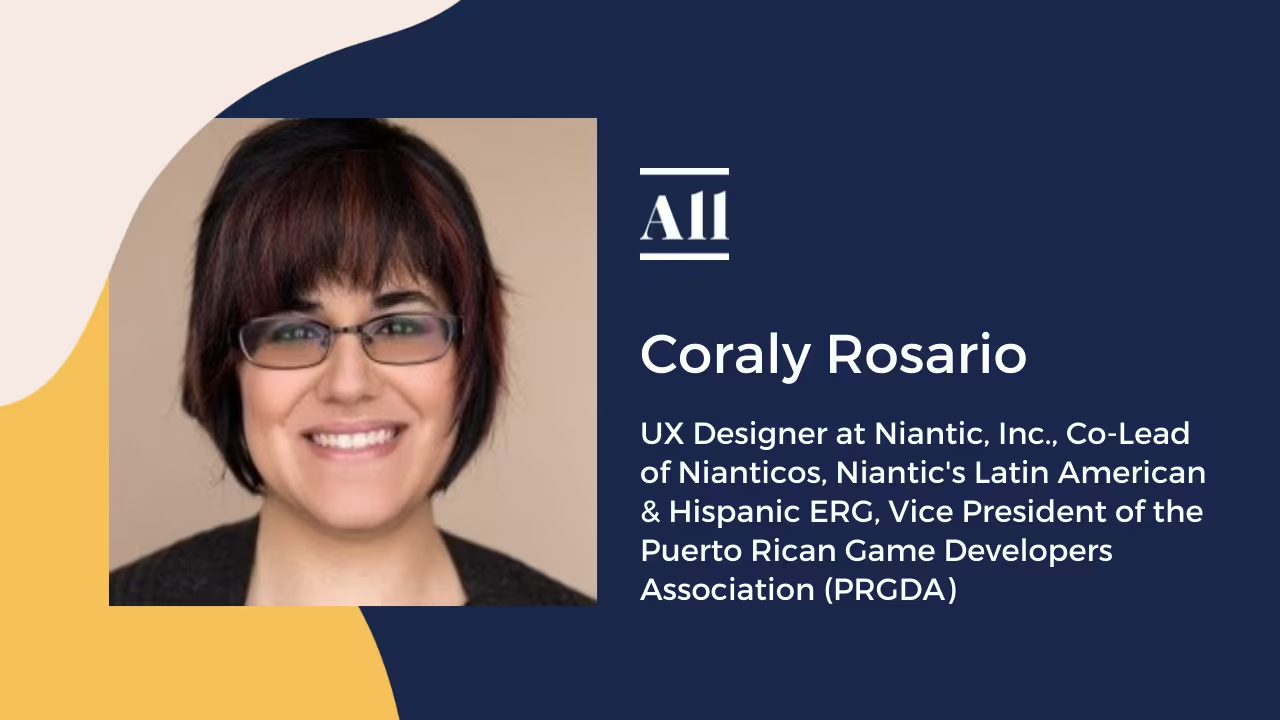
Coraly Rosario is a Puerto Rican UX designer and diversity advocate who spent years making the game industry more accessible for Latinx creators: first at Niantic, where she co-founded Nianticos, the company's Latin American & Hispanic ERG, and later in broader industry roles. She is also Vice President of the Puerto Rican Game Developers Association (PRGDA), an initiative focused on growing the game development community in Puerto Rico and beyond. She has since moved on from Niantic and is currently a Principal Experience Designer at Zynga.
This conversation, part of the Culture Champions series, was originally conducted in 2021. Her insights on ERG structure, scope management, and getting executive buy-in remain as relevant as ever, especially given the persistent representation gap in game development.
How Coraly Rosario built ERG leadership from the ground up
Most ERG leaders are solving two problems at once: doing the community-building work and figuring out how to make that work legible to a company that wasn't built with them in mind. Rosario has navigated both, starting an ERG before she had an office, then scaling it into a cross-functional program with OKRs, executive sponsorship, and external community partnerships.
What mindset best prepares a UX designer to lead people?
Leadership starts with a distinction Rosario draws clearly between a boss and a leader.
"I would say that having a specific mindset is key; you are a leader, not a boss telling others what to do. I strongly believe that managing others is not just about having them check off their tasks for the day. It's about helping them identify their career paths and working with them to ensure they are realizing that path through their work. I want to see my colleagues grow and flourish in this industry."
She puts this into practice by teaching skills directly, not just directing people toward resources. If a designer wants to learn UX, she runs workshops and puts them on real projects with her as a mentor. She also applies this logic to her broader UX process: designing collaboration across departments so engineers, artists, and designers all feel ownership over the work.
"Lastly, I'm aware of myself. I know I can't do it all or know it all. I rely on my peers to guide me as experts as well. I've learned how to delegate in a way that is balanced to all on the team and not just offloading what I can't do to someone else with a busy schedule."
How did she become co-lead of Nianticos before she even started at Niantic?
The founding of Nianticos started with a conversation before Rosario's first day of work.
"It's kinda a funny story. Prior to joining Niantic, Trinidad Hermida had approached me about initiatives she was building as Head of D&I. She wanted me to be a part of it by leading the Latin American side, especially given the partnerships I had already established via the PRGDA. I hadn't even started working at Niantic yet."
Once she started, she joined the Latin American & Hispanic Slack channel and, along with a small team, built a mission statement, brought on an executive sponsor, and established what became Nianticos. For the first eight months, Rosario managed the ERG alone. By the time this conversation took place, the team had grown to about 10 leaders, each owning a specific OKR.
What Nianticos set out to accomplish
Building community is the most visible part of an ERG's work. But the Nianticos model goes further: connecting internal programming to external partnerships and community impact. Their OKRs reflect that dual focus.
What is Nianticos' mission?
"Nianticos' Mission is to promote cultural awareness in the workplace and to bring Latinxs of Niantic together to give back to their communities. We hope to provide Nianticos with opportunities for personal and professional growth, and a safe space for social discussion and collaboration to build relationships and create new connections."
Their three main OKRs: create a sense of community and inclusion for Latinx employees at Niantic, raise Latinx awareness within Niantic, and give back to the Latinx community outside the company.
What accomplishments do they measure?
"This year was the first time we were able to sit down and really establish specific OKRs for our ERG. Each OKR has a specific metric of success we outlined based on last year's participation as well as an end-of-year survey."
In the year of this conversation, Nianticos partnered with Niantic's recruiting department for a Latinx job fair called CONEXION, collaborated with the LGBTQ+ ERG (Compass) for Gay Gaming Professionals, co-hosted a Hispanic Heritage Month speaker with the women's ERG (Wolfpack), and began sponsoring GOKIC: a nonprofit providing tech resources to Black and Brown kids in underserved areas of Seattle. They were also a main sponsor of the UNIDOS Online event run by Latinx in Gaming.
How ERG leaders can build support without burning out
ERG leadership is unpaid work that runs alongside a full-time job. The pattern that leads to burnout is predictable: one person manages everything, the scope expands, and the work collapses under its own weight. Rosario has practical advice for avoiding that.
How are ERG leaders recognized at Niantic?
At the time of this conversation, Niantic did not have formal compensation for ERG leaders, but it was under discussion internally. Rosario emphasized other forms of recognition that matter:
"Currently, the way I try to emphasize the good we bring is by getting more Nianticos involved in speaking opportunities or involved in product-related inquiries. ERGs are also given slots during our company all-hands to talk about the work we do."
What advice does she have for people starting an ERG?
"From a company leadership level, allow folks to create ERGs specific to different communities. Don't lump all ERG efforts into a single 'Diversity ERG'. Our experiences and perspectives are so different that it actually does a disservice to your employees by having everything lumped together."
On scope management, her advice is direct: delegate early, and do what you can realistically do with the bandwidth you have. The desire to drive every initiative is common among ERG leaders. But if one person is managing everything on top of their day job, they will burn out, and so will the ERG.
How ERG work connects to real community impact
The best ERGs do not stop at internal belonging programs. They connect company resources to external communities and create pathways for underrepresented talent to enter the industry.
What is her call to action for executives?
"For executives, reach out to your ERGs to understand how you can make your companies better, how you can take an active role in hiring more diverse candidates, improving systems so they feel safe to stay, and figuring out ways your company can create external initiatives that actually creates more opportunities for underrepresented communities."
She points to Niantic's Black Developers Initiative as a concrete example: direct investment in Black-owned or operated studios. Allies who want to contribute to ERG work should use their platforms to elevate the people doing the work, not replace them or speak over them.
How did Nianticos celebrate Hispanic Heritage Month?
Externally, Niantic sponsored UNIDOS Online and Nianticos provided a live stream panel on ERG-building. Several Niantic employees served as mentors for the PRGDA's Cafecitos mentoring event. Internally, Nianticos hosted a craft night on papel picado and Dia de los Muertos traditions, a fireside chat with Puerto Rican concept artist Karla Ortiz, and a company-wide fundraiser for GOKIC's Wifi as a Lifeline initiative.
What is her proudest moment?
"I always feel immensely proud of my peers whenever I see them take the stage, talk about their experiences, and see it resonate with so many across the globe. My goal isn't about me doing these things but rather about finding ways in which everyone can be involved in making the game industry better, more diverse, and equitable for folks of all backgrounds."
Where Latinx representation in gaming stands in 2025 and 2026
The gap between Hispanic players and Hispanic developers in the game industry has not closed since this conversation. The data makes the case for ERG work like Coraly's more clearly than ever.
The player-developer gap is widening, not closing
Roughly 72% of U.S. Hispanics aged 13 and older identify as gamers, and Latinos are 32% more likely than other populations to call gaming their main source of entertainment, according to Fair Play Talks research published in 2026. Yet only 11% of game developers identify as Hispanic or Latino. Latinx developers earn on average 25% less than white developers, and 83% of Latinx game developers say their ethnicity has hindered career progression.
Character representation tracks the same gap. About 7% of game characters are Latinx, a percentage that has barely moved in a decade despite the demographic's outsized engagement with the medium.
New coalitions and policy attention in 2024 and beyond
In September 2024, a formal Latino Representation in Gaming Coalition (LRGC) was launched, backed by Congressman Joaquin Castro and national Latino advocacy organizations including the Congressional Hispanic Caucus Institute, MANA, and Latinx in Gaming. The coalition's formation reflects growing recognition that individual ERGs like Nianticos cannot solve an industry-wide representation problem alone.
What this means for ERG leaders today
Three structural practices distinguish ERGs that move the needle:
- OKRs with measurable metrics. Vague goals produce vague outcomes. Tie each OKR to a specific number: event attendance, speaker slots secured, external partnerships launched.
- Cross-ERG programming. Intersectionality is not a concept. It is a calendar item. Schedule joint events with adjacent ERGs at least quarterly.
- Executive sponsorship with function accountability. The sponsor should own a specific function where representation is weakest, not simply show up at events.
The playbook Coraly Rosario described remains the standard for ERGs that actually move the needle. The power of employee resource groups in creating change depends entirely on whether they are structured as real business functions or treated as optional culture work. Building an inclusive workplace culture requires the same rigor applied to any other organizational priority. Connecting ERG insights to intersectionality at work, as Nianticos did through its cross-ERG partnerships, is what turns belonging programs into systems-level change. See how AllVoices supports ERG and employee relations programs.

.svg)
.svg)