
About This Episode
In this episode of Reimagining Company Culture, we’re chatting with Chris Broderick & Chris Mason, Senior Director Talent, Analytics & Agility & VP, HR Technology, Talent & Total Rewards at KeHe. Chris Mason has over 15 years of experience leading teams in a variety of for-profit organizations including OfficeMax, Sears Holdings and finally Patagonia before joining KeHE in 2019. Chris Broderick also spent 15 years at IBM where she launched the inaugural engagement measurement framework and established IBM’s market leadership in employee listening practices. Tune in to learn Chris M. and Chris B.’s thoughts on showing up for employees and communities, the role of the employee voice, encouraging leaders to be more open to feedback, and more!
About The Guest
Chris Mason, Ph.D., is Vice President, HR Technology, Talent & Total Rewards at KeHE, a $7B natural, organic, and specialty food distributor and certified B-Corp with 7,000 employees operating in all 50 of the United States. In this role, Chris leads enterprise HR Systems and Payroll, and Compensation and Benefits, as well as Talent Management, People Analytics, and Continuous Listening. Chris has over 15 years of experience leading teams in a variety of for-profit organizations including OfficeMax, Sears Holdings and finally Patagonia before joining KeHE in 2019. Chris completed his PhD in Industrial and Organizational Psychology at DePaul University. His passion is the reinvention of work so the experience is more dynamic and democratized and healthy for all employees in the company where he serves. Chris Broderick is Sr. Director Talent, Analytics & Agility at KeHE Distributors where she heads up Employee Listening, Performance Management, Talent Review and Succession Planning. Prior to KeHE Chris spent 5 years running BnearGlobal, a people & culture consultancy with clients ranging from the state of Illinois, to manufacturing and tech startup companies. Chris also spent 15 years at IBM where she launched the inaugural engagement measurement framework and established IBM’s market leadership in employee listening practices. Chris served as a Principal in PwC’s Customer Relationship Management Strategy practice. She established Purdue Krannert School’s graduate HR Analytics & Business Partnering curriculum. She also is co-owner to a US patent titled "Method for optimizing skill development to maximize labor value.”
Episode Breakdown

Engagement surveys produce data nobody acts on. Most companies run a survey, hold a leadership meeting, decide on three priorities, and then watch the priorities die in middle management. By the next survey, employees have noticed and response rates have dropped. On this episode of Reimagining Company Culture, Chris Broderick and Chris Mason from KeHE break down the collaborative action planning model that keeps survey data from going stale.

KeHE is a 7,000-person natural and organic food distributor that operates in all 50 states. Chris Mason runs HR Technology, Talent, and Total Rewards. Chris Broderick leads Talent Analytics and Agility. Their job is to take feedback from across a distributed workforce and turn it into measurable changes in how teams operate. The mechanism they use is collaborative action planning, and it is the kind of system that can be replicated by any People team willing to do the work.

Here is how collaborative action planning runs end to end and what makes it different from the standard survey-and-forget approach.

Why Standard Engagement Programs Stall Out

Most engagement programs collapse between the data and the action. Survey results land with senior leadership, get distilled into three priorities, and then get handed back to managers who already had no time. According to Gallup State of the Global Workplace research, the global engagement number has only fallen further over the last few years, which suggests the standard model is not getting better.

Collaborative action planning flips the assumption. Instead of leadership choosing the priorities and pushing them down, the team that took the survey reviews its own results and chooses one or two things to change. The action plan lives at the team level, not the company level. The manager facilitates. The team owns the plan. AllVoices employee survey tooling starts producing results because the people closest to the problem are picking the fix.

How Collaborative Action Planning Actually Works

What does a collaborative action planning cycle look like?

It starts with the team manager sharing the team's specific survey results, not just the company-wide numbers. The team discusses what surprised them, what felt accurate, and what they want to address. They pick one or two specific behaviors to change, write them down, and assign owners. The follow-up shows up in the next team meeting and again at the next survey window.

The thing that separates good cycles from theatrical ones is that the action is small and concrete. A team that picks 'communicate better' is going to fail. A team that picks 'every Friday standup ends with one thing the team learned this week' is going to succeed.

What role does the manager play in the cycle?

The manager is the facilitator, not the chooser. They open the conversation, share the data honestly, and create the room for the team to push back. The hardest move for managers is to resist filling the silence. The team has to do the choosing for the plan to stick. situational leadership for managers is what determines whether the cycle runs well or turns into another round of compliance theater.

What Actually Works in Collaborative Action Planning

Share the data, not the spin

Teams can read between the lines. If their results are bad, name it. If they are mixed, name it. The trust to act comes from the manager being willing to look at hard numbers in front of the team. Sanitized data destroys the credibility of the whole cycle.

Pick the smallest possible change

The classic mistake is choosing an ambitious change that requires resources nobody has. A team that picks one specific behavior change has a much better chance of moving the next survey number than a team that picks five sweeping ones.

Close the loop in public

Tell the team what changed. Tell them what did not. Tell them why. The visibility is what convinces the team to engage with the next cycle. Hidden follow-ups feel like the action plan never happened.

The pattern the guest describes on this episode lines up with broader research. The SHRM research on the future of work reinforces the operating-model lens and gives HR leaders a useful reference for grounding the conversation in numbers their CEOs and CFOs already trust. It also surfaces the same gap between stated culture priorities and how People work actually runs inside most organizations.

Where Employee Relations Fits

Action planning at the team level only works if the broader employee listening infrastructure is solid. AI for HR teams gives ER and People teams the visibility they need to spot which teams are running productive cycles and which are stuck. ongoing employee feedback signals turns into a usable input instead of a once-a-year ritual.

When the action planning cycle surfaces a real ER issue, the system also needs to handle the escalation cleanly. case management for ER escalations gives the team a place to take the issue from anonymous feedback into a tracked case without losing the audit trail.

How do collaborative action plans connect to ER work?

Some action plans surface conduct issues that need to leave the team conversation and move into a formal investigation. The handoff between team-level feedback and ER case work is where most companies fumble. AllVoices keeps that handoff inside one platform so the team feedback, the manager notes, and the case file all live in one place.

The pattern across AllVoices customers is consistent. ER teams that operate on a single workflow handle more cases at higher quality with the same headcount. The structured intake reduces the time between an employee raising a concern and the case being triaged. The case management layer keeps the documentation tight so investigations hold up to legal and audit review. The reporting layer surfaces the patterns leadership needs to act on structural issues rather than handling each case in isolation. That combination is what lets People teams treat ER as a strategic function rather than a reactive one.

Frequently Asked Questions About Collaborative Action Planning

What is collaborative action planning?

It is an engagement model where the team that took the survey reviews its own results and chooses one or two specific changes to make. The team owns the plan, the manager facilitates, and the action lives close to the work, not far above it.

How is collaborative action planning different from top-down planning?

Top-down planning assigns priorities from leadership to managers to teams. Collaborative planning lets the team that took the survey choose the action. Ownership shifts and the action is more specific, which is what makes it more likely to stick.

How often should teams run action planning cycles?

Twice a year is the minimum, quarterly is better, and a short pulse plus a yearly deep dive works for most companies. The cadence matters less than the discipline of closing the loop visibly between cycles.

What role do managers play in action planning?

Managers facilitate. They do not pick the actions. They create a space where the team can be honest about the data and choose changes the team is willing to commit to. The skill is in restraint, not direction.

Can collaborative action planning improve retention?

Yes when the cycle is run consistently. Teams that see their own feedback turn into visible changes report higher engagement and stay longer. The mechanism is trust, which is what employee engagement programs ultimately compete on.

The Bottom Line for HR Leaders

Collaborative action planning works because it puts the work close to the people who feel it. Senior leaders cannot fix a manager-level engagement problem from the top. Only the team can change how the team operates. The model Chris and Chris run at KeHE is a clean version of what every People team can build.

If the next survey cycle is approaching and the last one produced no change, the fix is not better questions. It is a better post-survey workflow. The infrastructure has to exist for the action to happen, and the team has to own the plan.

The conversation in this episode underlines a pattern AllVoices has seen across hundreds of People teams. Programming alone does not move the operating model. The structural work, the manager development, the ER infrastructure, and the listening cycles that close visibly are what produce the outcomes the company can actually measure. That is the work the function will be evaluated on over the next several years, and the People leaders who do it well will keep earning bigger seats at the table. For HR teams looking to start, the move that pays off fastest is usually the operational one. Audit one process this quarter. Pick the structural change with the highest impact. Build the documentation around it. Close the loop with employees so they can see what changed and why. The compound effect of doing that consistently across a year is bigger than any single program initiative. The People teams that take this approach end up running cultures that hold up under stress and operating models that the rest of the C-suite trusts. That is the standard the function is moving toward, and the AllVoices customer base is full of teams already getting there.

If you want to see how AllVoices supports the listening, action planning, and ER handoff in one platform, you can schedule a walkthrough. Book a tour of AllVoices.
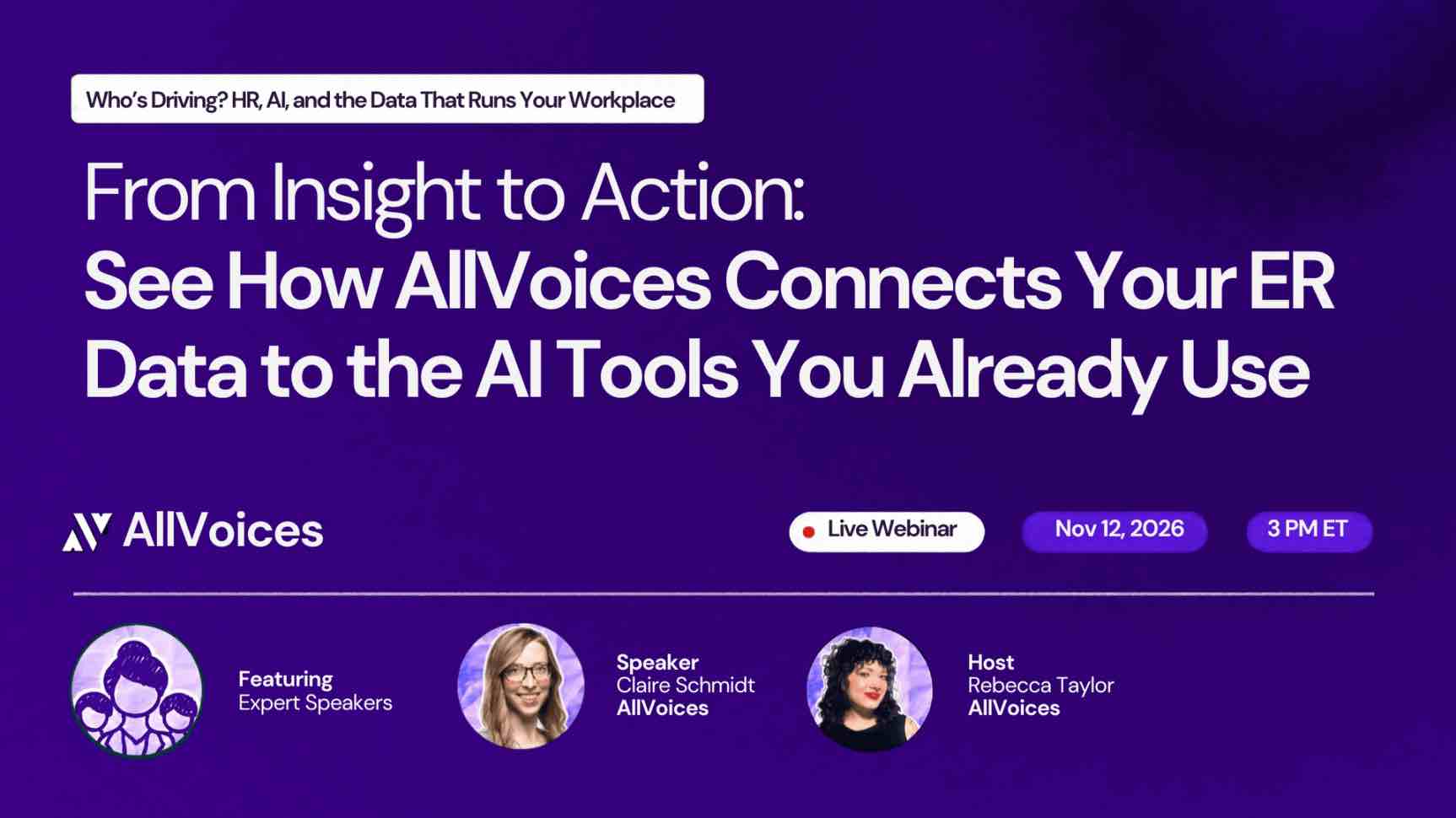
Our next webinar
Frequently asked questions

Got more questions? Email us at support@allvoices.co and we'll respond ASAP.

No items found.
Frequently asked questions

Got more questions? Email us at support@allvoices.co and we'll respond ASAP.

No items found.
Collaborative Action Planning with Chris Broderick & Chris Mason, Senior Director Talent, Analytics & Agility & VP, HR Technology, Talent & Total Rewards at KeHe
Episode 376
About This Episode
In this episode of Reimagining Company Culture, we’re chatting with Chris Broderick & Chris Mason, Senior Director Talent, Analytics & Agility & VP, HR Technology, Talent & Total Rewards at KeHe. Chris Mason has over 15 years of experience leading teams in a variety of for-profit organizations including OfficeMax, Sears Holdings and finally Patagonia before joining KeHE in 2019. Chris Broderick also spent 15 years at IBM where she launched the inaugural engagement measurement framework and established IBM’s market leadership in employee listening practices. Tune in to learn Chris M. and Chris B.’s thoughts on showing up for employees and communities, the role of the employee voice, encouraging leaders to be more open to feedback, and more!
About The Guest
Chris Mason, Ph.D., is Vice President, HR Technology, Talent & Total Rewards at KeHE, a $7B natural, organic, and specialty food distributor and certified B-Corp with 7,000 employees operating in all 50 of the United States. In this role, Chris leads enterprise HR Systems and Payroll, and Compensation and Benefits, as well as Talent Management, People Analytics, and Continuous Listening. Chris has over 15 years of experience leading teams in a variety of for-profit organizations including OfficeMax, Sears Holdings and finally Patagonia before joining KeHE in 2019. Chris completed his PhD in Industrial and Organizational Psychology at DePaul University. His passion is the reinvention of work so the experience is more dynamic and democratized and healthy for all employees in the company where he serves. Chris Broderick is Sr. Director Talent, Analytics & Agility at KeHE Distributors where she heads up Employee Listening, Performance Management, Talent Review and Succession Planning. Prior to KeHE Chris spent 5 years running BnearGlobal, a people & culture consultancy with clients ranging from the state of Illinois, to manufacturing and tech startup companies. Chris also spent 15 years at IBM where she launched the inaugural engagement measurement framework and established IBM’s market leadership in employee listening practices. Chris served as a Principal in PwC’s Customer Relationship Management Strategy practice. She established Purdue Krannert School’s graduate HR Analytics & Business Partnering curriculum. She also is co-owner to a US patent titled "Method for optimizing skill development to maximize labor value.”
Episode Transcription

Engagement surveys produce data nobody acts on. Most companies run a survey, hold a leadership meeting, decide on three priorities, and then watch the priorities die in middle management. By the next survey, employees have noticed and response rates have dropped. On this episode of Reimagining Company Culture, Chris Broderick and Chris Mason from KeHE break down the collaborative action planning model that keeps survey data from going stale.

KeHE is a 7,000-person natural and organic food distributor that operates in all 50 states. Chris Mason runs HR Technology, Talent, and Total Rewards. Chris Broderick leads Talent Analytics and Agility. Their job is to take feedback from across a distributed workforce and turn it into measurable changes in how teams operate. The mechanism they use is collaborative action planning, and it is the kind of system that can be replicated by any People team willing to do the work.

Here is how collaborative action planning runs end to end and what makes it different from the standard survey-and-forget approach.

Why Standard Engagement Programs Stall Out

Most engagement programs collapse between the data and the action. Survey results land with senior leadership, get distilled into three priorities, and then get handed back to managers who already had no time. According to Gallup State of the Global Workplace research, the global engagement number has only fallen further over the last few years, which suggests the standard model is not getting better.

Collaborative action planning flips the assumption. Instead of leadership choosing the priorities and pushing them down, the team that took the survey reviews its own results and chooses one or two things to change. The action plan lives at the team level, not the company level. The manager facilitates. The team owns the plan. AllVoices employee survey tooling starts producing results because the people closest to the problem are picking the fix.

How Collaborative Action Planning Actually Works

What does a collaborative action planning cycle look like?

It starts with the team manager sharing the team's specific survey results, not just the company-wide numbers. The team discusses what surprised them, what felt accurate, and what they want to address. They pick one or two specific behaviors to change, write them down, and assign owners. The follow-up shows up in the next team meeting and again at the next survey window.

The thing that separates good cycles from theatrical ones is that the action is small and concrete. A team that picks 'communicate better' is going to fail. A team that picks 'every Friday standup ends with one thing the team learned this week' is going to succeed.

What role does the manager play in the cycle?

The manager is the facilitator, not the chooser. They open the conversation, share the data honestly, and create the room for the team to push back. The hardest move for managers is to resist filling the silence. The team has to do the choosing for the plan to stick. situational leadership for managers is what determines whether the cycle runs well or turns into another round of compliance theater.

What Actually Works in Collaborative Action Planning

Share the data, not the spin

Teams can read between the lines. If their results are bad, name it. If they are mixed, name it. The trust to act comes from the manager being willing to look at hard numbers in front of the team. Sanitized data destroys the credibility of the whole cycle.

Pick the smallest possible change

The classic mistake is choosing an ambitious change that requires resources nobody has. A team that picks one specific behavior change has a much better chance of moving the next survey number than a team that picks five sweeping ones.

Close the loop in public

Tell the team what changed. Tell them what did not. Tell them why. The visibility is what convinces the team to engage with the next cycle. Hidden follow-ups feel like the action plan never happened.

The pattern the guest describes on this episode lines up with broader research. The SHRM research on the future of work reinforces the operating-model lens and gives HR leaders a useful reference for grounding the conversation in numbers their CEOs and CFOs already trust. It also surfaces the same gap between stated culture priorities and how People work actually runs inside most organizations.

Where Employee Relations Fits

Action planning at the team level only works if the broader employee listening infrastructure is solid. AI for HR teams gives ER and People teams the visibility they need to spot which teams are running productive cycles and which are stuck. ongoing employee feedback signals turns into a usable input instead of a once-a-year ritual.

When the action planning cycle surfaces a real ER issue, the system also needs to handle the escalation cleanly. case management for ER escalations gives the team a place to take the issue from anonymous feedback into a tracked case without losing the audit trail.

How do collaborative action plans connect to ER work?

Some action plans surface conduct issues that need to leave the team conversation and move into a formal investigation. The handoff between team-level feedback and ER case work is where most companies fumble. AllVoices keeps that handoff inside one platform so the team feedback, the manager notes, and the case file all live in one place.

The pattern across AllVoices customers is consistent. ER teams that operate on a single workflow handle more cases at higher quality with the same headcount. The structured intake reduces the time between an employee raising a concern and the case being triaged. The case management layer keeps the documentation tight so investigations hold up to legal and audit review. The reporting layer surfaces the patterns leadership needs to act on structural issues rather than handling each case in isolation. That combination is what lets People teams treat ER as a strategic function rather than a reactive one.

Frequently Asked Questions About Collaborative Action Planning

What is collaborative action planning?

It is an engagement model where the team that took the survey reviews its own results and chooses one or two specific changes to make. The team owns the plan, the manager facilitates, and the action lives close to the work, not far above it.

How is collaborative action planning different from top-down planning?

Top-down planning assigns priorities from leadership to managers to teams. Collaborative planning lets the team that took the survey choose the action. Ownership shifts and the action is more specific, which is what makes it more likely to stick.

How often should teams run action planning cycles?

Twice a year is the minimum, quarterly is better, and a short pulse plus a yearly deep dive works for most companies. The cadence matters less than the discipline of closing the loop visibly between cycles.

What role do managers play in action planning?

Managers facilitate. They do not pick the actions. They create a space where the team can be honest about the data and choose changes the team is willing to commit to. The skill is in restraint, not direction.

Can collaborative action planning improve retention?

Yes when the cycle is run consistently. Teams that see their own feedback turn into visible changes report higher engagement and stay longer. The mechanism is trust, which is what employee engagement programs ultimately compete on.

The Bottom Line for HR Leaders

Collaborative action planning works because it puts the work close to the people who feel it. Senior leaders cannot fix a manager-level engagement problem from the top. Only the team can change how the team operates. The model Chris and Chris run at KeHE is a clean version of what every People team can build.

If the next survey cycle is approaching and the last one produced no change, the fix is not better questions. It is a better post-survey workflow. The infrastructure has to exist for the action to happen, and the team has to own the plan.

The conversation in this episode underlines a pattern AllVoices has seen across hundreds of People teams. Programming alone does not move the operating model. The structural work, the manager development, the ER infrastructure, and the listening cycles that close visibly are what produce the outcomes the company can actually measure. That is the work the function will be evaluated on over the next several years, and the People leaders who do it well will keep earning bigger seats at the table. For HR teams looking to start, the move that pays off fastest is usually the operational one. Audit one process this quarter. Pick the structural change with the highest impact. Build the documentation around it. Close the loop with employees so they can see what changed and why. The compound effect of doing that consistently across a year is bigger than any single program initiative. The People teams that take this approach end up running cultures that hold up under stress and operating models that the rest of the C-suite trusts. That is the standard the function is moving toward, and the AllVoices customer base is full of teams already getting there.

If you want to see how AllVoices supports the listening, action planning, and ER handoff in one platform, you can schedule a walkthrough. Book a tour of AllVoices.

Want to learn more?
See the power of AllVoices today
Thank you! We look forward to meeting you soon
Oops! Something went wrong while submitting the form.
Frequently asked questions

Got more questions? Email us at support@allvoices.co and we'll respond ASAP.

No items found.
Frequently asked questions

Got more questions? Email us at support@allvoices.co and we'll respond ASAP.

No items found.


