About This Episode
In this episode of Reimagining Company Culture, we’re chatting with Tracy Tobin, Chief People Officer at AdSwerve. Tracy is the company’s first to lead employee growth and development initiatives. Tune in to learn Tracy’s thoughts on modeling key behavior, defining and creating employee connectivity, the unique role of managers, and more!
About The Guest
Tracy Tobin is the Chief People Officer (CPO) of Adswerve, a leading Google Marketing Platform Consultancy, and Partner. She is the company’s first to lead employee growth and development initiatives. Tobin joins Adswerve with a distinguished career of over 20 years, most recently serving as Vice President of Human Resources at The Integer Group, a leading agency, and a member of The Omnicom Group. Tobin oversaw HR operations for 1,000 associates while at The Integer Group. Before that, she led HR teams at PHD USA, BBDO Detroit, and FCB Worldwide.
Episode Breakdown

Most companies invest in big employee experience programs and underinvest in the small moments that actually shape how people feel about their job. The annual offsite, the all-hands, the recognition program at the end of the year. Those matter, but they are not what employees remember. On this episode of Reimagining Company Culture, Tracy Tobin, Chief People Officer at Adswerve, makes the case for building the small moments deliberately and treating them as the actual employee experience.

Tracy has spent her career inside companies where the People function had to do more with less. The small-moments approach came out of that constraint. The cost of designing for small moments is low, the consistency they create is high, and employees report on them in surveys for years.

Here is what designing for small, repeatable, personal moments looks like as a People-team discipline.

Why the Big Programs Are Not What Employees Remember

When you ask employees what made them feel valued at work, they almost never name the big offsite. They name a manager who remembered something about their family, the way a layoff was communicated to a friend, the moment somebody senior asked their opinion in a meeting. According to Gallup data on US employee engagement, only 21% of employees strongly agree that their manager explains how culture impacts their role, which is a small-moments problem more than a programs problem.

The small-moments thesis is that employee experience is not built in the budget meeting. It is built in the way managers actually run their week. employee engagement work programs that ignore this end up generating attendance numbers but not feeling. The trick is to design for moments managers can repeat without effort.

How HR Teams Design for Small, Personal Moments

What kind of moments matter most to employees?

The first day, the first week, the first hard week, the first major win, the first significant feedback conversation, the moment of a promotion, and the moment of a transition or departure. These are the inflection points where employees decide whether the company is a place worth investing in. structured employee onboarding sits at the start of that list and is the most underinvested moment in most companies.

How do managers create personal moments without making them feel forced?

By being specific. Generic recognition is worse than no recognition because employees can tell it was generated for the sake of recognition. A specific note about a real piece of work that the manager paid attention to is what carries the signal. The manager's job is to notice, not to perform. situational leadership habits is the discipline that makes this consistent across teams.

What Actually Works in Designing Personal Moments

Inventory the moments that already happen

Most companies already have a moments calendar. Onboarding, anniversaries, milestones. The first move is to look at how those moments are run today and decide which ones are landing and which ones are theater. The audit usually surfaces ten low-cost wins.

Train managers in the small skills

Noticing, naming, and remembering are the three skills. None of them require a leadership development budget. They require the manager to do five minutes of preparation before a one-on-one. performance management cycle conversations cycles get sharper when managers actually prepare.

Make the personal moments visible

Recognition only compounds when others see it. Public moments raise the bar and signal what behavior is valued. The recognition does not have to be loud. It has to be visible enough that the rest of the team understands what got noticed.

The pattern the guest describes on this episode lines up with broader research. The SHRM research on the future of work reinforces the operating-model lens and gives HR leaders a useful reference for grounding the conversation in numbers their CEOs and CFOs already trust. It also surfaces the same gap between stated culture priorities and how People work actually runs inside most organizations.

Where Employee Relations Fits

Personal moments matter most when something has gone wrong. The way a manager handles a personal crisis, an investigation, or a difficult feedback conversation is what employees carry. employee relations operations is the function that owns the hardest of those moments and the one most sensitive to small-moment quality.

the Vera AI co-pilot helps ER teams handle the cadence of communication during a case. Reporters get acknowledgment. Investigators get tooling. The moments inside an investigation that an employee remembers, the calm of the intake call or the quality of the close-out conversation, are what shape whether they trust the next round of communication from the company.

How do personal moments translate into ER outcomes?

The quality of the small communications during an ER case shapes the employee's long-term trust in the company. AllVoices supports those communications with structured intake, status updates, and case documentation. ER teams handle moments at scale without losing the personal feel.

The pattern across AllVoices customers is consistent. ER teams that operate on a single workflow handle more cases at higher quality with the same headcount. The structured intake reduces the time between an employee raising a concern and the case being triaged. The case management layer keeps the documentation tight so investigations hold up to legal and audit review. The reporting layer surfaces the patterns leadership needs to act on structural issues rather than handling each case in isolation. That combination is what lets People teams treat ER as a strategic function rather than a reactive one.

Frequently Asked Questions About Personal Moments at Work

What does it mean to create meaningful personal moments at work?

It means designing the small interactions that shape employee experience deliberately. Onboarding details, recognition language, and how managers handle one-on-ones all qualify. The discipline is in the consistency, not the scale.

Which employee moments matter most for retention?

Onboarding, the first hard week, the first major feedback conversation, anniversaries, and transitions. Each of these is a decision point where employees recalibrate their commitment to the company.

How do you make recognition feel personal at scale?

Train managers to be specific. Generic recognition reads as performative. A specific reference to a real piece of work, written by the person who saw it, is what carries weight. Tooling helps, but the words matter most.

How do small moments connect to broader company culture?

Culture is the sum of the small moments. The values on the wall do not move culture. The way a manager handles a Friday afternoon conversation does. Small moments are the operating layer of culture.

How does HR scale personal moments across a large workforce?

Document the moments calendar, train managers on the small skills, and use tooling to make the practice consistent across teams. Scale is about defaults, not heroics. The company that defaults to noticing builds the strongest culture.

The Bottom Line for HR Leaders

Personal moments are the operating layer of employee experience. The big programs matter, but the small moments are what employees remember and what shapes their trust in the company over time. Tracy's framing in this episode is a reminder that culture work is mostly small and repeatable.

If you are auditing employee experience, the place to start is the moments calendar. Look at what already happens, decide which moments are landing, and rebuild the ones that are theater. The compound effect over a year is bigger than any single program initiative.

The conversation in this episode underlines a pattern AllVoices has seen across hundreds of People teams. Programming alone does not move the operating model. The structural work, the manager development, the ER infrastructure, and the listening cycles that close visibly are what produce the outcomes the company can actually measure. That is the work the function will be evaluated on over the next several years, and the People leaders who do it well will keep earning bigger seats at the table. For HR teams looking to start, the move that pays off fastest is usually the operational one. Audit one process this quarter. Pick the structural change with the highest impact. Build the documentation around it. Close the loop with employees so they can see what changed and why. The compound effect of doing that consistently across a year is bigger than any single program initiative. The People teams that take this approach end up running cultures that hold up under stress and operating models that the rest of the C-suite trusts. That is the standard the function is moving toward, and the AllVoices customer base is full of teams already getting there.

If you want to see how AllVoices supports the small-moment quality of ER work, you can request a walkthrough of the platform. Book a tour of AllVoices.
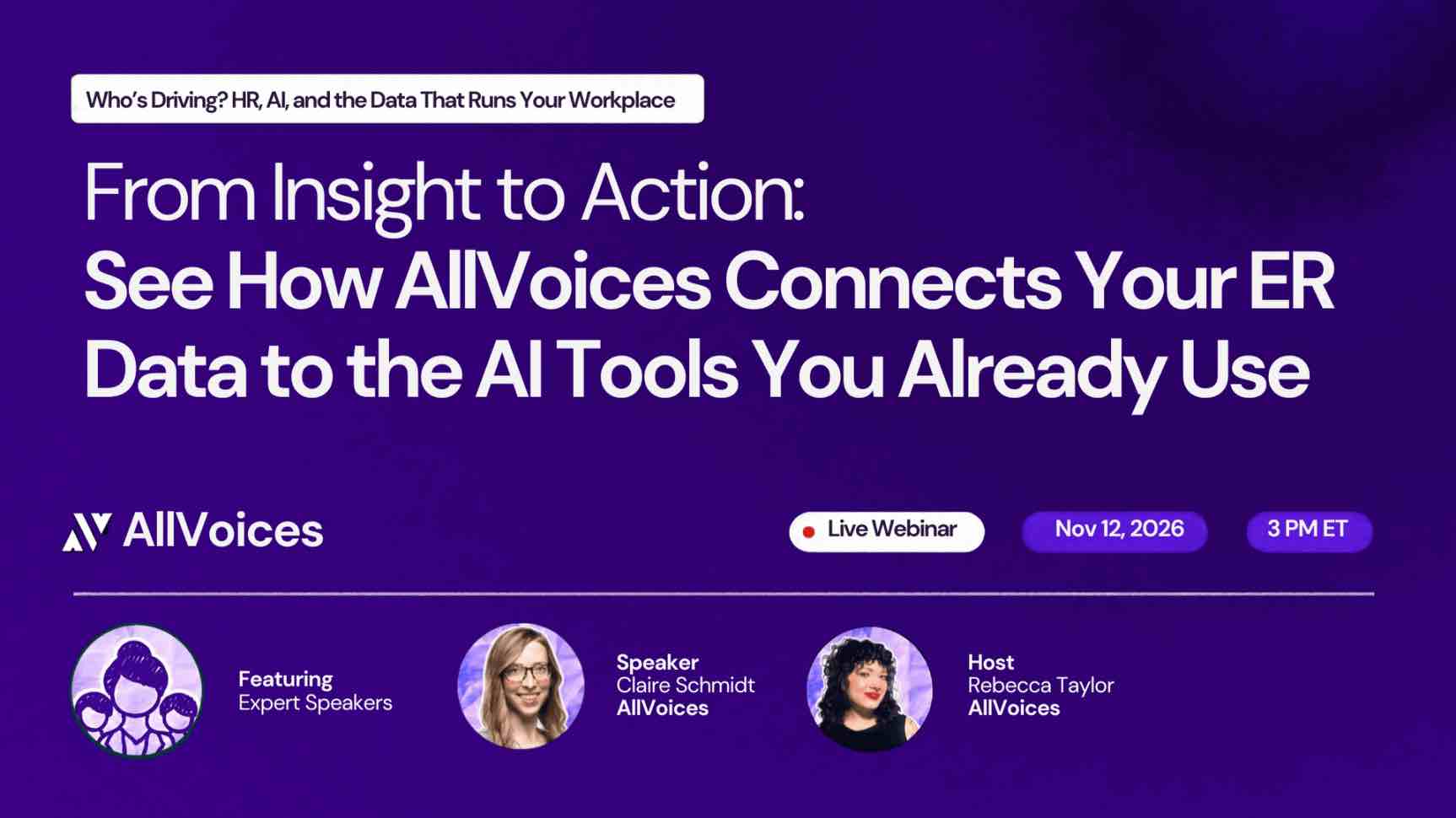
Our next webinar
Frequently asked questions

Got more questions? Email us at support@allvoices.co and we'll respond ASAP.

No items found.
Frequently asked questions

Got more questions? Email us at support@allvoices.co and we'll respond ASAP.

No items found.
Creating Meaningful Personal Moments with Tracy Tobin, Chief People Officer at AdSwerve
Episode 335
About This Episode
In this episode of Reimagining Company Culture, we’re chatting with Tracy Tobin, Chief People Officer at AdSwerve. Tracy is the company’s first to lead employee growth and development initiatives. Tune in to learn Tracy’s thoughts on modeling key behavior, defining and creating employee connectivity, the unique role of managers, and more!
About The Guest
Tracy Tobin is the Chief People Officer (CPO) of Adswerve, a leading Google Marketing Platform Consultancy, and Partner. She is the company’s first to lead employee growth and development initiatives. Tobin joins Adswerve with a distinguished career of over 20 years, most recently serving as Vice President of Human Resources at The Integer Group, a leading agency, and a member of The Omnicom Group. Tobin oversaw HR operations for 1,000 associates while at The Integer Group. Before that, she led HR teams at PHD USA, BBDO Detroit, and FCB Worldwide.
Episode Transcription

Most companies invest in big employee experience programs and underinvest in the small moments that actually shape how people feel about their job. The annual offsite, the all-hands, the recognition program at the end of the year. Those matter, but they are not what employees remember. On this episode of Reimagining Company Culture, Tracy Tobin, Chief People Officer at Adswerve, makes the case for building the small moments deliberately and treating them as the actual employee experience.

Tracy has spent her career inside companies where the People function had to do more with less. The small-moments approach came out of that constraint. The cost of designing for small moments is low, the consistency they create is high, and employees report on them in surveys for years.

Here is what designing for small, repeatable, personal moments looks like as a People-team discipline.

Why the Big Programs Are Not What Employees Remember

When you ask employees what made them feel valued at work, they almost never name the big offsite. They name a manager who remembered something about their family, the way a layoff was communicated to a friend, the moment somebody senior asked their opinion in a meeting. According to Gallup data on US employee engagement, only 21% of employees strongly agree that their manager explains how culture impacts their role, which is a small-moments problem more than a programs problem.

The small-moments thesis is that employee experience is not built in the budget meeting. It is built in the way managers actually run their week. employee engagement work programs that ignore this end up generating attendance numbers but not feeling. The trick is to design for moments managers can repeat without effort.

How HR Teams Design for Small, Personal Moments

What kind of moments matter most to employees?

The first day, the first week, the first hard week, the first major win, the first significant feedback conversation, the moment of a promotion, and the moment of a transition or departure. These are the inflection points where employees decide whether the company is a place worth investing in. structured employee onboarding sits at the start of that list and is the most underinvested moment in most companies.

How do managers create personal moments without making them feel forced?

By being specific. Generic recognition is worse than no recognition because employees can tell it was generated for the sake of recognition. A specific note about a real piece of work that the manager paid attention to is what carries the signal. The manager's job is to notice, not to perform. situational leadership habits is the discipline that makes this consistent across teams.

What Actually Works in Designing Personal Moments

Inventory the moments that already happen

Most companies already have a moments calendar. Onboarding, anniversaries, milestones. The first move is to look at how those moments are run today and decide which ones are landing and which ones are theater. The audit usually surfaces ten low-cost wins.

Train managers in the small skills

Noticing, naming, and remembering are the three skills. None of them require a leadership development budget. They require the manager to do five minutes of preparation before a one-on-one. performance management cycle conversations cycles get sharper when managers actually prepare.

Make the personal moments visible

Recognition only compounds when others see it. Public moments raise the bar and signal what behavior is valued. The recognition does not have to be loud. It has to be visible enough that the rest of the team understands what got noticed.

The pattern the guest describes on this episode lines up with broader research. The SHRM research on the future of work reinforces the operating-model lens and gives HR leaders a useful reference for grounding the conversation in numbers their CEOs and CFOs already trust. It also surfaces the same gap between stated culture priorities and how People work actually runs inside most organizations.

Where Employee Relations Fits

Personal moments matter most when something has gone wrong. The way a manager handles a personal crisis, an investigation, or a difficult feedback conversation is what employees carry. employee relations operations is the function that owns the hardest of those moments and the one most sensitive to small-moment quality.

the Vera AI co-pilot helps ER teams handle the cadence of communication during a case. Reporters get acknowledgment. Investigators get tooling. The moments inside an investigation that an employee remembers, the calm of the intake call or the quality of the close-out conversation, are what shape whether they trust the next round of communication from the company.

How do personal moments translate into ER outcomes?

The quality of the small communications during an ER case shapes the employee's long-term trust in the company. AllVoices supports those communications with structured intake, status updates, and case documentation. ER teams handle moments at scale without losing the personal feel.

The pattern across AllVoices customers is consistent. ER teams that operate on a single workflow handle more cases at higher quality with the same headcount. The structured intake reduces the time between an employee raising a concern and the case being triaged. The case management layer keeps the documentation tight so investigations hold up to legal and audit review. The reporting layer surfaces the patterns leadership needs to act on structural issues rather than handling each case in isolation. That combination is what lets People teams treat ER as a strategic function rather than a reactive one.

Frequently Asked Questions About Personal Moments at Work

What does it mean to create meaningful personal moments at work?

It means designing the small interactions that shape employee experience deliberately. Onboarding details, recognition language, and how managers handle one-on-ones all qualify. The discipline is in the consistency, not the scale.

Which employee moments matter most for retention?

Onboarding, the first hard week, the first major feedback conversation, anniversaries, and transitions. Each of these is a decision point where employees recalibrate their commitment to the company.

How do you make recognition feel personal at scale?

Train managers to be specific. Generic recognition reads as performative. A specific reference to a real piece of work, written by the person who saw it, is what carries weight. Tooling helps, but the words matter most.

How do small moments connect to broader company culture?

Culture is the sum of the small moments. The values on the wall do not move culture. The way a manager handles a Friday afternoon conversation does. Small moments are the operating layer of culture.

How does HR scale personal moments across a large workforce?

Document the moments calendar, train managers on the small skills, and use tooling to make the practice consistent across teams. Scale is about defaults, not heroics. The company that defaults to noticing builds the strongest culture.

The Bottom Line for HR Leaders

Personal moments are the operating layer of employee experience. The big programs matter, but the small moments are what employees remember and what shapes their trust in the company over time. Tracy's framing in this episode is a reminder that culture work is mostly small and repeatable.

If you are auditing employee experience, the place to start is the moments calendar. Look at what already happens, decide which moments are landing, and rebuild the ones that are theater. The compound effect over a year is bigger than any single program initiative.

The conversation in this episode underlines a pattern AllVoices has seen across hundreds of People teams. Programming alone does not move the operating model. The structural work, the manager development, the ER infrastructure, and the listening cycles that close visibly are what produce the outcomes the company can actually measure. That is the work the function will be evaluated on over the next several years, and the People leaders who do it well will keep earning bigger seats at the table. For HR teams looking to start, the move that pays off fastest is usually the operational one. Audit one process this quarter. Pick the structural change with the highest impact. Build the documentation around it. Close the loop with employees so they can see what changed and why. The compound effect of doing that consistently across a year is bigger than any single program initiative. The People teams that take this approach end up running cultures that hold up under stress and operating models that the rest of the C-suite trusts. That is the standard the function is moving toward, and the AllVoices customer base is full of teams already getting there.

If you want to see how AllVoices supports the small-moment quality of ER work, you can request a walkthrough of the platform. Book a tour of AllVoices.

Want to learn more?
See the power of AllVoices today
Thank you! We look forward to meeting you soon
Oops! Something went wrong while submitting the form.
Frequently asked questions

Got more questions? Email us at support@allvoices.co and we'll respond ASAP.

No items found.
Frequently asked questions

Got more questions? Email us at support@allvoices.co and we'll respond ASAP.

No items found.