About This Episode
In this episode of Reimagining Company Culture, we’re chatting with Devon O’Nalty, Director of Diversity and Inclusion at NBC Sports Group. Devin has proven experience spearheading DE&I strategy, collaborating with talent acquisition, removing barriers and promoting equitable opportunities for all. Tune in to learn Devon’s thoughts on measuring DEIB progress, taking a stand as a company or leader, equity-driven leadership, and more!
About The Guest
Devon O’Nalty is the new Director of Diversity and Inclusion at NBC Sports Group. Prior to accepting this role at NBC, Devon served as the Director of Diversity, Equity, and Inclusion at AVANGRID – a leading sustainable energy company based in Orange, CT. While there, he spearheaded the organization’s DE&I strategy, served as a strategic business partner to leaders at all levels of the organization, collaborated with talent acquisition on establishing comprehensive and measurable recruiting strategies to increase diverse representation, focused on building internal and external communities in and outside of AVANGRID, all while removing barriers and promoting equitable opportunities for all. In his spare time, O’Nalty serves as the Head Diving Coach for Fairfield University where he was recently named “Diving Coach of the Year '' for the 2021 – 2022 season. Additionally, he volunteers for several organizations including the University of Connecticut’s HR Management Black Student & Alumni Union, Marist College Alumni Board, and the Workplace – a Workforce Development Board that serves the community in southwestern Connecticut. O’Nalty holds a MS in HR Management from the University of Connecticut, a MS in Management and Organizational Leadership from Albertus Magnus College, and a BA in Communications from Marist College.
Episode Breakdown

Most retention conversations focus on compensation and benefits. Both matter, and both have a ceiling. After a certain point, employees do not stay because of pay. They stay because of the people. The community at work is the part of the retention picture most companies underinvest in. On this episode of Reimagining Company Culture, Devon O'Nalty walks through what it takes to build community at work and why that work pays off in retention numbers that compensation alone cannot reach.

Devon's perspective comes from years inside companies that tried both approaches and saw the results in retention data. The pattern was consistent. Companies that built strong internal community held employees longer and at lower cost than companies that competed primarily on pay.

Here is what investing in community at work looks like as an HR discipline and why the work compounds over time.

Why Community Outperforms Compensation in Retention

Compensation has a ceiling. Once employees feel paid fairly, additional money produces less and less retention impact. According to Gallup State of the Global Workplace research, engagement and culture issues account for the majority of voluntary turnover, far outweighing pure pay or benefits. Community sits inside that engagement and culture bucket and is one of the most useful parts.

The companies that win on retention have built communities employees do not want to leave. The communities can take many forms. Tight teams. Strong manager relationships. Active employee resource groups. Cross-functional projects with real ownership. employee retention rates numbers move when these communities are strong.

How HR Teams Build Real Community at Work

What is the difference between community and engagement?

Engagement is how employees feel about their work. Community is how they feel about each other. Both matter and they reinforce each other, but the interventions are different. Engagement work focuses on the manager and the role. Community work focuses on the relationships across the team and across the company.

How do you build community without making it feel forced?

By creating the conditions for community rather than mandating it. Shared projects, cross-functional teams, regular cadences for connection, and infrastructure for affinity groups all help. Forced community-building events tend to feel performative. Conditions that make community natural tend to compound.

What Actually Works in Building Workplace Community

Invest in cross-functional connection

Cross-functional projects with real ownership build community faster than any team-building event. Employees who work together on something meaningful build trust naturally. The HR job is to create the conditions for those projects to exist.

Support employee-led groups

Affinity groups, interest groups, and project communities all build connection if they are properly resourced. The companies that get this right give the groups budget, executive sponsorship, and time during the workweek.

Make connection visible across the organization

Recognition programs, internal newsletters, and visible cross-team collaboration all reinforce that the company values connection. Visibility is what turns community work from a side project into a cultural priority.

The pattern the guest describes on this episode lines up with broader research. The Deloitte Global Human Capital Trends report reinforces the operating-model lens and gives HR leaders a useful reference for grounding the conversation in numbers their CEOs and CFOs already trust. It also surfaces the same gap between stated culture priorities and how People work actually runs inside most organizations.

Where Employee Relations Fits

Community work runs into ER work when interpersonal dynamics break down. Conflict between team members, manager-employee tension, and group-based exclusion all eventually surface as ER cases. The way these are handled either reinforces the community or breaks it.

employee relations operations teams that operate with consistency build community even through difficult cases. Employees see that the process is fair and that the community is protected. HR case management workflow provides the workflow rigor that makes consistency possible.

How does ER work support community building?

ER work that is consistent, transparent, and well-documented sends a signal to the broader workforce that the community is protected. AllVoices gives ER teams the workflow tools to handle cases at the standard the community needs.

The pattern across AllVoices customers is consistent. ER teams that operate on a single workflow handle more cases at higher quality with the same headcount. The structured intake reduces the time between an employee raising a concern and the case being triaged. The case management layer keeps the documentation tight so investigations hold up to legal and audit review. The reporting layer surfaces the patterns leadership needs to act on structural issues rather than handling each case in isolation. That combination is what lets People teams treat ER as a strategic function rather than a reactive one.

Frequently Asked Questions About Community-Driven Retention

How does workplace community affect employee retention?

Strong workplace community correlates with longer tenure and higher engagement. Once compensation is at market, the relationships at work are the strongest predictor of whether employees stay or leave.

What is the difference between community and engagement?

Engagement is how employees feel about their work. Community is how they feel about each other. Both matter, and the interventions are different. Engagement work centers on the manager and role. Community work centers on the relationships across the team.

How do you build community in a hybrid workforce?

Through deliberate cadences for connection, shared cross-functional projects, and supported employee-led groups. Hybrid work makes community harder, which is why it has to be designed deliberately rather than allowed to happen.

Are employee resource groups effective community builders?

Yes when properly resourced. Groups that get budget, executive sponsorship, and time during the workweek build real community. Groups that exist on paper without resourcing produce activity without impact.

How does ER work affect workplace community?

ER cases test the strength of the community. Cases handled with consistency and transparency reinforce trust. Cases handled poorly break it, often permanently. Clean ER work is part of the community infrastructure.

The Bottom Line for HR Leaders

Community is one of the most underinvested parts of the retention picture. Compensation and benefits matter, and they have a ceiling. Community keeps compounding past the point where pay stops moving the number.

Devon's framing in the episode is a reminder that the relationships employees build at work are part of the asset the company is creating. The HR job is to design the conditions for those relationships to form and to protect them when conflict happens.

For HR leaders working through this from a broader operations angle, the AllVoices references on employee engagement programs, retention strategy work, and turnover rate dynamics cover the adjacent ground in more depth. They are useful companions to the conversation in this episode.

The conversation in this episode underlines a pattern AllVoices has seen across hundreds of People teams. Programming alone does not move the operating model. The structural work, the manager development, the ER infrastructure, and the listening cycles that close visibly are what produce the outcomes the company can actually measure. That is the work the function will be evaluated on over the next several years, and the People leaders who do it well will keep earning bigger seats at the table. For HR teams looking to start, the move that pays off fastest is usually the operational one. Audit one process this quarter. Pick the structural change with the highest impact. Build the documentation around it. Close the loop with employees so they can see what changed and why. The compound effect of doing that consistently across a year is bigger than any single program initiative. The People teams that take this approach end up running cultures that hold up under stress and operating models that the rest of the C-suite trusts. That is the standard the function is moving toward, and the AllVoices customer base is full of teams already getting there.

If you want to see how AllVoices supports the ER side of protecting workplace community, you can schedule a tour. Book a tour of AllVoices.
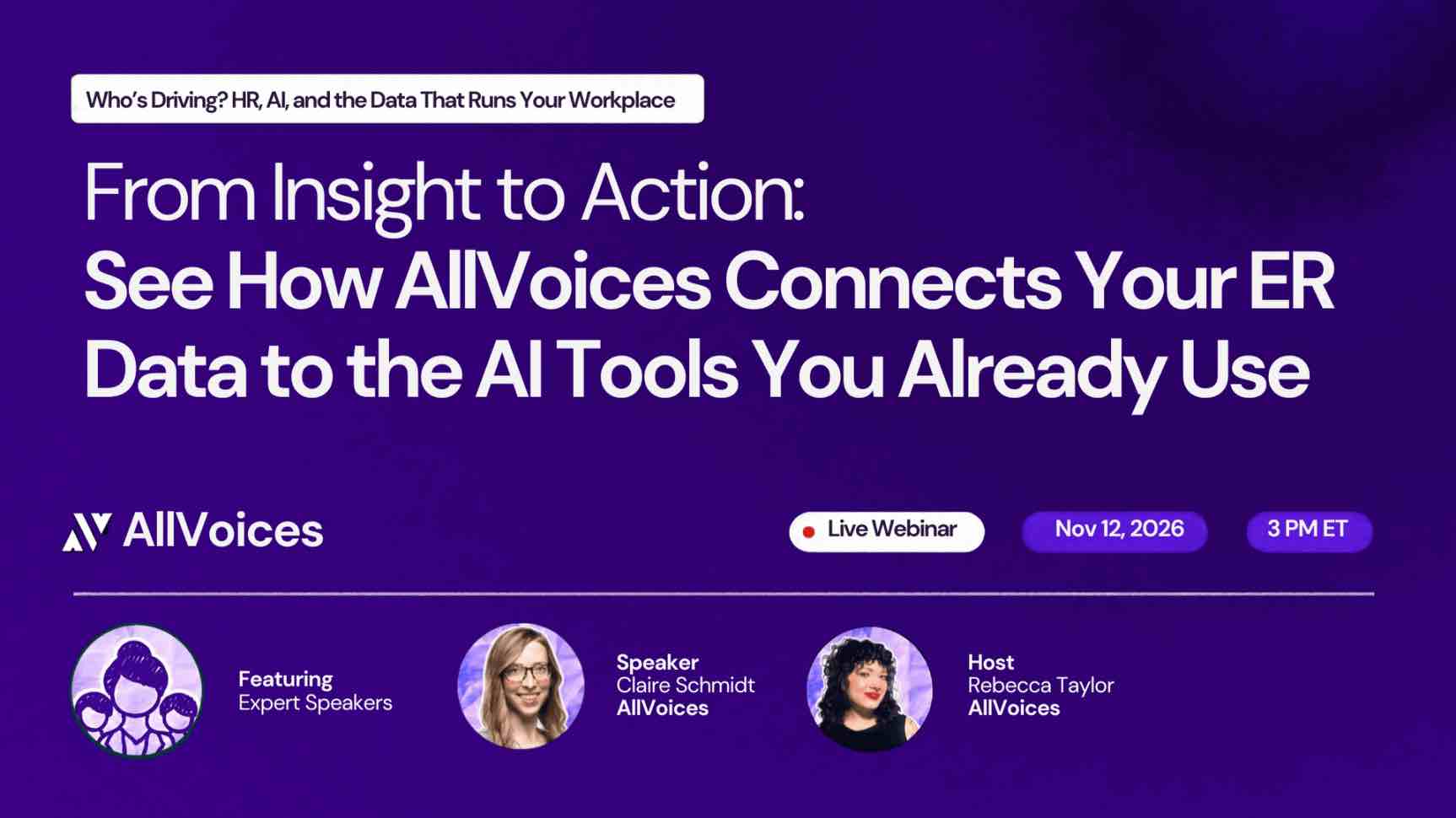
Our next webinar
Frequently asked questions

Got more questions? Email us at support@allvoices.co and we'll respond ASAP.

No items found.
Frequently asked questions

Got more questions? Email us at support@allvoices.co and we'll respond ASAP.

No items found.
Devon O’Nalty, Director of Diversity and Inclusion at NBC Sports Group - Creating Community & Retention
Episode 284
About This Episode
In this episode of Reimagining Company Culture, we’re chatting with Devon O’Nalty, Director of Diversity and Inclusion at NBC Sports Group. Devin has proven experience spearheading DE&I strategy, collaborating with talent acquisition, removing barriers and promoting equitable opportunities for all. Tune in to learn Devon’s thoughts on measuring DEIB progress, taking a stand as a company or leader, equity-driven leadership, and more!
About The Guest
Devon O’Nalty is the new Director of Diversity and Inclusion at NBC Sports Group. Prior to accepting this role at NBC, Devon served as the Director of Diversity, Equity, and Inclusion at AVANGRID – a leading sustainable energy company based in Orange, CT. While there, he spearheaded the organization’s DE&I strategy, served as a strategic business partner to leaders at all levels of the organization, collaborated with talent acquisition on establishing comprehensive and measurable recruiting strategies to increase diverse representation, focused on building internal and external communities in and outside of AVANGRID, all while removing barriers and promoting equitable opportunities for all. In his spare time, O’Nalty serves as the Head Diving Coach for Fairfield University where he was recently named “Diving Coach of the Year '' for the 2021 – 2022 season. Additionally, he volunteers for several organizations including the University of Connecticut’s HR Management Black Student & Alumni Union, Marist College Alumni Board, and the Workplace – a Workforce Development Board that serves the community in southwestern Connecticut. O’Nalty holds a MS in HR Management from the University of Connecticut, a MS in Management and Organizational Leadership from Albertus Magnus College, and a BA in Communications from Marist College.
Episode Transcription

Most retention conversations focus on compensation and benefits. Both matter, and both have a ceiling. After a certain point, employees do not stay because of pay. They stay because of the people. The community at work is the part of the retention picture most companies underinvest in. On this episode of Reimagining Company Culture, Devon O'Nalty walks through what it takes to build community at work and why that work pays off in retention numbers that compensation alone cannot reach.

Devon's perspective comes from years inside companies that tried both approaches and saw the results in retention data. The pattern was consistent. Companies that built strong internal community held employees longer and at lower cost than companies that competed primarily on pay.

Here is what investing in community at work looks like as an HR discipline and why the work compounds over time.

Why Community Outperforms Compensation in Retention

Compensation has a ceiling. Once employees feel paid fairly, additional money produces less and less retention impact. According to Gallup State of the Global Workplace research, engagement and culture issues account for the majority of voluntary turnover, far outweighing pure pay or benefits. Community sits inside that engagement and culture bucket and is one of the most useful parts.

The companies that win on retention have built communities employees do not want to leave. The communities can take many forms. Tight teams. Strong manager relationships. Active employee resource groups. Cross-functional projects with real ownership. employee retention rates numbers move when these communities are strong.

How HR Teams Build Real Community at Work

What is the difference between community and engagement?

Engagement is how employees feel about their work. Community is how they feel about each other. Both matter and they reinforce each other, but the interventions are different. Engagement work focuses on the manager and the role. Community work focuses on the relationships across the team and across the company.

How do you build community without making it feel forced?

By creating the conditions for community rather than mandating it. Shared projects, cross-functional teams, regular cadences for connection, and infrastructure for affinity groups all help. Forced community-building events tend to feel performative. Conditions that make community natural tend to compound.

What Actually Works in Building Workplace Community

Invest in cross-functional connection

Cross-functional projects with real ownership build community faster than any team-building event. Employees who work together on something meaningful build trust naturally. The HR job is to create the conditions for those projects to exist.

Support employee-led groups

Affinity groups, interest groups, and project communities all build connection if they are properly resourced. The companies that get this right give the groups budget, executive sponsorship, and time during the workweek.

Make connection visible across the organization

Recognition programs, internal newsletters, and visible cross-team collaboration all reinforce that the company values connection. Visibility is what turns community work from a side project into a cultural priority.

The pattern the guest describes on this episode lines up with broader research. The Deloitte Global Human Capital Trends report reinforces the operating-model lens and gives HR leaders a useful reference for grounding the conversation in numbers their CEOs and CFOs already trust. It also surfaces the same gap between stated culture priorities and how People work actually runs inside most organizations.

Where Employee Relations Fits

Community work runs into ER work when interpersonal dynamics break down. Conflict between team members, manager-employee tension, and group-based exclusion all eventually surface as ER cases. The way these are handled either reinforces the community or breaks it.

employee relations operations teams that operate with consistency build community even through difficult cases. Employees see that the process is fair and that the community is protected. HR case management workflow provides the workflow rigor that makes consistency possible.

How does ER work support community building?

ER work that is consistent, transparent, and well-documented sends a signal to the broader workforce that the community is protected. AllVoices gives ER teams the workflow tools to handle cases at the standard the community needs.

The pattern across AllVoices customers is consistent. ER teams that operate on a single workflow handle more cases at higher quality with the same headcount. The structured intake reduces the time between an employee raising a concern and the case being triaged. The case management layer keeps the documentation tight so investigations hold up to legal and audit review. The reporting layer surfaces the patterns leadership needs to act on structural issues rather than handling each case in isolation. That combination is what lets People teams treat ER as a strategic function rather than a reactive one.

Frequently Asked Questions About Community-Driven Retention

How does workplace community affect employee retention?

Strong workplace community correlates with longer tenure and higher engagement. Once compensation is at market, the relationships at work are the strongest predictor of whether employees stay or leave.

What is the difference between community and engagement?

Engagement is how employees feel about their work. Community is how they feel about each other. Both matter, and the interventions are different. Engagement work centers on the manager and role. Community work centers on the relationships across the team.

How do you build community in a hybrid workforce?

Through deliberate cadences for connection, shared cross-functional projects, and supported employee-led groups. Hybrid work makes community harder, which is why it has to be designed deliberately rather than allowed to happen.

Are employee resource groups effective community builders?

Yes when properly resourced. Groups that get budget, executive sponsorship, and time during the workweek build real community. Groups that exist on paper without resourcing produce activity without impact.

How does ER work affect workplace community?

ER cases test the strength of the community. Cases handled with consistency and transparency reinforce trust. Cases handled poorly break it, often permanently. Clean ER work is part of the community infrastructure.

The Bottom Line for HR Leaders

Community is one of the most underinvested parts of the retention picture. Compensation and benefits matter, and they have a ceiling. Community keeps compounding past the point where pay stops moving the number.

Devon's framing in the episode is a reminder that the relationships employees build at work are part of the asset the company is creating. The HR job is to design the conditions for those relationships to form and to protect them when conflict happens.

For HR leaders working through this from a broader operations angle, the AllVoices references on employee engagement programs, retention strategy work, and turnover rate dynamics cover the adjacent ground in more depth. They are useful companions to the conversation in this episode.

The conversation in this episode underlines a pattern AllVoices has seen across hundreds of People teams. Programming alone does not move the operating model. The structural work, the manager development, the ER infrastructure, and the listening cycles that close visibly are what produce the outcomes the company can actually measure. That is the work the function will be evaluated on over the next several years, and the People leaders who do it well will keep earning bigger seats at the table. For HR teams looking to start, the move that pays off fastest is usually the operational one. Audit one process this quarter. Pick the structural change with the highest impact. Build the documentation around it. Close the loop with employees so they can see what changed and why. The compound effect of doing that consistently across a year is bigger than any single program initiative. The People teams that take this approach end up running cultures that hold up under stress and operating models that the rest of the C-suite trusts. That is the standard the function is moving toward, and the AllVoices customer base is full of teams already getting there.

If you want to see how AllVoices supports the ER side of protecting workplace community, you can schedule a tour. Book a tour of AllVoices.

Want to learn more?
See the power of AllVoices today
Thank you! We look forward to meeting you soon
Oops! Something went wrong while submitting the form.
Frequently asked questions

Got more questions? Email us at support@allvoices.co and we'll respond ASAP.

No items found.
Frequently asked questions

Got more questions? Email us at support@allvoices.co and we'll respond ASAP.

No items found.