About This Episode
In this episode of Reimagining Company Culture, we’re chatting with Emily Olinger, Chief People Officer at Monolith. She has 16 years of overall experience with various perspectives on organizational management. Tune in to learn Emily’s thoughts on the unique role of CPOs to be a culture conduit, the current perception of HR, organizationally designing teams, and more!
About The Guest
Emily earned a Bachelor of Arts in Psychology with a Minor in Mathematics from the University of Nebraska-Lincoln. She brings 16 years of overall experience with various perspectives on organizational management. Her most recent experience was 7 years as Chief People Officer at Spreetail where she scaled the organization from 100 to 1,600 people and built out the HR organization from 1 to over 70 today. During her tenure at Spreetail, they expanded from 3 locations to 8. She oversees talent acquisition, talent management including leadership coaching and onboarding, HR business partnership including employee relations, Total Rewards, HRIS and People Operations including communications and employee experience. Emily most recently joined Monolith as the Chief People Officer. Emily will be a member of the executive leadership team and be responsible for providing the overall people leadership and strategy for the company. She will build a scalable, best-in-class Human Resources function, with oversight of all aspects of HR management including talent acquisition, talent management, leadership development, compensation and benefits, compliance, succession planning, employee engagement, diversity and inclusion, and HR operations. She will serve as a strategic business partner and adviser to the CEO and executive management and set and drive people-related strategies in support of all Monolith employees.
Episode Breakdown

The gap between what a company says about its culture and what employees actually experience is the most expensive thing People teams routinely tolerate. The gap shows up in retention, in engagement scores, in trust numbers, and in the unspoken rules of how things really get done. On this episode of Reimagining Company Culture, Emily Olinger walks through how HR leaders close the gap between culture words and culture actions and why the work is one of the highest-impact things a People team can do.

Emily's perspective comes from companies that ran the experiment of either tolerating the gap or closing it. The pattern is consistent. The companies that closed the gap built the kind of trust that survives difficult quarters. The companies that tolerated it watched the trust erode quietly until it was too late to recover.

Here is what closing the words-actions gap looks like as an HR practice and why most companies underestimate the cost of leaving it open.

Why the Words-Actions Gap Is the Most Expensive Culture Problem

Employees notice the gap before leadership does. They notice it in how decisions get made, how complaints get handled, how promotions get awarded, and how difficult conversations get avoided. According to Gallup data on US employee engagement, only 21% of employees strongly agree that their manager explains how culture impacts their role, which is a gap problem more than a programming problem.

The cost compounds. Every time the gap is observed and unaddressed, it gets harder to close. Employees stop trusting the language. Leaders stop pushing for accountability because the gap is normalized. organizational culture as a system drifts in the direction of the actual behavior, regardless of what is on the wall.

How HR Teams Close the Gap Between Words and Actions

Where does the gap usually show up first?

In the difficult moments. Investigations, performance issues, layoffs, and policy disputes are where the gap is most visible. The way these moments are handled is the lived experience of the culture for the employees involved. employee relations practice programs that operate inconsistently are the most common gap source.

How do you close the gap in practice?

Through accountability for behaviors that contradict the values. Through structural changes that make the values harder to ignore. And through visible action when the gap is discovered. The work is mechanical and durable rather than aspirational.

What Actually Works in Closing the Gap

Audit the moments where the gap shows up

Inventory the recent decisions where employees would have noticed inconsistency. Investigations, terminations, promotions, and layoffs are the usual sources. The audit is the diagnostic the rest of the work depends on.

Hold managers accountable for behavior

The values only become real when consequences for ignoring them are real. Manager scorecards, performance review criteria, and ER outcomes all need to reflect the values. Without that, the words remain decorative.

Communicate the close visibly

Closing the gap in private produces no benefit. Communicating what was wrong, what changed, and why is what restores trust. The visibility is part of the discipline.

The pattern the guest describes on this episode lines up with broader research. The SHRM research on the future of work reinforces the operating-model lens and gives HR leaders a useful reference for grounding the conversation in numbers their CEOs and CFOs already trust. It also surfaces the same gap between stated culture priorities and how People work actually runs inside most organizations.

Where Employee Relations Fits

ER work is the most common place the gap shows up and the most important place to close it. Cases handled inconsistently destroy the trust that the values claim to be building. Cases handled consistently rebuild the trust faster than any communication campaign.

HR case management software provides the documentation and workflow rigor that lets ER teams operate with the consistency the closure requires. the Vera AI co-pilot adds AI assistance that makes that consistency feasible at scale.

How does AllVoices help close the words-actions gap in ER?

AllVoices gives ER teams structured intake, calibrated investigation processes, and reporting that surfaces inconsistency. The infrastructure makes it harder to handle similar cases differently across teams or business units, which is the most common gap source.

The pattern across AllVoices customers is consistent. ER teams that operate on a single workflow handle more cases at higher quality with the same headcount. The structured intake reduces the time between an employee raising a concern and the case being triaged. The case management layer keeps the documentation tight so investigations hold up to legal and audit review. The reporting layer surfaces the patterns leadership needs to act on structural issues rather than handling each case in isolation. That combination is what lets People teams treat ER as a strategic function rather than a reactive one.

Frequently Asked Questions About Aligning Culture Words and Actions

What is the words-actions gap in company culture?

It is the gap between what the company says about its culture and what employees actually experience. The gap shows up in difficult moments and erodes trust over time when left unaddressed.

Where does the gap usually show up first?

In investigations, performance issues, layoffs, and policy disputes. The way these difficult moments are handled is the most direct test of whether the culture words match the culture actions.

How do you close the gap structurally?

Through accountability for behaviors that contradict the values, structural changes that make the values harder to ignore, and visible action when inconsistencies are discovered. The work is operational rather than aspirational.

Why does the gap compound over time?

Because every time the gap is observed and unaddressed, employees become less likely to trust the language. The trust erosion is often invisible until it shows up in retention numbers or engagement scores.

How does ER work intersect with the gap?

ER cases are the most common place the gap shows up. Inconsistent ER outcomes destroy the trust the culture claims to build. Consistent ER work is one of the most durable ways to close the gap.

The Bottom Line for HR Leaders

The gap between culture words and culture actions is the most expensive thing People teams routinely tolerate. Closing the gap is operational work that pays off in retention, in trust, and in the quality of the decisions the company is able to make.

Emily's framing in the episode is a useful reminder that culture is observable. Either the actions match the words or they do not. The People teams that take the gap seriously build cultures that hold up. The ones that ignore it watch the trust erode.

For HR leaders working through this from a broader operations angle, the AllVoices references on company culture operations and values statement design cover the adjacent ground in more depth. Both are useful companions to the conversation in this episode.

The conversation in this episode underlines a pattern AllVoices has seen across hundreds of People teams. Programming alone does not move the operating model. The structural work, the manager development, the ER infrastructure, and the listening cycles that close visibly are what produce the outcomes the company can actually measure. That is the work the function will be evaluated on over the next several years, and the People leaders who do it well will keep earning bigger seats at the table. For HR teams looking to start, the move that pays off fastest is usually the operational one. Audit one process this quarter. Pick the structural change with the highest impact. Build the documentation around it. Close the loop with employees so they can see what changed and why. The compound effect of doing that consistently across a year is bigger than any single program initiative. The People teams that take this approach end up running cultures that hold up under stress and operating models that the rest of the C-suite trusts. That is the standard the function is moving toward, and the AllVoices customer base is full of teams already getting there.

If you want to see how AllVoices supports the consistency that closes the culture gap in ER work, you can schedule a tour. Book a tour of AllVoices.
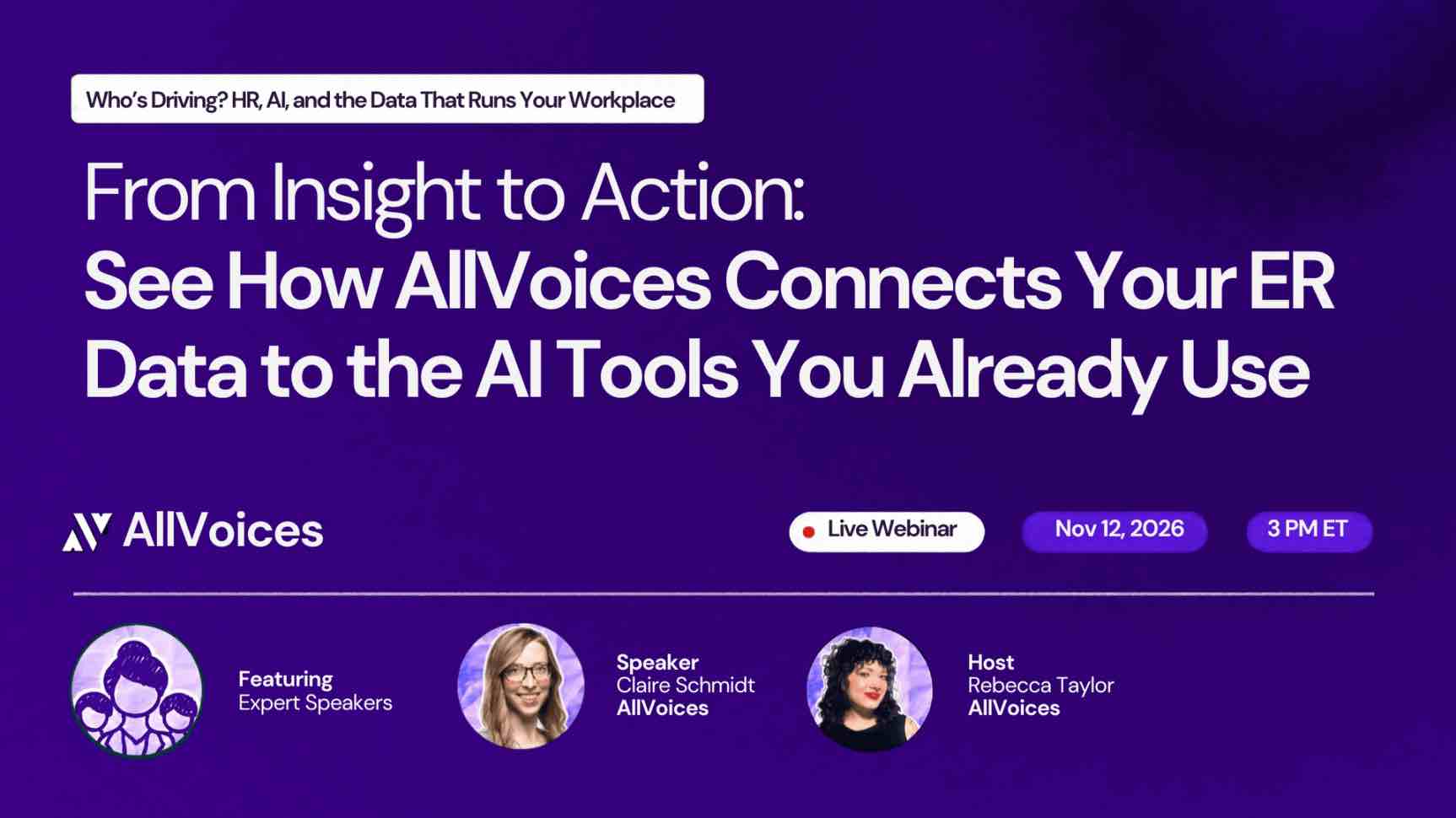
Our next webinar
Frequently asked questions

Got more questions? Email us at support@allvoices.co and we'll respond ASAP.

No items found.
Frequently asked questions

Got more questions? Email us at support@allvoices.co and we'll respond ASAP.

No items found.
Emily Olinger, Chief People Officer at Monolith - Align Your Culture, Words & Actions
Episode 271
About This Episode
In this episode of Reimagining Company Culture, we’re chatting with Emily Olinger, Chief People Officer at Monolith. She has 16 years of overall experience with various perspectives on organizational management. Tune in to learn Emily’s thoughts on the unique role of CPOs to be a culture conduit, the current perception of HR, organizationally designing teams, and more!
About The Guest
Emily earned a Bachelor of Arts in Psychology with a Minor in Mathematics from the University of Nebraska-Lincoln. She brings 16 years of overall experience with various perspectives on organizational management. Her most recent experience was 7 years as Chief People Officer at Spreetail where she scaled the organization from 100 to 1,600 people and built out the HR organization from 1 to over 70 today. During her tenure at Spreetail, they expanded from 3 locations to 8. She oversees talent acquisition, talent management including leadership coaching and onboarding, HR business partnership including employee relations, Total Rewards, HRIS and People Operations including communications and employee experience. Emily most recently joined Monolith as the Chief People Officer. Emily will be a member of the executive leadership team and be responsible for providing the overall people leadership and strategy for the company. She will build a scalable, best-in-class Human Resources function, with oversight of all aspects of HR management including talent acquisition, talent management, leadership development, compensation and benefits, compliance, succession planning, employee engagement, diversity and inclusion, and HR operations. She will serve as a strategic business partner and adviser to the CEO and executive management and set and drive people-related strategies in support of all Monolith employees.
Episode Transcription

The gap between what a company says about its culture and what employees actually experience is the most expensive thing People teams routinely tolerate. The gap shows up in retention, in engagement scores, in trust numbers, and in the unspoken rules of how things really get done. On this episode of Reimagining Company Culture, Emily Olinger walks through how HR leaders close the gap between culture words and culture actions and why the work is one of the highest-impact things a People team can do.

Emily's perspective comes from companies that ran the experiment of either tolerating the gap or closing it. The pattern is consistent. The companies that closed the gap built the kind of trust that survives difficult quarters. The companies that tolerated it watched the trust erode quietly until it was too late to recover.

Here is what closing the words-actions gap looks like as an HR practice and why most companies underestimate the cost of leaving it open.

Why the Words-Actions Gap Is the Most Expensive Culture Problem

Employees notice the gap before leadership does. They notice it in how decisions get made, how complaints get handled, how promotions get awarded, and how difficult conversations get avoided. According to Gallup data on US employee engagement, only 21% of employees strongly agree that their manager explains how culture impacts their role, which is a gap problem more than a programming problem.

The cost compounds. Every time the gap is observed and unaddressed, it gets harder to close. Employees stop trusting the language. Leaders stop pushing for accountability because the gap is normalized. organizational culture as a system drifts in the direction of the actual behavior, regardless of what is on the wall.

How HR Teams Close the Gap Between Words and Actions

Where does the gap usually show up first?

In the difficult moments. Investigations, performance issues, layoffs, and policy disputes are where the gap is most visible. The way these moments are handled is the lived experience of the culture for the employees involved. employee relations practice programs that operate inconsistently are the most common gap source.

How do you close the gap in practice?

Through accountability for behaviors that contradict the values. Through structural changes that make the values harder to ignore. And through visible action when the gap is discovered. The work is mechanical and durable rather than aspirational.

What Actually Works in Closing the Gap

Audit the moments where the gap shows up

Inventory the recent decisions where employees would have noticed inconsistency. Investigations, terminations, promotions, and layoffs are the usual sources. The audit is the diagnostic the rest of the work depends on.

Hold managers accountable for behavior

The values only become real when consequences for ignoring them are real. Manager scorecards, performance review criteria, and ER outcomes all need to reflect the values. Without that, the words remain decorative.

Communicate the close visibly

Closing the gap in private produces no benefit. Communicating what was wrong, what changed, and why is what restores trust. The visibility is part of the discipline.

The pattern the guest describes on this episode lines up with broader research. The SHRM research on the future of work reinforces the operating-model lens and gives HR leaders a useful reference for grounding the conversation in numbers their CEOs and CFOs already trust. It also surfaces the same gap between stated culture priorities and how People work actually runs inside most organizations.

Where Employee Relations Fits

ER work is the most common place the gap shows up and the most important place to close it. Cases handled inconsistently destroy the trust that the values claim to be building. Cases handled consistently rebuild the trust faster than any communication campaign.

HR case management software provides the documentation and workflow rigor that lets ER teams operate with the consistency the closure requires. the Vera AI co-pilot adds AI assistance that makes that consistency feasible at scale.

How does AllVoices help close the words-actions gap in ER?

AllVoices gives ER teams structured intake, calibrated investigation processes, and reporting that surfaces inconsistency. The infrastructure makes it harder to handle similar cases differently across teams or business units, which is the most common gap source.

The pattern across AllVoices customers is consistent. ER teams that operate on a single workflow handle more cases at higher quality with the same headcount. The structured intake reduces the time between an employee raising a concern and the case being triaged. The case management layer keeps the documentation tight so investigations hold up to legal and audit review. The reporting layer surfaces the patterns leadership needs to act on structural issues rather than handling each case in isolation. That combination is what lets People teams treat ER as a strategic function rather than a reactive one.

Frequently Asked Questions About Aligning Culture Words and Actions

What is the words-actions gap in company culture?

It is the gap between what the company says about its culture and what employees actually experience. The gap shows up in difficult moments and erodes trust over time when left unaddressed.

Where does the gap usually show up first?

In investigations, performance issues, layoffs, and policy disputes. The way these difficult moments are handled is the most direct test of whether the culture words match the culture actions.

How do you close the gap structurally?

Through accountability for behaviors that contradict the values, structural changes that make the values harder to ignore, and visible action when inconsistencies are discovered. The work is operational rather than aspirational.

Why does the gap compound over time?

Because every time the gap is observed and unaddressed, employees become less likely to trust the language. The trust erosion is often invisible until it shows up in retention numbers or engagement scores.

How does ER work intersect with the gap?

ER cases are the most common place the gap shows up. Inconsistent ER outcomes destroy the trust the culture claims to build. Consistent ER work is one of the most durable ways to close the gap.

The Bottom Line for HR Leaders

The gap between culture words and culture actions is the most expensive thing People teams routinely tolerate. Closing the gap is operational work that pays off in retention, in trust, and in the quality of the decisions the company is able to make.

Emily's framing in the episode is a useful reminder that culture is observable. Either the actions match the words or they do not. The People teams that take the gap seriously build cultures that hold up. The ones that ignore it watch the trust erode.

For HR leaders working through this from a broader operations angle, the AllVoices references on company culture operations and values statement design cover the adjacent ground in more depth. Both are useful companions to the conversation in this episode.

The conversation in this episode underlines a pattern AllVoices has seen across hundreds of People teams. Programming alone does not move the operating model. The structural work, the manager development, the ER infrastructure, and the listening cycles that close visibly are what produce the outcomes the company can actually measure. That is the work the function will be evaluated on over the next several years, and the People leaders who do it well will keep earning bigger seats at the table. For HR teams looking to start, the move that pays off fastest is usually the operational one. Audit one process this quarter. Pick the structural change with the highest impact. Build the documentation around it. Close the loop with employees so they can see what changed and why. The compound effect of doing that consistently across a year is bigger than any single program initiative. The People teams that take this approach end up running cultures that hold up under stress and operating models that the rest of the C-suite trusts. That is the standard the function is moving toward, and the AllVoices customer base is full of teams already getting there.

If you want to see how AllVoices supports the consistency that closes the culture gap in ER work, you can schedule a tour. Book a tour of AllVoices.

Want to learn more?
See the power of AllVoices today
Thank you! We look forward to meeting you soon
Oops! Something went wrong while submitting the form.
Frequently asked questions

Got more questions? Email us at support@allvoices.co and we'll respond ASAP.

No items found.
Frequently asked questions

Got more questions? Email us at support@allvoices.co and we'll respond ASAP.

No items found.