About This Episode
In this episode of Reimagining Company Culture, we’re chatting with Victoria Hill, Director of Diversity & Social Impact at Advanced Group. Victoria has 15+ years of experience in the human resources marketplace. She is skilled in all aspects of Diversity, Equity, and Inclusion (DE&I), Leadership Development, and Human Resources Management. Tune in to learn Victoria’s thoughts on the unique role of employers in creating equity, showing up for the full lives of employees, equity-driven leadership, and more!
About The Guest
Victoria has 15+ years of experience in the human resources marketplace. She is skilled in all aspects of Diversity, Equity and Inclusion (DE&I), Leadership Development and Human Resources Management. Her focus is the human experience and building inclusive relationships. Victoria is currently working as the Director of Diversity and Social Impact for Advanced Group. Advanced Group offers contingent and permanent staffing solutions, talent acquisition and management, consulting, outsourcing, clinical research and professional services. In 2018 Victoria started and now leads the company’s Diversity, Equity & Inclusion Committee which focuses on awareness, training, recruitment process, and public relations. The DE& I Committee won its first award in 2019 from the American Staffing Association - ASA Care Honorable Mention and it’s second award in 2022 from the Staffing Industry Analyst – 2022 DEI Influencer. Victoria also facilitates Neurodiversity, Conscious Inclusion, Interview Bias, Bystander Intervention, Building Inclusive Relationships, and many other DE& I trainings for her organization as well as external partners. Victoria and her team develop diversity programs to promote unbiased decision-making while creating a safe space for employees to thrive. Victoria and her husband live in Chicagoland and enjoy hosting karaoke parties for fun and relaxation.
Episode Breakdown

Equity is one of those words that has stretched far enough to become unhelpful. Most companies use it to mean something general about fairness and end up with programming that does not produce specific outcomes. The reframe Victoria Hill offers is concrete. Equity means access. And once you frame it that way, the work becomes operational. On this episode of Reimagining Company Culture, Victoria walks through what it looks like to translate equity into access across hiring, performance, promotion, and ER work.

Victoria's perspective comes from years of running equity work that produced demographic results rather than activity. The pattern she describes is that the companies that translate equity into access make different operational choices than the companies that treat equity as a value statement. The difference shows up in the data within a few cycles.

Here is what equity-as-access looks like as an operational HR discipline.

Why Treating Equity as a Value Produces Activity Without Outcomes

Equity as a value is hard to operationalize. Every leader can claim it. Every program can be justified by it. The breadth is what makes it ineffective. According to McKinsey diversity and inclusion findings, the companies that produce sustained equity outcomes have moved past the value framing and translated equity into specific operational changes.

Equity as access is operational. Access to information. Access to decision-makers. Access to development opportunities. Access to mentorship. Access to recognition. Access to compensation that reflects contribution. Each of those is concrete and auditable. workplace equity practice programs that work this way produce different outcomes than ones that operate at the value level.

How HR Teams Translate Equity Into Access in Practice

How do you audit access in an organization?

By looking at who has access to what across the company. Information access. Meeting access. Sponsorship access. Compensation access. Each can be audited and the gaps surfaced. The audit is the diagnostic the rest of the work depends on.

How do you close access gaps once they are surfaced?

Through structural changes that distribute access more broadly. Sponsorship programs. Open meetings. Information transparency. Calibrated promotion processes. Each is a specific intervention with specific outcomes. structured talent management programs designed for access produce broader leadership pipelines.

What Actually Works in Equity-as-Access Practice

Audit access before launching programs

Programs designed without an access audit produce activity. Programs designed against an audit address specific gaps and produce specific outcomes.

Distribute access through structure, not exception

Access distributed through individual exceptions produces uneven outcomes. Access distributed through structural change produces durable equity.

Use ER infrastructure to monitor access

HR case management software reports show how access patterns are evolving. The visibility is what allows leadership to catch drift early.

The pattern the guest describes on this episode lines up with broader research. The Deloitte Global Human Capital Trends report reinforces the operating-model lens and gives HR leaders a useful reference for grounding the conversation in numbers their CEOs and CFOs already trust. It also surfaces the same gap between stated culture priorities and how People work actually runs inside most organizations.

Where Employee Relations Fits

Access work runs into ER work continuously. Cases involving exclusion, retaliation, or denied opportunity are usually access cases. The way they are handled either reinforces inequitable access or signals that access is being addressed.

employee relations operations programs that integrate access auditing with case management produce stronger equity outcomes. anonymous reporting infrastructure keeps the channels open for the employees most affected by access gaps.

How does AllVoices support equity-as-access work in ER?

AllVoices gives ER teams the documentation and pattern detection that lets access issues surface across cases. The visibility is what allows leadership to address structural access gaps rather than handle each case in isolation.

The pattern across AllVoices customers is consistent. ER teams that operate on a single workflow handle more cases at higher quality with the same headcount. The structured intake reduces the time between an employee raising a concern and the case being triaged. The case management layer keeps the documentation tight so investigations hold up to legal and audit review. The reporting layer surfaces the patterns leadership needs to act on structural issues rather than handling each case in isolation. That combination is what lets People teams treat ER as a strategic function rather than a reactive one.

Frequently Asked Questions About Equity as Access

What does equity-as-access mean in HR?

It means translating the abstract concept of equity into specific access decisions. Access to information, decision-makers, development, mentorship, recognition, and compensation. Each is concrete and auditable.

Why is the value framing of equity hard to operationalize?

Because every leader can claim it and every program can be justified by it. The breadth makes it ineffective as a guide for specific decisions. Reframing equity as access produces operational discipline.

How do you audit access in an organization?

By looking at who has access to what across the company. Information access, meeting access, sponsorship access, and compensation access can all be audited and the gaps surfaced.

How do you close access gaps structurally?

Through sponsorship programs, open meetings, information transparency, and calibrated promotion processes. Each is a specific intervention with specific outcomes.

How does ER work intersect with equity-as-access?

ER cases involving exclusion, retaliation, or denied opportunity are usually access cases. The handling of those cases either reinforces inequitable access or signals that access is being addressed.

The Bottom Line for HR Leaders

Equity becomes operational when it is reframed as access. Access is auditable. Access gaps are addressable. And the outcomes show up in retention, in promotion, and in the broader experience employees have of the company.

Victoria's framing in the episode is a useful translation. The People teams that take equity-as-access seriously produce demographic outcomes that value-framed programming cannot match.

For HR leaders working through this from a broader operations angle, the AllVoices reference on DEI solutions for HR teams covers the adjacent ground in more depth. It is a useful companion to the conversation in this episode.

The conversation in this episode underlines a pattern AllVoices has seen across hundreds of People teams. Programming alone does not move the operating model. The structural work, the manager development, the ER infrastructure, and the listening cycles that close visibly are what produce the outcomes the company can actually measure. That is the work the function will be evaluated on over the next several years, and the People leaders who do it well will keep earning bigger seats at the table. For HR teams looking to start, the move that pays off fastest is usually the operational one. Audit one process this quarter. Pick the structural change with the highest impact. Build the documentation around it. Close the loop with employees so they can see what changed and why. The compound effect of doing that consistently across a year is bigger than any single program initiative. The People teams that take this approach end up running cultures that hold up under stress and operating models that the rest of the C-suite trusts. That is the standard the function is moving toward, and the AllVoices customer base is full of teams already getting there.

If you want to see how AllVoices supports the ER infrastructure for equity-as-access work, you can request a tour. Book a tour of AllVoices.
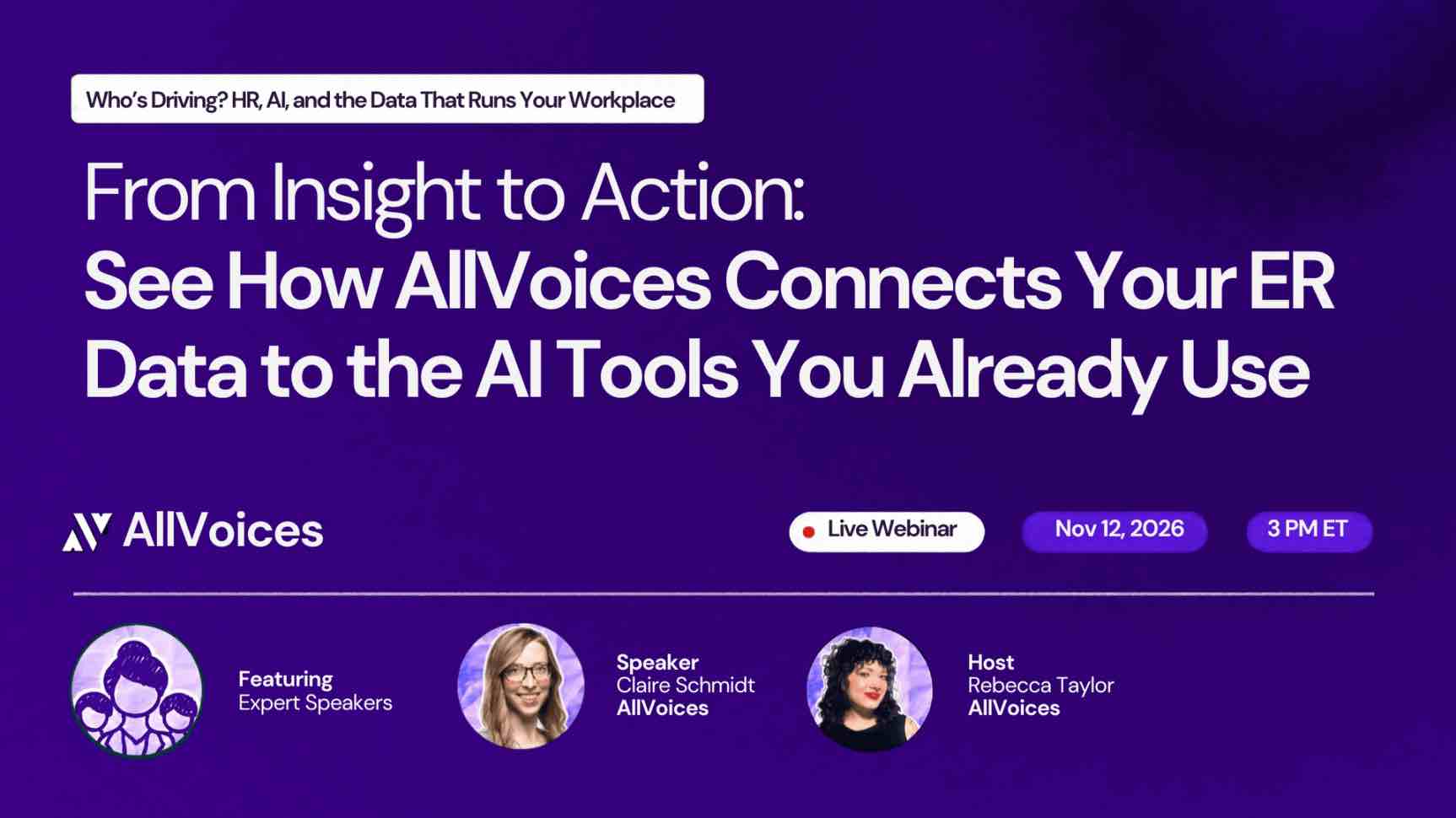
Our next webinar
Frequently asked questions

Got more questions? Email us at support@allvoices.co and we'll respond ASAP.

No items found.
Frequently asked questions

Got more questions? Email us at support@allvoices.co and we'll respond ASAP.

No items found.
Equity Means Access with Victoria Hill, Director of Diversity & Social Impact at Advanced Group
Episode 375
About This Episode
In this episode of Reimagining Company Culture, we’re chatting with Victoria Hill, Director of Diversity & Social Impact at Advanced Group. Victoria has 15+ years of experience in the human resources marketplace. She is skilled in all aspects of Diversity, Equity, and Inclusion (DE&I), Leadership Development, and Human Resources Management. Tune in to learn Victoria’s thoughts on the unique role of employers in creating equity, showing up for the full lives of employees, equity-driven leadership, and more!
About The Guest
Victoria has 15+ years of experience in the human resources marketplace. She is skilled in all aspects of Diversity, Equity and Inclusion (DE&I), Leadership Development and Human Resources Management. Her focus is the human experience and building inclusive relationships. Victoria is currently working as the Director of Diversity and Social Impact for Advanced Group. Advanced Group offers contingent and permanent staffing solutions, talent acquisition and management, consulting, outsourcing, clinical research and professional services. In 2018 Victoria started and now leads the company’s Diversity, Equity & Inclusion Committee which focuses on awareness, training, recruitment process, and public relations. The DE& I Committee won its first award in 2019 from the American Staffing Association - ASA Care Honorable Mention and it’s second award in 2022 from the Staffing Industry Analyst – 2022 DEI Influencer. Victoria also facilitates Neurodiversity, Conscious Inclusion, Interview Bias, Bystander Intervention, Building Inclusive Relationships, and many other DE& I trainings for her organization as well as external partners. Victoria and her team develop diversity programs to promote unbiased decision-making while creating a safe space for employees to thrive. Victoria and her husband live in Chicagoland and enjoy hosting karaoke parties for fun and relaxation.
Episode Transcription

Equity is one of those words that has stretched far enough to become unhelpful. Most companies use it to mean something general about fairness and end up with programming that does not produce specific outcomes. The reframe Victoria Hill offers is concrete. Equity means access. And once you frame it that way, the work becomes operational. On this episode of Reimagining Company Culture, Victoria walks through what it looks like to translate equity into access across hiring, performance, promotion, and ER work.

Victoria's perspective comes from years of running equity work that produced demographic results rather than activity. The pattern she describes is that the companies that translate equity into access make different operational choices than the companies that treat equity as a value statement. The difference shows up in the data within a few cycles.

Here is what equity-as-access looks like as an operational HR discipline.

Why Treating Equity as a Value Produces Activity Without Outcomes

Equity as a value is hard to operationalize. Every leader can claim it. Every program can be justified by it. The breadth is what makes it ineffective. According to McKinsey diversity and inclusion findings, the companies that produce sustained equity outcomes have moved past the value framing and translated equity into specific operational changes.

Equity as access is operational. Access to information. Access to decision-makers. Access to development opportunities. Access to mentorship. Access to recognition. Access to compensation that reflects contribution. Each of those is concrete and auditable. workplace equity practice programs that work this way produce different outcomes than ones that operate at the value level.

How HR Teams Translate Equity Into Access in Practice

How do you audit access in an organization?

By looking at who has access to what across the company. Information access. Meeting access. Sponsorship access. Compensation access. Each can be audited and the gaps surfaced. The audit is the diagnostic the rest of the work depends on.

How do you close access gaps once they are surfaced?

Through structural changes that distribute access more broadly. Sponsorship programs. Open meetings. Information transparency. Calibrated promotion processes. Each is a specific intervention with specific outcomes. structured talent management programs designed for access produce broader leadership pipelines.

What Actually Works in Equity-as-Access Practice

Audit access before launching programs

Programs designed without an access audit produce activity. Programs designed against an audit address specific gaps and produce specific outcomes.

Distribute access through structure, not exception

Access distributed through individual exceptions produces uneven outcomes. Access distributed through structural change produces durable equity.

Use ER infrastructure to monitor access

HR case management software reports show how access patterns are evolving. The visibility is what allows leadership to catch drift early.

The pattern the guest describes on this episode lines up with broader research. The Deloitte Global Human Capital Trends report reinforces the operating-model lens and gives HR leaders a useful reference for grounding the conversation in numbers their CEOs and CFOs already trust. It also surfaces the same gap between stated culture priorities and how People work actually runs inside most organizations.

Where Employee Relations Fits

Access work runs into ER work continuously. Cases involving exclusion, retaliation, or denied opportunity are usually access cases. The way they are handled either reinforces inequitable access or signals that access is being addressed.

employee relations operations programs that integrate access auditing with case management produce stronger equity outcomes. anonymous reporting infrastructure keeps the channels open for the employees most affected by access gaps.

How does AllVoices support equity-as-access work in ER?

AllVoices gives ER teams the documentation and pattern detection that lets access issues surface across cases. The visibility is what allows leadership to address structural access gaps rather than handle each case in isolation.

The pattern across AllVoices customers is consistent. ER teams that operate on a single workflow handle more cases at higher quality with the same headcount. The structured intake reduces the time between an employee raising a concern and the case being triaged. The case management layer keeps the documentation tight so investigations hold up to legal and audit review. The reporting layer surfaces the patterns leadership needs to act on structural issues rather than handling each case in isolation. That combination is what lets People teams treat ER as a strategic function rather than a reactive one.

Frequently Asked Questions About Equity as Access

What does equity-as-access mean in HR?

It means translating the abstract concept of equity into specific access decisions. Access to information, decision-makers, development, mentorship, recognition, and compensation. Each is concrete and auditable.

Why is the value framing of equity hard to operationalize?

Because every leader can claim it and every program can be justified by it. The breadth makes it ineffective as a guide for specific decisions. Reframing equity as access produces operational discipline.

How do you audit access in an organization?

By looking at who has access to what across the company. Information access, meeting access, sponsorship access, and compensation access can all be audited and the gaps surfaced.

How do you close access gaps structurally?

Through sponsorship programs, open meetings, information transparency, and calibrated promotion processes. Each is a specific intervention with specific outcomes.

How does ER work intersect with equity-as-access?

ER cases involving exclusion, retaliation, or denied opportunity are usually access cases. The handling of those cases either reinforces inequitable access or signals that access is being addressed.

The Bottom Line for HR Leaders

Equity becomes operational when it is reframed as access. Access is auditable. Access gaps are addressable. And the outcomes show up in retention, in promotion, and in the broader experience employees have of the company.

Victoria's framing in the episode is a useful translation. The People teams that take equity-as-access seriously produce demographic outcomes that value-framed programming cannot match.

For HR leaders working through this from a broader operations angle, the AllVoices reference on DEI solutions for HR teams covers the adjacent ground in more depth. It is a useful companion to the conversation in this episode.

The conversation in this episode underlines a pattern AllVoices has seen across hundreds of People teams. Programming alone does not move the operating model. The structural work, the manager development, the ER infrastructure, and the listening cycles that close visibly are what produce the outcomes the company can actually measure. That is the work the function will be evaluated on over the next several years, and the People leaders who do it well will keep earning bigger seats at the table. For HR teams looking to start, the move that pays off fastest is usually the operational one. Audit one process this quarter. Pick the structural change with the highest impact. Build the documentation around it. Close the loop with employees so they can see what changed and why. The compound effect of doing that consistently across a year is bigger than any single program initiative. The People teams that take this approach end up running cultures that hold up under stress and operating models that the rest of the C-suite trusts. That is the standard the function is moving toward, and the AllVoices customer base is full of teams already getting there.

If you want to see how AllVoices supports the ER infrastructure for equity-as-access work, you can request a tour. Book a tour of AllVoices.

Want to learn more?
See the power of AllVoices today
Thank you! We look forward to meeting you soon
Oops! Something went wrong while submitting the form.
Frequently asked questions

Got more questions? Email us at support@allvoices.co and we'll respond ASAP.

No items found.
Frequently asked questions

Got more questions? Email us at support@allvoices.co and we'll respond ASAP.

No items found.