About This Episode
In this episode of Reimagining Company Culture, we’re chatting with Haley Dorsey, People Business Partner at LeanIX. Haley began her professional career in hotel management and has been working in HR roles in tech start-ups since 2017. Tune in to learn Haley’s thoughts on building a people team globally and quickly, the effect of radical flexibility, personalizing the employee experience at scale, and more!
About The Guest
Haley was born and raised in central Massachusetts in a city called Fitchburg and has been living just outside of Boston, in Malden, for the last 8 year with her husband Jeff. Haley has a bachelor’s degree in hospitality and tourism management from UMass Amherst and an MBA with an HR concentration from Southern New Hampshire University. She began my professional career in hotel management and has been working in HR roles in tech start-ups since 2017.
Episode Breakdown

The phrase "people strategy" tends to imply something fixed: a five-year plan, an org chart, a set of programs that hum along. Haley Dorsey, People Business Partner at LeanIX, argues for a different version on Reimagining Company Culture. The strategy has to be fluid, because the business is fluid, and the workforce is fluid, and any plan you wrote eighteen months ago is already wrong about half of what is happening now.

Haley moved into HR after starting in hotel management, which is a useful background for thinking about service design. Hotels rebuild the experience for every guest while running on the same underlying infrastructure. People teams should aspire to that. Personalize the experience at scale. Reset the strategy as the business resets. Stop pretending that one playbook works for every cohort and every market.

Building a Global People Team Without Slowing the Business

Tech companies tend to scale headcount before they scale the people function. Three months in, HR is buried in onboarding, comp questions, and the early signals of culture stress. Haley's lesson from LeanIX is to staff the operational layer first, then the strategic layer. People operations who can answer questions, run benefits, and process changes free up the partner roles to actually partner.

Gallup's State of the Global Workplace report shows that engagement levels in best-practice organizations sit near 70%, compared to 22% globally. The gap is overwhelmingly explained by manager quality, which is downstream of how well the people team supports them. Skip the operational layer and the manager bench will not get the support it needs to be good.

Why Radical Flexibility Is a Strategy, Not a Perk

Companies that treat flexibility as a perk usually misprice it. They offer remote days because the market is offering them, not because they have done the work to make the operating model fit. Haley's argument is that radical flexibility is a strategy. It changes how you hire, how you measure performance, how you build culture, and how managers run their teams.

The data supports the strategic framing. Deloitte research on workplace trust shows that nearly 30% of professionals will not use available flexible work options because they fear consequences to their careers. The flexibility exists on paper. The trust to use it does not. Closing that gap is the actual work.

How Do You Personalize the Experience at Scale?

You build the system to handle the categories, then let managers and employees customize within them. Workforce planning done well sets the categories: career stage, geography, role family. Talent management done well runs the conversations inside those categories. Personalization without structure produces inconsistency. Structure without personalization produces resentment.

What Breaks First in a Fast-Scaling People Team?

The case management workflow. ER cases pile up in inboxes and shared docs. Patterns get missed. Investigations take longer than they should. The fix is operational, not strategic. A purpose-built case management platform takes the first six months of the workflow problem off the table. After that, the team can focus on the harder strategic work.

What Actually Works for a Fluid People Strategy

Plan in Quarters, Not Years

The annual planning cycle assumes too much stability. Run people-strategy planning in twelve-week increments. Pick three things that matter. Ship them. Review what you learned. Reset the next twelve weeks. The companies that do this right keep up with the business; the ones that do not become the bottleneck.

Hire People Who Can Build and Operate

Pure strategists struggle in fast-scaling companies. The hires that work are people who can write the plan and ship the plan. Building people-team efficiency is more about hiring profile than headcount.

Codify the Manager Job Early

If you wait until you have two hundred managers to write the manager playbook, you have already shipped two hundred different interpretations of the role. Write it at fifty managers. Update it at a hundred. Train every new manager on it within their first sixty days.

Where Employee Relations Fits in a Scaling Company

ER is the function that catches what scaling breaks. New managers without training, new hires without onboarding context, new geographies without local norms: all of it produces ER cases. The companies that scale well treat ER as a leading indicator, not a complaints desk.

The Role of AI in Scaling ER Capacity

You cannot scale ER linearly with headcount. Vera, the AllVoices AI co-pilot, lets a small ER team handle a much larger volume of cases without dropping quality. The judgment stays with the specialist. The drafting, summarization, and pattern-matching move to the AI. The result is more cases handled well, not fewer cases handled badly.

Frequently Asked Questions About Scaling People Operations

How early should a startup hire its first HRBP?

Around fifty to seventy-five employees, sooner if the company is hiring fast or operating across multiple countries. Earlier than that, an experienced people operations lead usually carries more weight than a generalist HRBP.

What is the right ratio of HR to employees in a scaling company?

Roughly one HR person per hundred employees is a defensible target, with adjustments for industry and complexity. Companies that operate in heavily regulated industries or across multiple countries usually need a richer ratio.

How do you keep culture consistent across geographies?

You make the values explicit and the rituals local. Same operating principles, locally adapted execution. The companies that try to export every ritual unchanged usually find the cultural rejection comes fast.

How do you handle ER cases across time zones?

Centralize intake, distribute resolution. A single anonymous reporting layer works across time zones. Local HR partners run the resolution conversations during local hours.

When does a fluid strategy become incoherent?

When the operating cadence breaks. Quarterly resets are productive. Monthly resets are usually a sign that nobody knows what the strategy is and the team is exhausted.

The Bottom Line for HR Leaders

The cost of a slow people function in a fast-scaling company shows up everywhere. Open roles stay open longer. New hires take longer to ramp. ER cases pile up. Engagement dips. SHRM research on workplace burnout shows that workers experiencing burnout are nearly three times more likely to be searching for a new job than their peers. A people team that cannot keep up with the business is a leading indicator of attrition you cannot afford.

The reverse is also true. A people team that resets quarterly, ships against a tight roadmap, and invests in operational infrastructure tends to see retention numbers that bend in their favor. The work is unglamorous. The compounding effect is significant.

Engagement data tells the same story. Best-practice organizations that invest early in operational HR see manager engagement near 79%, while the global average sits at 22%, according to Gallup. The compounding effect of a healthy people function is hard to see in any single quarter and impossible to miss across years.

Haley's argument for a fluid people strategy is the practical version of every "agile" framework HR has tried to import from engineering. The point is not the framework. The point is the discipline of resetting the plan often enough to actually keep up with the business.

See how AllVoices supports people teams who are scaling fast and need a real ER infrastructure.
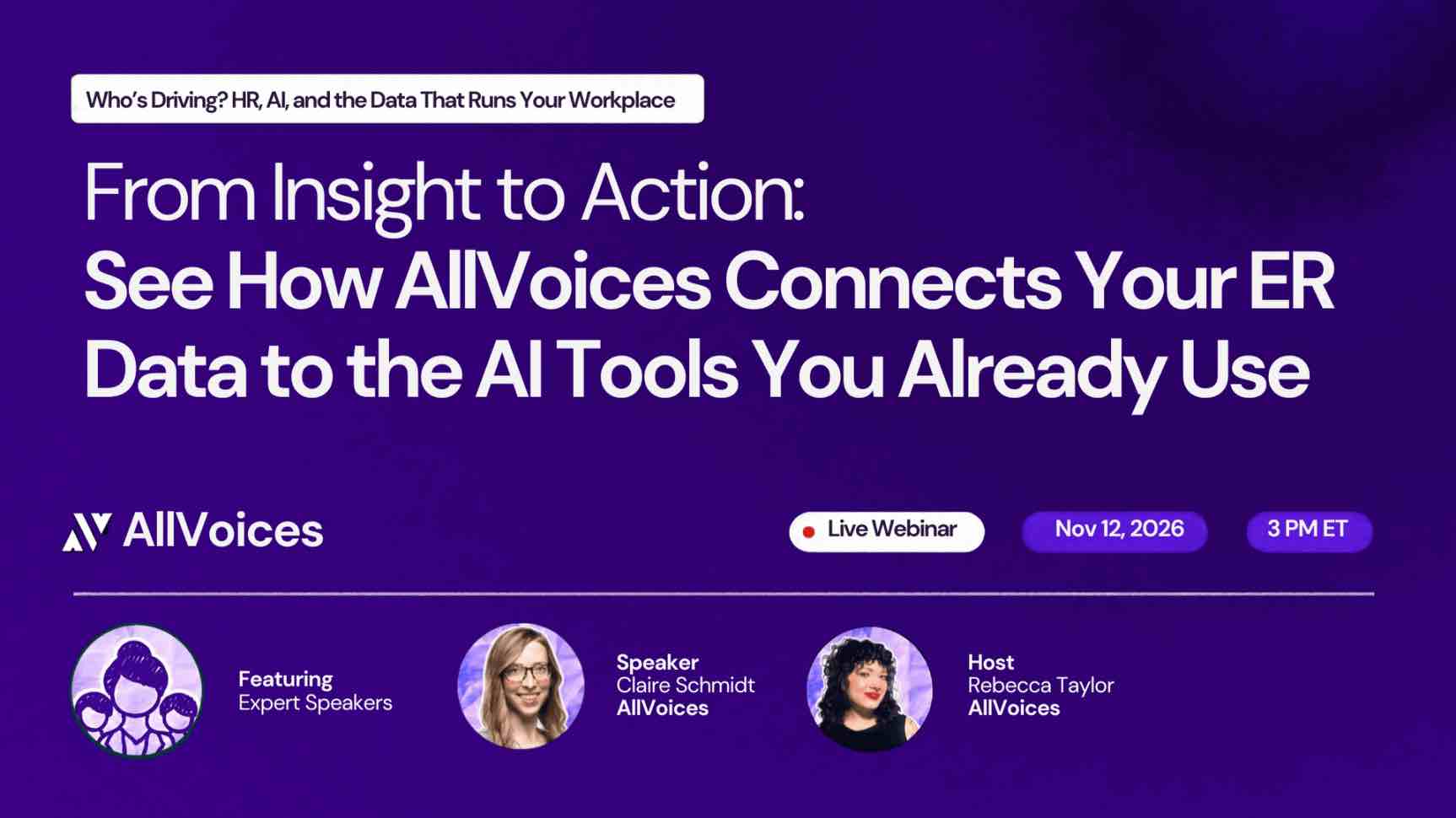
Our next webinar
Frequently asked questions

Got more questions? Email us at support@allvoices.co and we'll respond ASAP.

No items found.
Frequently asked questions

Got more questions? Email us at support@allvoices.co and we'll respond ASAP.

No items found.
Haley Dorsey, People Business Partner at LeanIX - A Fluid People Strategy
Episode 314
About This Episode
In this episode of Reimagining Company Culture, we’re chatting with Haley Dorsey, People Business Partner at LeanIX. Haley began her professional career in hotel management and has been working in HR roles in tech start-ups since 2017. Tune in to learn Haley’s thoughts on building a people team globally and quickly, the effect of radical flexibility, personalizing the employee experience at scale, and more!
About The Guest
Haley was born and raised in central Massachusetts in a city called Fitchburg and has been living just outside of Boston, in Malden, for the last 8 year with her husband Jeff. Haley has a bachelor’s degree in hospitality and tourism management from UMass Amherst and an MBA with an HR concentration from Southern New Hampshire University. She began my professional career in hotel management and has been working in HR roles in tech start-ups since 2017.
Episode Transcription

The phrase "people strategy" tends to imply something fixed: a five-year plan, an org chart, a set of programs that hum along. Haley Dorsey, People Business Partner at LeanIX, argues for a different version on Reimagining Company Culture. The strategy has to be fluid, because the business is fluid, and the workforce is fluid, and any plan you wrote eighteen months ago is already wrong about half of what is happening now.

Haley moved into HR after starting in hotel management, which is a useful background for thinking about service design. Hotels rebuild the experience for every guest while running on the same underlying infrastructure. People teams should aspire to that. Personalize the experience at scale. Reset the strategy as the business resets. Stop pretending that one playbook works for every cohort and every market.

Building a Global People Team Without Slowing the Business

Tech companies tend to scale headcount before they scale the people function. Three months in, HR is buried in onboarding, comp questions, and the early signals of culture stress. Haley's lesson from LeanIX is to staff the operational layer first, then the strategic layer. People operations who can answer questions, run benefits, and process changes free up the partner roles to actually partner.

Gallup's State of the Global Workplace report shows that engagement levels in best-practice organizations sit near 70%, compared to 22% globally. The gap is overwhelmingly explained by manager quality, which is downstream of how well the people team supports them. Skip the operational layer and the manager bench will not get the support it needs to be good.

Why Radical Flexibility Is a Strategy, Not a Perk

Companies that treat flexibility as a perk usually misprice it. They offer remote days because the market is offering them, not because they have done the work to make the operating model fit. Haley's argument is that radical flexibility is a strategy. It changes how you hire, how you measure performance, how you build culture, and how managers run their teams.

The data supports the strategic framing. Deloitte research on workplace trust shows that nearly 30% of professionals will not use available flexible work options because they fear consequences to their careers. The flexibility exists on paper. The trust to use it does not. Closing that gap is the actual work.

How Do You Personalize the Experience at Scale?

You build the system to handle the categories, then let managers and employees customize within them. Workforce planning done well sets the categories: career stage, geography, role family. Talent management done well runs the conversations inside those categories. Personalization without structure produces inconsistency. Structure without personalization produces resentment.

What Breaks First in a Fast-Scaling People Team?

The case management workflow. ER cases pile up in inboxes and shared docs. Patterns get missed. Investigations take longer than they should. The fix is operational, not strategic. A purpose-built case management platform takes the first six months of the workflow problem off the table. After that, the team can focus on the harder strategic work.

What Actually Works for a Fluid People Strategy

Plan in Quarters, Not Years

The annual planning cycle assumes too much stability. Run people-strategy planning in twelve-week increments. Pick three things that matter. Ship them. Review what you learned. Reset the next twelve weeks. The companies that do this right keep up with the business; the ones that do not become the bottleneck.

Hire People Who Can Build and Operate

Pure strategists struggle in fast-scaling companies. The hires that work are people who can write the plan and ship the plan. Building people-team efficiency is more about hiring profile than headcount.

Codify the Manager Job Early

If you wait until you have two hundred managers to write the manager playbook, you have already shipped two hundred different interpretations of the role. Write it at fifty managers. Update it at a hundred. Train every new manager on it within their first sixty days.

Where Employee Relations Fits in a Scaling Company

ER is the function that catches what scaling breaks. New managers without training, new hires without onboarding context, new geographies without local norms: all of it produces ER cases. The companies that scale well treat ER as a leading indicator, not a complaints desk.

The Role of AI in Scaling ER Capacity

You cannot scale ER linearly with headcount. Vera, the AllVoices AI co-pilot, lets a small ER team handle a much larger volume of cases without dropping quality. The judgment stays with the specialist. The drafting, summarization, and pattern-matching move to the AI. The result is more cases handled well, not fewer cases handled badly.

Frequently Asked Questions About Scaling People Operations

How early should a startup hire its first HRBP?

Around fifty to seventy-five employees, sooner if the company is hiring fast or operating across multiple countries. Earlier than that, an experienced people operations lead usually carries more weight than a generalist HRBP.

What is the right ratio of HR to employees in a scaling company?

Roughly one HR person per hundred employees is a defensible target, with adjustments for industry and complexity. Companies that operate in heavily regulated industries or across multiple countries usually need a richer ratio.

How do you keep culture consistent across geographies?

You make the values explicit and the rituals local. Same operating principles, locally adapted execution. The companies that try to export every ritual unchanged usually find the cultural rejection comes fast.

How do you handle ER cases across time zones?

Centralize intake, distribute resolution. A single anonymous reporting layer works across time zones. Local HR partners run the resolution conversations during local hours.

When does a fluid strategy become incoherent?

When the operating cadence breaks. Quarterly resets are productive. Monthly resets are usually a sign that nobody knows what the strategy is and the team is exhausted.

The Bottom Line for HR Leaders

The cost of a slow people function in a fast-scaling company shows up everywhere. Open roles stay open longer. New hires take longer to ramp. ER cases pile up. Engagement dips. SHRM research on workplace burnout shows that workers experiencing burnout are nearly three times more likely to be searching for a new job than their peers. A people team that cannot keep up with the business is a leading indicator of attrition you cannot afford.

The reverse is also true. A people team that resets quarterly, ships against a tight roadmap, and invests in operational infrastructure tends to see retention numbers that bend in their favor. The work is unglamorous. The compounding effect is significant.

Engagement data tells the same story. Best-practice organizations that invest early in operational HR see manager engagement near 79%, while the global average sits at 22%, according to Gallup. The compounding effect of a healthy people function is hard to see in any single quarter and impossible to miss across years.

Haley's argument for a fluid people strategy is the practical version of every "agile" framework HR has tried to import from engineering. The point is not the framework. The point is the discipline of resetting the plan often enough to actually keep up with the business.

See how AllVoices supports people teams who are scaling fast and need a real ER infrastructure.

Want to learn more?
See the power of AllVoices today
Thank you! We look forward to meeting you soon
Oops! Something went wrong while submitting the form.
Frequently asked questions

Got more questions? Email us at support@allvoices.co and we'll respond ASAP.

No items found.
Frequently asked questions

Got more questions? Email us at support@allvoices.co and we'll respond ASAP.

No items found.