About This Episode
In this episode of Reimagining Company Culture, we’re chatting with Carolyn Kwon Montgomery, VP of HR at Pangea Money Transfer. At Pangea, Carolyn serves as a partner to the CEO and leadership team to design and implement people solutions that support business growth and employee engagement.
About The Guest
Carolyn is currently the VP of People at Pangea Money Transfer, a global payments fintech company with offices in Chicago and Mexico City, which was recently acquired by Enova International. At Pangea, Carolyn serves as a partner to the CEO and leadership team to design and implement people solutions that support business growth and employee engagement. Prior to Pangea, Carolyn was an HR Business Partner at Centro, supporting the company's sales, media services, finance, and marketing functions. Earlier in her career, Carolyn ran a full desk as a technical recruiter at a boutique staffing firm in Chicago. Carolyn has her Bachelor's degree from the University of Iowa and holds certifications in Analytics for Talent Management (ATM) and Objectives and Key Results (OKR).
Episode Breakdown

Carolyn Kwon Montgomery is the VP of HR at Pangea Money Transfer, a global fintech recently acquired by Enova International. On Reimagining Company Culture, she joins us to talk about what it looks like when HR earns a seat at the strategy table. The phrase 'HR business partner' is everywhere; the practice is rare. Carolyn talks about the muscles HR leaders need to build to operate as actual partners, not order-takers in suits.

Her perspective: business partnership is earned through fluency in the business, not awarded by a title change.

Why Most HR-Business-Partner Programs Stall

Companies often rebrand HR generalists as HR business partners and call it a transformation. The result is the same work with a new title and continued frustration on both sides.

Real partnership requires HR leaders to read financial statements, understand the operating model, and influence decisions before they reach the people-cost stage. People team efficiency matters here, partners need bandwidth to think strategically.

What True Partnership Looks Like

HR sits in strategy, not just execution

Partners are present when business plans are written, not when they are translated into headcount.

Metrics align with business outcomes

Revenue per employee, regrettable attrition, and time-to-fill against revenue plans replace activity metrics like training hours.

Leaders are coached, not just supported

Manager coaching is one of the highest-impact skills an HR partner can develop. Harvard Business Review's analysis of mentorship found that coaching outperforms classroom training nearly two-to-one for behavior change.

Building the Bench

Carolyn argues that HR teams have to invest in their own bench the way they encourage other functions to. Strategic HRM is a craft, not a side hustle. Companies that invest in HR development internally produce stronger partners externally.

This is also where human resources operations maturity pays off. The base layer of the function has to be solid before the partnership layer can flourish.

Where Employee Relations Fits

Strategic HR partners need real data on employee relations trends. HR case management and AI-assisted employee relations give partners the visibility to spot patterns before they become exits or lawsuits.

Carolyn treats this data as the early-warning system that lets HR leaders bring real signal to the strategy conversation.

Why This Conversation Matters Right Now

The HR field has been through three waves in the last few years: an emergency pivot to distributed work, a wave of public commitments around inclusion, and a slow correction as leaders started measuring which of those commitments actually moved retention and engagement.

That shift puts pressure on people leaders to be specific. Generic advice about belonging or psychological safety does not survive a budget review. The HR teams that are pulling ahead are the ones that connect cultural commitments to operating systems, instrument the resulting work, and report on outcomes in the same business-critical language the CFO uses for revenue. According to SHRM's reporting on retention strategies, the cost of underinvesting in culture shows up directly in voluntary attrition, and the math gets harder every year.

This is also where employee relations operations becomes a more visible part of the modern People organization. Employee relations is no longer a quiet compliance function; it is the data layer that tells leaders whether their stated values are being lived inside the organization, and it is increasingly the place where cultural drift first becomes visible.

A Practical Playbook for HR Leaders

Translating a great podcast conversation into actual change inside your organization takes a stepwise plan, not a rallying cry. The most consistent leaders we work with run a 90-day discovery loop, a 90-day pilot, and a 90-day expansion that together compress what would otherwise be a multi-year cultural shift into a single calendar year.

Discovery is mostly listening. That means structured conversations with managers, frontline employees, and recent leavers, paired with quantitative pulls from your HRIS, ATS, and case-management system. Most HR teams find that the data they already have, surfaced honestly, points to two or three high-impact interventions they had not previously prioritized.

Pilots are deliberately small. Pick one team, one geography, or one stage of the employee journey and instrument it well. Set a clear hypothesis, a measurable target, and a review cadence shorter than a quarter. The teams that pilot this way produce stories the rest of the organization actually wants to copy.

Expansion is the patient work. The organizations that scale change well treat the pilot lessons as the operating manual and resist the urge to rebrand the work. Manager training, listening infrastructure, and case-management discipline travel with the program; without those layers, even successful pilots fail to take root in the rest of the company.

The throughline across every successful version of this playbook is the same: change is treated as a system, not a moment. Hiring, performance, recognition, manager development, and reporting infrastructure all have to move together for the new culture to take root. The companies that move the whole stack at once, even imperfectly, usually compound their gains for the next several years.

One last note for HR leaders worried about whether the moment is right to invest. The cost of waiting always looks smaller than the cost of acting until the data comes in, and by then the talent has already left. The discipline is to move at the cadence of the workforce, not the cadence of the budget cycle, and the People leaders who hold that line tend to outlast the ones who do not.

Frequently Asked Questions About HR Business Partnership

How do I know if I am a real business partner?

Check whether you are invited into strategy conversations before they hit headcount. If you are only consulted at execution time, you are still in a service role.

What is the most important skill for an HRBP?

Business fluency. Understand revenue, margin, and operating priorities the way the CFO does.

How big should our HRBP-to-employee ratio be?

Industry medians sit around 1:200, but the right number depends on complexity and leadership maturity.

How do I prove HR's strategic value?

Tie HR initiatives to business outcomes, revenue impact, retention savings, or speed-to-productivity, and report on them in business terms.

How do I get a seat at the strategy table?

Bring a perspective on the business. Partners who only bring people problems get treated like a service desk.

The Bottom Line for HR Leaders

Carolyn's career shows that strategic HR partnership is craft. The companies that build it well invest in HR fluency, instrument the people side of the business, and bring people insight to strategy conversations, not the other way around.

See how AllVoices helps strategic HR partners operate with real-time employee insight.
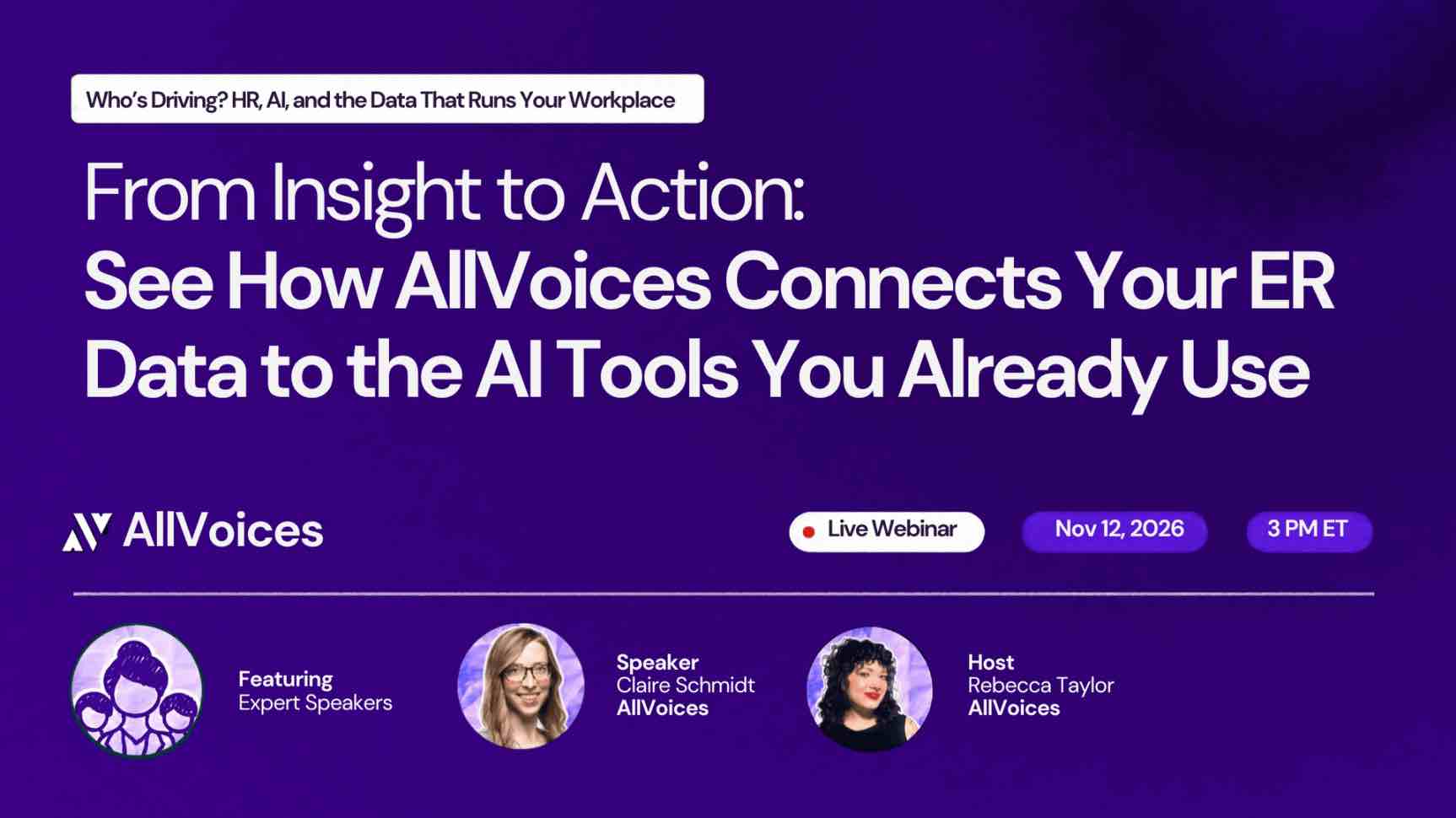
Our next webinar
Frequently asked questions

Got more questions? Email us at support@allvoices.co and we'll respond ASAP.

No items found.
Frequently asked questions

Got more questions? Email us at support@allvoices.co and we'll respond ASAP.

No items found.
VP of HR at Pangea Money Transfer, Carolyn Kwon Montgomery - HR as a Strategic Business Partner
Episode 116
About This Episode
In this episode of Reimagining Company Culture, we’re chatting with Carolyn Kwon Montgomery, VP of HR at Pangea Money Transfer. At Pangea, Carolyn serves as a partner to the CEO and leadership team to design and implement people solutions that support business growth and employee engagement.
About The Guest
Carolyn is currently the VP of People at Pangea Money Transfer, a global payments fintech company with offices in Chicago and Mexico City, which was recently acquired by Enova International. At Pangea, Carolyn serves as a partner to the CEO and leadership team to design and implement people solutions that support business growth and employee engagement. Prior to Pangea, Carolyn was an HR Business Partner at Centro, supporting the company's sales, media services, finance, and marketing functions. Earlier in her career, Carolyn ran a full desk as a technical recruiter at a boutique staffing firm in Chicago. Carolyn has her Bachelor's degree from the University of Iowa and holds certifications in Analytics for Talent Management (ATM) and Objectives and Key Results (OKR).
Episode Transcription

Carolyn Kwon Montgomery is the VP of HR at Pangea Money Transfer, a global fintech recently acquired by Enova International. On Reimagining Company Culture, she joins us to talk about what it looks like when HR earns a seat at the strategy table. The phrase 'HR business partner' is everywhere; the practice is rare. Carolyn talks about the muscles HR leaders need to build to operate as actual partners, not order-takers in suits.

Her perspective: business partnership is earned through fluency in the business, not awarded by a title change.

Why Most HR-Business-Partner Programs Stall

Companies often rebrand HR generalists as HR business partners and call it a transformation. The result is the same work with a new title and continued frustration on both sides.

Real partnership requires HR leaders to read financial statements, understand the operating model, and influence decisions before they reach the people-cost stage. People team efficiency matters here, partners need bandwidth to think strategically.

What True Partnership Looks Like

HR sits in strategy, not just execution

Partners are present when business plans are written, not when they are translated into headcount.

Metrics align with business outcomes

Revenue per employee, regrettable attrition, and time-to-fill against revenue plans replace activity metrics like training hours.

Leaders are coached, not just supported

Manager coaching is one of the highest-impact skills an HR partner can develop. Harvard Business Review's analysis of mentorship found that coaching outperforms classroom training nearly two-to-one for behavior change.

Building the Bench

Carolyn argues that HR teams have to invest in their own bench the way they encourage other functions to. Strategic HRM is a craft, not a side hustle. Companies that invest in HR development internally produce stronger partners externally.

This is also where human resources operations maturity pays off. The base layer of the function has to be solid before the partnership layer can flourish.

Where Employee Relations Fits

Strategic HR partners need real data on employee relations trends. HR case management and AI-assisted employee relations give partners the visibility to spot patterns before they become exits or lawsuits.

Carolyn treats this data as the early-warning system that lets HR leaders bring real signal to the strategy conversation.

Why This Conversation Matters Right Now

The HR field has been through three waves in the last few years: an emergency pivot to distributed work, a wave of public commitments around inclusion, and a slow correction as leaders started measuring which of those commitments actually moved retention and engagement.

That shift puts pressure on people leaders to be specific. Generic advice about belonging or psychological safety does not survive a budget review. The HR teams that are pulling ahead are the ones that connect cultural commitments to operating systems, instrument the resulting work, and report on outcomes in the same business-critical language the CFO uses for revenue. According to SHRM's reporting on retention strategies, the cost of underinvesting in culture shows up directly in voluntary attrition, and the math gets harder every year.

This is also where employee relations operations becomes a more visible part of the modern People organization. Employee relations is no longer a quiet compliance function; it is the data layer that tells leaders whether their stated values are being lived inside the organization, and it is increasingly the place where cultural drift first becomes visible.

A Practical Playbook for HR Leaders

Translating a great podcast conversation into actual change inside your organization takes a stepwise plan, not a rallying cry. The most consistent leaders we work with run a 90-day discovery loop, a 90-day pilot, and a 90-day expansion that together compress what would otherwise be a multi-year cultural shift into a single calendar year.

Discovery is mostly listening. That means structured conversations with managers, frontline employees, and recent leavers, paired with quantitative pulls from your HRIS, ATS, and case-management system. Most HR teams find that the data they already have, surfaced honestly, points to two or three high-impact interventions they had not previously prioritized.

Pilots are deliberately small. Pick one team, one geography, or one stage of the employee journey and instrument it well. Set a clear hypothesis, a measurable target, and a review cadence shorter than a quarter. The teams that pilot this way produce stories the rest of the organization actually wants to copy.

Expansion is the patient work. The organizations that scale change well treat the pilot lessons as the operating manual and resist the urge to rebrand the work. Manager training, listening infrastructure, and case-management discipline travel with the program; without those layers, even successful pilots fail to take root in the rest of the company.

The throughline across every successful version of this playbook is the same: change is treated as a system, not a moment. Hiring, performance, recognition, manager development, and reporting infrastructure all have to move together for the new culture to take root. The companies that move the whole stack at once, even imperfectly, usually compound their gains for the next several years.

One last note for HR leaders worried about whether the moment is right to invest. The cost of waiting always looks smaller than the cost of acting until the data comes in, and by then the talent has already left. The discipline is to move at the cadence of the workforce, not the cadence of the budget cycle, and the People leaders who hold that line tend to outlast the ones who do not.

Frequently Asked Questions About HR Business Partnership

How do I know if I am a real business partner?

Check whether you are invited into strategy conversations before they hit headcount. If you are only consulted at execution time, you are still in a service role.

What is the most important skill for an HRBP?

Business fluency. Understand revenue, margin, and operating priorities the way the CFO does.

How big should our HRBP-to-employee ratio be?

Industry medians sit around 1:200, but the right number depends on complexity and leadership maturity.

How do I prove HR's strategic value?

Tie HR initiatives to business outcomes, revenue impact, retention savings, or speed-to-productivity, and report on them in business terms.

How do I get a seat at the strategy table?

Bring a perspective on the business. Partners who only bring people problems get treated like a service desk.

The Bottom Line for HR Leaders

Carolyn's career shows that strategic HR partnership is craft. The companies that build it well invest in HR fluency, instrument the people side of the business, and bring people insight to strategy conversations, not the other way around.

See how AllVoices helps strategic HR partners operate with real-time employee insight.

Want to learn more?
See the power of AllVoices today
Thank you! We look forward to meeting you soon
Oops! Something went wrong while submitting the form.
Frequently asked questions

Got more questions? Email us at support@allvoices.co and we'll respond ASAP.

No items found.
Frequently asked questions

Got more questions? Email us at support@allvoices.co and we'll respond ASAP.

No items found.