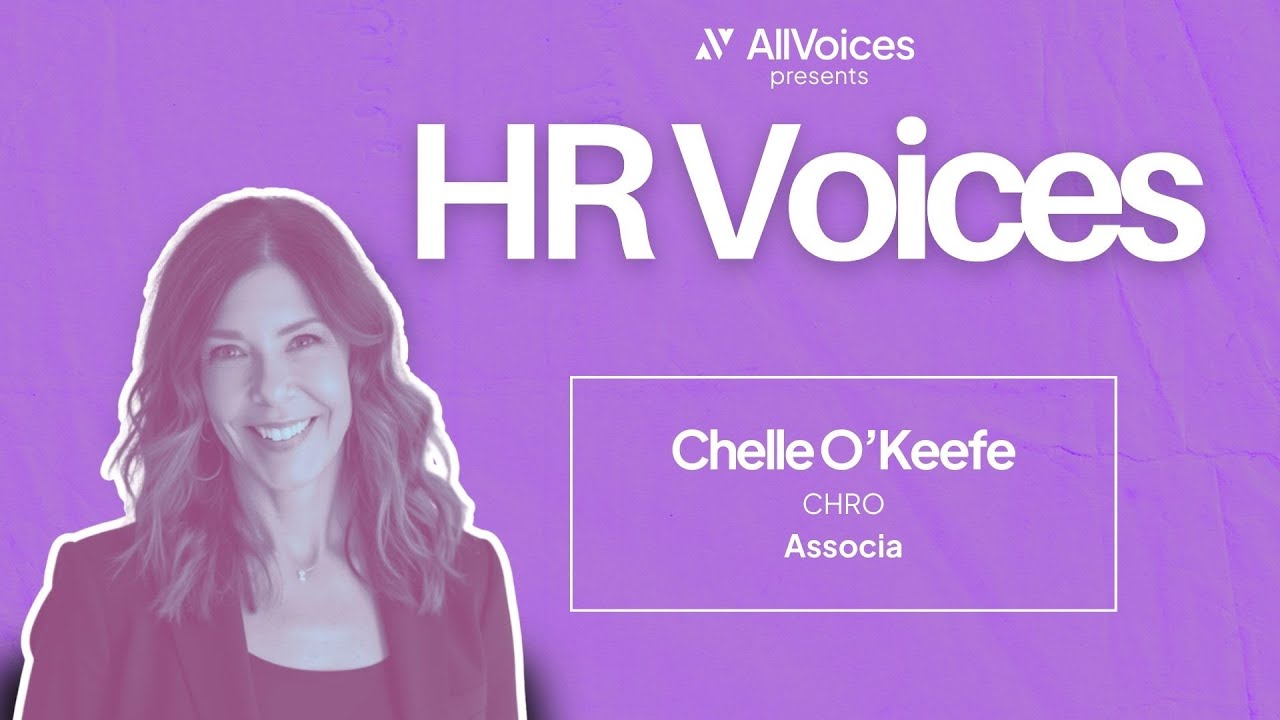

Sixteen companies moved onto Associa’s HR platform and employee benefits plans on the same day, January 1. Chelle O’Keefe, Executive Vice President and Chief Human Resources Officer at Associa, called it a lot of work. Her teams joke that “the best problems to have are growth problems.” She describes Associa as the largest company in property and community management. It oversees more than 30,000 communities and roughly four million homeowners across the United States, Canada, and Mexico.
Growth by acquisition creates the tension Chelle described to host Rebecca Taylor. Associa wants one united culture, but its business is neighborhoods, and everything about it is local. Her answers ran through people more than platforms: two playbooks for branch leaders, AI aimed first at repetitive work, and successors built at the front line.
Why One Culture Has to Leave Room for Local Identity
Chelle named the biggest challenge plainly: keeping a united culture while allowing for local differentiation. Associa brings everyone onto standardized platforms, on the client side and the employee side. The harder part is what employees feel locally.
In her words, “your employee experience is influenced most directly by your leader and the colleagues that you have around you.” For an acquirer, that puts the branch leader, not the head office, at the center of how two workplace cultures become one. Associa has more than 150 of those leaders, called branch presidents.
How a Loss of Control Becomes a Question of Identity
Rebecca has done her share of M&A integration in HR. In her experience, the platforms were never the hard part; the people were, especially founders and long-tenured staff facing a shift in identity. Chelle called that one of her takeaways from the conversation.
Integration tends to focus on control, she explained, and local leaders and HR teams feel a real loss of it. Chelle would rather treat that loss on a human level, as identity changing. The job is to help those leaders and their HR counterparts think through “that evolution of identity instead of a loss.”
Small changes carry that weight. Rebecca recalled an acquisition that turned account executives into sales representatives. Chelle agreed that changing a job title can look minor to the acquirer and land hard on the person. The bigger company’s instinct is to make the change and move on. Her alternative is to “intentionally create space” for acknowledgment, though she did not claim Associa has mastered it.
The stakes are high. Clayton Christensen and his coauthors wrote in Harvard Business Review that study after study puts the failure rate of mergers and acquisitions between 70 and 90 percent. Integration still runs on an HR integration checklist, and much of it is complicated work. What Chelle warned against is the “urgency trap,” where leaders push everything toward the goal without pausing to learn.
What Actually Works
Run Two Playbooks for Branch Leaders
Associa treats its branch presidents as two groups. Core branches have been with the company for five or more years and work within its established rhythms. With those leaders, HR works through core competencies, core values, and how to build Associa’s culture locally.
Newer acquisitions often still have seller-owners, leaders “used to running their own shop.” Associa gives them more freedom, including keeping values their company was founded on. “We talk about alignment,” Chelle said. The question is which of those values already fit the broader company. Over time, the goal is to bring each branch into the fold.
Start AI at the Bottom of the Pyramid
Chelle’s view of AI changed at a conference a couple of years ago. Asking how to insert AI into existing processes is, in her view, “the wrong question.” The better question is about “the work at that bottom level of the pyramid that is painful and repetitive.”
Her test case was a change to Associa’s 401(k) plan. The provider’s price for the modeling was, as she saw it, “a somewhat outrageous quote.” So she spent a couple of days building scenarios with an AI tool. Then, in her words, “I took it back to the humans,” and the plan providers and the broker checked the model. It saved the company a significant amount of money. Her lesson is that HR leaders have to be early adopters themselves, and they still have to check the work.
Build Successors at the Front Line
“We love to promote from within because we have a niche industry,” Chelle said. Few people know what an HOA is before they live in one. As the largest company in its space, Associa cannot easily hire from competitors either.
At one point, 80 percent of Associa’s promotions were internal, and the share is slightly lower now. The habit has research behind it. Wharton professor Matthew Bidwell found that external hires get significantly lower performance evaluations in their first two years than internal workers promoted into similar jobs, while earning about 18 to 20 percent more.
A new tool for developing internal successors asks frontline leaders to think about their own replacements and how they develop their direct reports. A ready successor is what lets a leader move up. Annual leadership development programs run alongside it, an approach that echoes 84 Lumber’s store leadership pipeline.
Where Employee Relations Fits
Every change Chelle described can prompt a concern, and she noted that people take pay and benefits personally. Those concerns surface across more than 150 branches, each with its own leader and history.
One united culture depends on handling them the same way wherever they start. Chelle’s bottom-up test applies here too. Intake, documentation, and routing are the repetitive layer of ER work. AI-powered case management takes on that layer, so ER teams and local HR partners can focus on the conversation itself.
Frequently Asked Questions About Integrating Acquisitions at Associa
It moved all sixteen onto its HR platform and benefits plans on January 1. Chelle says Associa integrates acquired companies in January 1 cycles to limit disruption for employees. At least ten more were planned as the company moved toward 2027.
It gives them more room. Seller-owners are used to running their own businesses, so Associa allows more freedom and flexibility. They can keep values core to their company while working toward alignment with Associa’s values over time.
It means starting with the painful, repetitive work at the bottom of the pyramid that a team would love to drop. Rather than asking how to insert AI into every process, HR automates that routine work first and then moves up.
Chelle built the model herself with an AI tool. After the provider quoted a price she considered somewhat outrageous, she spent a couple of days working through scenarios. The plan providers and broker then checked the result. She says it saved a significant amount of money.
It needs to, in Chelle’s view. Property and community management is a niche industry, and as its largest company, Associa cannot easily hire from competitors. Most promotions have been internal, and a new succession tool asks frontline leaders to develop their own replacements.
The Bottom Line for HR Leaders
Chelle O’Keefe’s framing reaches past M&A. Integration asks people to give up control, and she treats that as identity evolving rather than identity lost.
Her closing advice was to keep developing, because “we all can get better and we all have to evolve.” People teams can hold one standard for the process and still make room for the people living through the change.
See how AllVoices helps People teams handle every employee concern consistently, from the newest acquisition to the oldest branch.