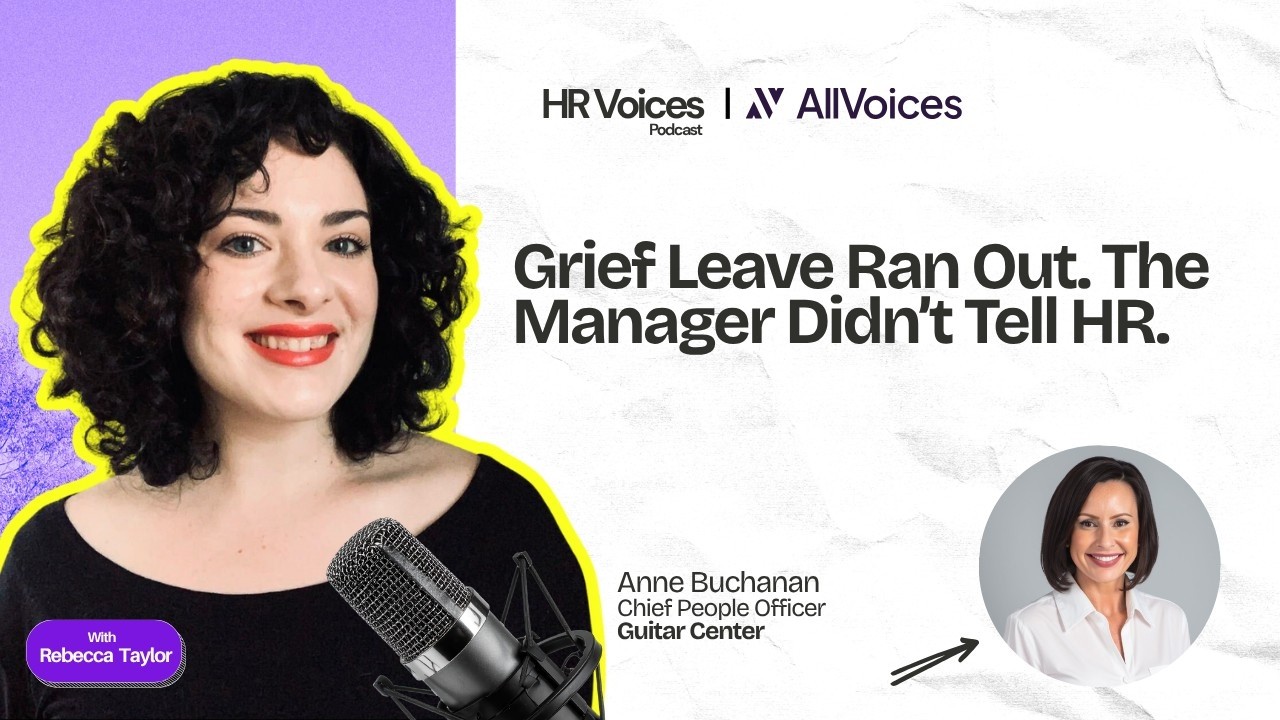

The scenario Rebecca Taylor brought to Anne Buchanan, Chief People Officer at Guitar Center, starts with a policy working exactly as written. An employee’s bereavement leave after his spouse’s death ends after five days. He is clearly not okay. His manager keeps quietly covering for him instead of escalating, and three weeks in, his work has stalled while teammates absorb it without complaint, for now.
Anne did not treat the compassion as the problem. The risk, in Anne’s view, was a manager making decisions alone and never asking HR for support, a position People teams land in often. Everyone in the scenario was running on goodwill instead of process. Goodwill runs out. Anne’s answer covered who to call, how to plan for leave that runs long, what to tell the team, and why the record protects everyone.
Why a Quiet Manager Is the Real Risk
Anne’s first question was about culture, not compliance. A manager who accommodates someone under the radar is telling HR something: escalating feels like it will hurt the employee. Managers often assume there are no options, and that going to HR means something bad for the employee or for them.
That fear is the warning sign. In Anne’s view, an HR department that people fear is proof that something is wrong. The line “you have to go to HR” has made Anne’s team cringe for an entire career.
Good intentions are not the same as good decisions. Managers often do not know the laws and rules involved, so in trying to do the right thing, they often do not. Anne compared it to rough water on a boat, where passengers feel safer with a professional captain at the wheel.
Timing compounds it. Three weeks later, there is a team, an employee, a manager, and stalled work. The case is bigger, and Anne wished it had come in sooner.
What Unequal Treatment Costs a Team
Teammates covering out of compassion looks like a strength. Anne sees a slow leak. Unfairness, in Anne’s words, is “a cancer and it spreads quickly.”
The fix is not perfect fairness. Life is not always equitable, at work or at home. People can live with an inequity when they know it has been escalated and is being handled professionally; they resent the same inequity when it is handled in silence.
Rebecca put the point another way: people want to trust how the decision was made. That is the gap between equal treatment rules on paper and fairness a team can see.
Anne also sees an opening in the shortfall. Covering the work can be a stretch opportunity for someone who wants it. When a whole team collapses because one person is out, Anne reads a second problem: the bench. Solve the immediate issue, then build a stronger one.
What Actually Works
Build the Escalation Map on Day One
Who HR calls first depends on where the escalation came from. If it did not come from the manager, Anne aligns the manager next. Anne also alerts the senior executive involved, not to ask for help but so that leader is not caught off guard.
The next calls go to the leave and accommodations team and to benefits for mental health resources, such as EAP counseling and referrals. An executive assistant sends flowers to the family. The HR business partner, who usually holds the relationship, reaches out to the employee directly.
Make a Plan for Leave That Runs Long
Anne’s informed opinion, after many years, is that leaves usually extend, bereavement or not. The employee’s first worries tend to be pay and job security. Anne, who has lived paycheck to paycheck as a single parent, does not assume anyone can absorb unpaid time.
The data backs that caution. The Federal Reserve’s survey of household well-being in 2025 found that 63 percent of adults would cover a hypothetical $400 emergency expense with cash or its equivalent.
The options start with paid bereavement days, vacation, sick time, and PTO. Then come intermittent leave, a full leave of absence, a personal leave, or federal FMLA protection where it applies. According to the Department of Labor, FMLA leave is job-protected and unpaid, and one qualifying reason is a serious health condition that makes the employee unable to work.
Federal rules also allow intermittent or reduced-schedule leave for an employee’s own serious health condition when there is a medical need for it. Rebecca added that the return can need a workplace accommodation of its own, such as a partial schedule for the first month.
Anne lets the employee guide the process. Some people come back too soon because they want something else to think about. The person who returns may not be the person who left, so support for grieving employees cannot end when the leave does. Exceptions stay possible, but Anne warns that “running an HR department based on exceptions is not a good approach at all.”
Design What the Team Hears
Anne’s default is to share no personal details. Some deaths are suicides or overdoses that a family does not want discussed. When the employee is able, HR asks what they want the team to know, and even full permission gets only the basics.
With any doubt, the team hears that a personal matter is keeping the employee out for a couple of weeks, possibly longer. Then the conversation turns to the work: what needs covering, and what everyone is comfortable taking on. Getting people focused on the future quickly is what binds the team.
Where Employee Relations Fits
Anne wants situations like this documented for the company, the manager, and the employee. Without an HR escalation, there is no record. If a harassment or discrimination claim surfaces later, HR needs to show what it offered and when. As Anne put it, “this is for everybody.”
The record also answers the complaint the scenario warns about. Rebecca noted that a teammate’s complaint about favoritism could trace back to a case like this. Anne has walked employees through their own record, what was offered on which day, until they saw how much had been done.
A leave management workflow keeps intake, tracking, and documentation in one place, not in one manager’s memory.
Frequently Asked Questions About Grief and Extended Leave
Plan for more time. Anne’s experience is that most leaves extend, so HR reviews paid days, vacation, sick time, and PTO, then options such as intermittent leave, FMLA where it applies, or a personal leave.
Usually out of compassion and fear. Anne finds that managers assume escalating will hurt the employee or themselves, and many are unsure what they can say. Anne reads that as a signal about the culture.
Start with whoever escalated it, then align the manager. Anne also alerts the senior executive involved, the leave and accommodations team, and benefits, and has the HR business partner contact the employee directly.
Only what the employee consents to and what the team needs. Without consent, “a personal matter” and the expected length of the absence are enough. Then the conversation moves to how the work gets covered.
It shows what was offered and when. Anne has walked employees through that record after a complaint, and the facts clarified what the company and the manager had done, and why.
The Bottom Line for HR Leaders
Anne’s framing fits in one instruction: when in doubt, ask instead of assuming. Managers ask HR before they cover quietly, and HR asks the employee what they need. Anne would also send this manager back through leave and accommodation training, because training for managers rarely feels real until they live the situation.
The goal Anne Buchanan sets is long range. Ten years later, the employee should look back on a terrible time and say Guitar Center supported them through it.
See how AllVoices helps HR teams handle leave and accommodation requests with a full record from first escalation to return.