About This Episode
In this episode of Reimagining Company Culture, we’re chatting with Kyan Wei, Director of Talent Acquisition and DEIB Chair at Therapy Brands. Kyan is a talent acquisition professional, recruitment and people management strategist. Tune in to learn Kyan’s thoughts on scaling company culture, the unique role of HR and DEI leaders, examples and transparency and effective company communication, and more!
About The Guest
Kyan is a talent acquisition professional, recruitment and people management strategist. He is a HCM/ATS/LMS implementation specialist, career transition coach and mentor.
Episode Breakdown

Scaling company culture often requires resetting the mindsets that built the early version. The original team's habits do not always travel. The original founders' instincts are not always the right defaults at a hundred employees, let alone a thousand. Kyan Wei, Director of Talent Acquisition and DEIB Chair at Therapy Brands, makes the case on Reimagining Company Culture for treating mindset realignment as an explicit operational task rather than an emergent process.

Kyan's background as a recruitment and people-management strategist gives him a particular view. He has watched what happens when companies hire faster than they realign. The early-team mindset hits the new-hire mindset, and the culture either bends or breaks.

Why Scaling Requires Mindset Resets

The patterns that worked at twenty employees do not work at two hundred. Decisions made by Slack consensus break when the consensus pool is too large. Manager promotions made on individual contribution break when the new managers have no training. The original culture has to be re-articulated for the company that exists now.

Gallup's State of the Global Workplace report shows that engagement levels at best-practice organizations sit near 70%, while the global average is around 22%. The gap is largely operational. Companies that have done the mindset and infrastructure work produce the best-practice numbers; companies that have not produce the global-average ones.

The Unique Role of HR and DEI Leaders in Resets

Kyan's framing is that HR and DEI leaders are the operating layer that makes mindset resets possible. They have the data, the relationships, and the structural authority to identify which patterns need to change. The companies that support them produce smoother transitions; the companies that sideline them produce predictable cultural fractures.

The infrastructure matters. DEI work that scales with the company tends to compound. Engagement programs tied to mindset reset goals produce visible results.

What Are the Most Common Mindset Failures During Scaling?

The "we don't do that here" reflex when a new hire suggests something the early team did not need. The reverse: importing entire playbooks from the new hire's previous company. The middle path is intentional integration.

How Do You Know a Mindset Reset Is Working?

Reduced friction in cross-functional decisions. Faster onboarding ramp. Engagement scores that rise as the new hires settle. Each metric is worth tracking quarterly.

Examples and Transparency in Effective Communication

Kyan's argument is that effective communication during scaling depends on specific examples and visible transparency. Vague memos do not move mindsets. Specific examples of how decisions get made now, what changed, and why, produce a different kind of clarity. The companies that publish their reasoning produce different cultural alignment than companies that announce conclusions only.

What Actually Works for Cultural Scaling

Train Hiring Managers on the Reset

Hiring managers carry the culture into every interview. Training them on the reset goals produces different hire profiles than leaving them to interpret on their own.

Document the Cultural Operating Model

Vague values do not survive scaling. Documented operating norms, decision-making patterns, and conflict resolution paths produce a cultural artifact the new hires can read.

Use Anonymous Channels to Surface the Friction

Cultural friction is uncomfortable to raise in person. Anonymous reporting creates a path for the friction signals that would otherwise stay hidden.

Where Employee Relations Fits

ER catches the cases that scaling produces. A purpose-built case management platform handles them with the structure scaling requires. Pattern data informs the next round of mindset reset work.

How AI Supports Scaling People Functions

Vera, the AllVoices AI co-pilot, drafts responses, summarizes histories, and surfaces patterns. The judgment stays with the ER specialist; the drudge work moves to the AI.

Frequently Asked Questions About Cultural Scaling

How often should the cultural operating model be refreshed?

Roughly every doubling of headcount, with smaller updates between. The operating norms that work at fifty break at a hundred and break harder at two hundred.

How do you handle long-tenured employees who resist resets?

Engage explicitly. Acknowledge what worked in the early version. Articulate what has to change and why. The companies that respect tenure and ask for the reset produce different outcomes than companies that ignore tenure or dismiss it.

What is the recruiter's role in cultural scaling?

To screen for the values that survive the reset, not the values that worked in the early company. The shift is hard and necessary.

How do you handle a hire who flat-out rejects the cultural reset?

Direct conversation, then performance plan, then exit if needed. Companies that tolerate rejection create cultural drift faster than they realize.

What is the right cadence for skip-levels during a reset?

Monthly is the right floor during active reset periods. Quarterly when the reset has stabilized.

The Bottom Line for HR Leaders

Kyan's framing of mindset resets as an operational discipline is the right altitude. Scaling companies that do not realign produce cultural drift; companies that realign deliberately produce a culture that survives the next doubling.

SHRM research on workplace burnout ranks poor leadership and heavy workloads as top burnout drivers. Both are downstream of cultural-scaling failures. The fix is upstream: realign mindsets, document operating norms, build manager benches, and back the work with real ER capacity.

How These Disciplines Hold Up at Different Company Sizes

The operational disciplines described here scale differently across organization sizes. Mid-market companies tend to feel the pressure first because they are growing past the informal practices that worked at smaller scale. Enterprise companies feel the pressure differently: their existing infrastructure is solid, but it can ossify around legacy patterns that no longer serve a modern workforce. Both face the same underlying challenge of balancing structure with humanity.

The pattern that holds across sizes is that the work is operational rather than aspirational. Companies that treat the people function as a real operating discipline produce different retention, engagement, and case-resolution outcomes than companies that treat it as a soft function. Talent management done with operational rigor produces compounding returns that announcement-driven approaches never match.

The compounding effect of consistent operational discipline shows up in the data over multi-year horizons. Companies that have built the infrastructure tend to see improving retention, faster issue resolution, and steadier engagement scores year over year. The investment is unglamorous; the cumulative outcome is significant for any people team measuring real business impact.

The patterns that travel across companies share a common feature: they treat the work as a multi-year operational discipline rather than a quarterly campaign. Companies that have done this consistently produce retention curves that diverge from peer-group averages within three to four years. The investment is significant, the returns are durable, and the cost of skipping the work is paid in attrition, lost institutional knowledge, and the eventual scramble to rebuild what could have been preserved with consistent attention.

The discipline also produces second-order effects that compound. ER cases tend to drop in volume as upstream interventions take hold. Engagement scores stabilize across business units that previously diverged. Internal mobility broadens because the people who would have left now stay long enough to advance. Each second-order effect feeds back into the first-order numbers, which is why the operational version of this work compounds while the announcement version dissipates.
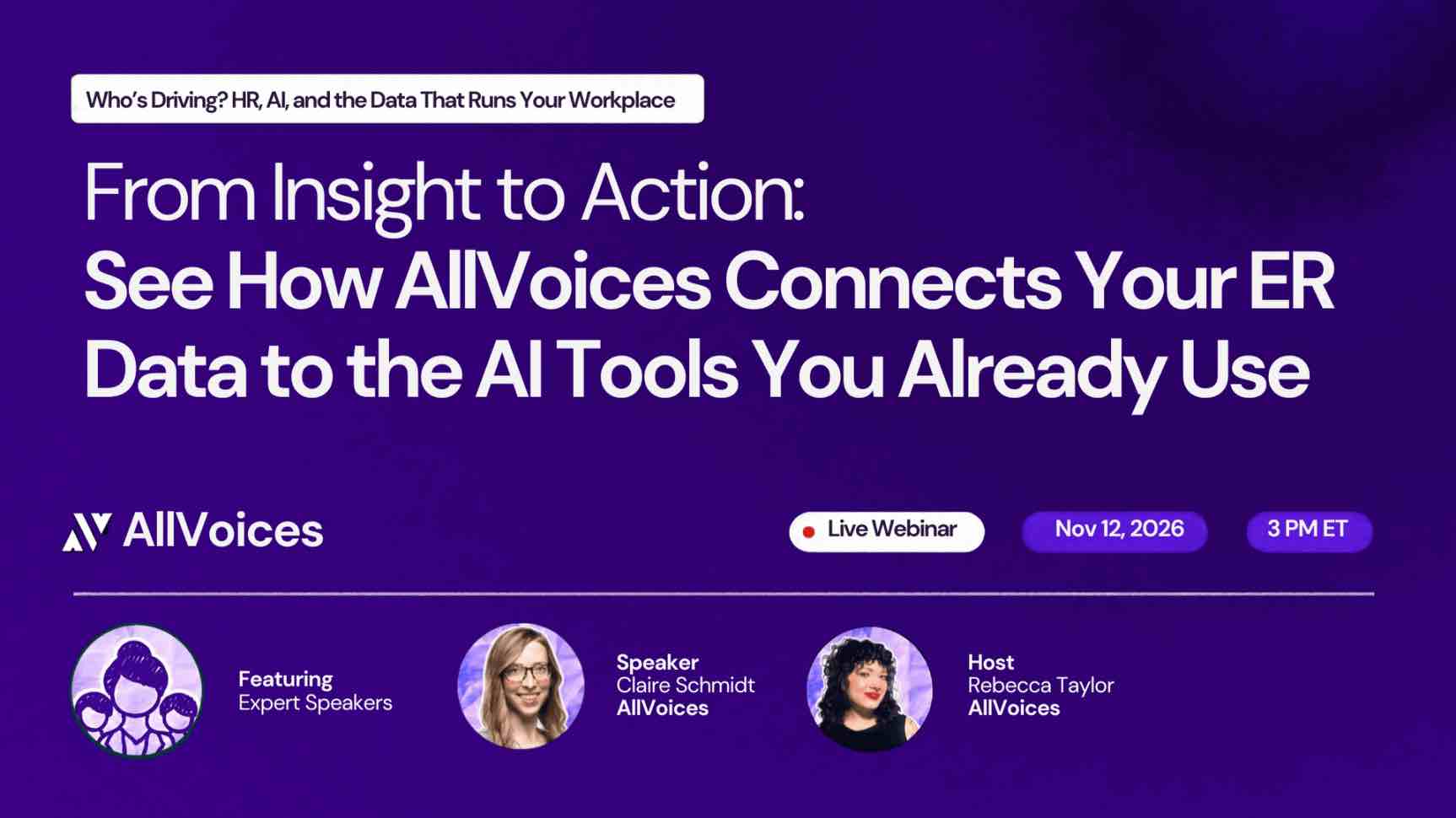
See how AllVoices supports people teams who want to scale culture deliberately rather than reactively.

Our next webinar
Frequently asked questions

Got more questions? Email us at support@allvoices.co and we'll respond ASAP.

No items found.
Frequently asked questions

Got more questions? Email us at support@allvoices.co and we'll respond ASAP.

No items found.
Realign and Reset Mindsets with Kyan Wei, Director of Talent Acquisition and DEIB Chair at Therapy Brands
Episode 378
About This Episode
In this episode of Reimagining Company Culture, we’re chatting with Kyan Wei, Director of Talent Acquisition and DEIB Chair at Therapy Brands. Kyan is a talent acquisition professional, recruitment and people management strategist. Tune in to learn Kyan’s thoughts on scaling company culture, the unique role of HR and DEI leaders, examples and transparency and effective company communication, and more!
About The Guest
Kyan is a talent acquisition professional, recruitment and people management strategist. He is a HCM/ATS/LMS implementation specialist, career transition coach and mentor.
Episode Transcription

Scaling company culture often requires resetting the mindsets that built the early version. The original team's habits do not always travel. The original founders' instincts are not always the right defaults at a hundred employees, let alone a thousand. Kyan Wei, Director of Talent Acquisition and DEIB Chair at Therapy Brands, makes the case on Reimagining Company Culture for treating mindset realignment as an explicit operational task rather than an emergent process.

Kyan's background as a recruitment and people-management strategist gives him a particular view. He has watched what happens when companies hire faster than they realign. The early-team mindset hits the new-hire mindset, and the culture either bends or breaks.

Why Scaling Requires Mindset Resets

The patterns that worked at twenty employees do not work at two hundred. Decisions made by Slack consensus break when the consensus pool is too large. Manager promotions made on individual contribution break when the new managers have no training. The original culture has to be re-articulated for the company that exists now.

Gallup's State of the Global Workplace report shows that engagement levels at best-practice organizations sit near 70%, while the global average is around 22%. The gap is largely operational. Companies that have done the mindset and infrastructure work produce the best-practice numbers; companies that have not produce the global-average ones.

The Unique Role of HR and DEI Leaders in Resets

Kyan's framing is that HR and DEI leaders are the operating layer that makes mindset resets possible. They have the data, the relationships, and the structural authority to identify which patterns need to change. The companies that support them produce smoother transitions; the companies that sideline them produce predictable cultural fractures.

The infrastructure matters. DEI work that scales with the company tends to compound. Engagement programs tied to mindset reset goals produce visible results.

What Are the Most Common Mindset Failures During Scaling?

The "we don't do that here" reflex when a new hire suggests something the early team did not need. The reverse: importing entire playbooks from the new hire's previous company. The middle path is intentional integration.

How Do You Know a Mindset Reset Is Working?

Reduced friction in cross-functional decisions. Faster onboarding ramp. Engagement scores that rise as the new hires settle. Each metric is worth tracking quarterly.

Examples and Transparency in Effective Communication

Kyan's argument is that effective communication during scaling depends on specific examples and visible transparency. Vague memos do not move mindsets. Specific examples of how decisions get made now, what changed, and why, produce a different kind of clarity. The companies that publish their reasoning produce different cultural alignment than companies that announce conclusions only.

What Actually Works for Cultural Scaling

Train Hiring Managers on the Reset

Hiring managers carry the culture into every interview. Training them on the reset goals produces different hire profiles than leaving them to interpret on their own.

Document the Cultural Operating Model

Vague values do not survive scaling. Documented operating norms, decision-making patterns, and conflict resolution paths produce a cultural artifact the new hires can read.

Use Anonymous Channels to Surface the Friction

Cultural friction is uncomfortable to raise in person. Anonymous reporting creates a path for the friction signals that would otherwise stay hidden.

Where Employee Relations Fits

ER catches the cases that scaling produces. A purpose-built case management platform handles them with the structure scaling requires. Pattern data informs the next round of mindset reset work.

How AI Supports Scaling People Functions

Vera, the AllVoices AI co-pilot, drafts responses, summarizes histories, and surfaces patterns. The judgment stays with the ER specialist; the drudge work moves to the AI.

Frequently Asked Questions About Cultural Scaling

How often should the cultural operating model be refreshed?

Roughly every doubling of headcount, with smaller updates between. The operating norms that work at fifty break at a hundred and break harder at two hundred.

How do you handle long-tenured employees who resist resets?

Engage explicitly. Acknowledge what worked in the early version. Articulate what has to change and why. The companies that respect tenure and ask for the reset produce different outcomes than companies that ignore tenure or dismiss it.

What is the recruiter's role in cultural scaling?

To screen for the values that survive the reset, not the values that worked in the early company. The shift is hard and necessary.

How do you handle a hire who flat-out rejects the cultural reset?

Direct conversation, then performance plan, then exit if needed. Companies that tolerate rejection create cultural drift faster than they realize.

What is the right cadence for skip-levels during a reset?

Monthly is the right floor during active reset periods. Quarterly when the reset has stabilized.

The Bottom Line for HR Leaders

Kyan's framing of mindset resets as an operational discipline is the right altitude. Scaling companies that do not realign produce cultural drift; companies that realign deliberately produce a culture that survives the next doubling.

SHRM research on workplace burnout ranks poor leadership and heavy workloads as top burnout drivers. Both are downstream of cultural-scaling failures. The fix is upstream: realign mindsets, document operating norms, build manager benches, and back the work with real ER capacity.

How These Disciplines Hold Up at Different Company Sizes

The operational disciplines described here scale differently across organization sizes. Mid-market companies tend to feel the pressure first because they are growing past the informal practices that worked at smaller scale. Enterprise companies feel the pressure differently: their existing infrastructure is solid, but it can ossify around legacy patterns that no longer serve a modern workforce. Both face the same underlying challenge of balancing structure with humanity.

The pattern that holds across sizes is that the work is operational rather than aspirational. Companies that treat the people function as a real operating discipline produce different retention, engagement, and case-resolution outcomes than companies that treat it as a soft function. Talent management done with operational rigor produces compounding returns that announcement-driven approaches never match.

The compounding effect of consistent operational discipline shows up in the data over multi-year horizons. Companies that have built the infrastructure tend to see improving retention, faster issue resolution, and steadier engagement scores year over year. The investment is unglamorous; the cumulative outcome is significant for any people team measuring real business impact.

The patterns that travel across companies share a common feature: they treat the work as a multi-year operational discipline rather than a quarterly campaign. Companies that have done this consistently produce retention curves that diverge from peer-group averages within three to four years. The investment is significant, the returns are durable, and the cost of skipping the work is paid in attrition, lost institutional knowledge, and the eventual scramble to rebuild what could have been preserved with consistent attention.

The discipline also produces second-order effects that compound. ER cases tend to drop in volume as upstream interventions take hold. Engagement scores stabilize across business units that previously diverged. Internal mobility broadens because the people who would have left now stay long enough to advance. Each second-order effect feeds back into the first-order numbers, which is why the operational version of this work compounds while the announcement version dissipates.

See how AllVoices supports people teams who want to scale culture deliberately rather than reactively.

Want to learn more?
See the power of AllVoices today
Thank you! We look forward to meeting you soon
Oops! Something went wrong while submitting the form.
Frequently asked questions

Got more questions? Email us at support@allvoices.co and we'll respond ASAP.

No items found.
Frequently asked questions

Got more questions? Email us at support@allvoices.co and we'll respond ASAP.

No items found.