About This Episode
In this episode of Reimagining Company Culture, we’re chatting with Mia Ellis, Global Head of Diversity, Equity, and Inclusion at Mendix. Mia has over 13 years of experience in the higher education, healthcare, and retail industry working with adult learners in the community and with people leaders in a variety of corporate environments. Tune in to learn Mia’s thoughts on measuring belonging, holding folks to be accountable, intentionally thinking about global DEI, and more!
About The Guest
Mia Ellis is the Global Head of Diversity, Equity, and Inclusion at Mendix, a Siemens company. In her current role, she leads DEI initiatives for several areas of the business across the globe. She has over 13 years of experience in the higher education, healthcare, and retail industry working with adult learners in the community and with people leaders in a variety of corporate environments. She holds a bachelor’s degree in marketing, an MBA in Global Business, an MPS in Organizational Development and Change Management and is currently working towards her doctorate in Adult Learning and Development at Northwestern State University. Her research interests also include organizational psychology, human behavior, and emotions research. On a personal level, Mia is an avid traveler, reader, animal lover, and foodie. She is originally from New Jersey but currently resides in Pittsburgh, PA with her husband and two cats.
Episode Breakdown

The DEI leaders who actually move outcomes share an underrated skill: relational intelligence. The ability to read what is happening between people, anticipate what will land or backfire, and build the relationships that change minds. Mia Ellis, Global Head of Diversity, Equity, and Inclusion at Mendix, brings the lens to Reimagining Company Culture in a way that gives the field something more useful than the standard DEI vocabulary.

Mia's background spans higher education, healthcare, and retail before her current role at a Siemens company. The cross-industry experience produces the right kind of skepticism. Frameworks that travel poorly between contexts get exposed; the operational disciplines that hold up across industries earn their place in the strategy.

What Relational Intelligence Means in Practice

Relational intelligence is the discipline of understanding how decisions land across different audiences. The DEI announcement that excited the executive committee may have produced fear in the middle-management layer. The diversity goal that the board endorsed may have undermined a long-tenured manager who feels their work is being delegitimized. Reading those dynamics is the work.

McKinsey research on diversity, equity, and inclusion on the inclusion sentiment gap reinforces the relevance. Diversity sentiment is broadly positive while inclusion sentiment is broadly negative, which means the operational reality is more contested than the demographic representation suggests. Relational intelligence is what surfaces the contestation.

Measuring Belonging With Operational Discipline

Mia's argument is that belonging has to be measured to be managed. Survey questions specifically about belonging. Retention and internal mobility cuts by demographic. Qualitative pulse signals from skip-level interviews. ER pattern data by manager. The metrics together produce a picture that any single signal would miss.

The infrastructure matters. DEI programs with operational measurement produce different outcomes than programs that operate on intuition.

What Is the Difference Between Engagement and Belonging?

Engagement is whether people are showing up effectively. Belonging is whether they feel they fit. Companies can have high engagement and low belonging if the dominant culture rewards a narrow profile. Measuring both surfaces the gap.

How Do You Hold People Leaders Accountable to Inclusion Outcomes?

Tie the outcomes to manager scorecards. Track promotion rate, retention rate, and skip-level engagement scores by manager and team. Companies that publish these dashboards internally produce different leadership behavior than companies that keep them in HR.

The Cross-Industry Lessons

Mia's cross-industry path produces useful comparisons. Healthcare DEI work looks different than tech DEI work; both look different than retail DEI work. The lesson is that operational disciplines travel; specific tactics do not. Companies that import frameworks without adaptation usually produce friction in both directions.

What Actually Works for DEI Outcomes

Build Relational Intelligence in the DEI Function

The hires that matter are the people who can read the room and adapt the message. The pure researchers struggle without the relational skill; the pure relationship-builders struggle without the operational rigor. The combination is what produces durable outcomes.

Tie Inclusion Goals to Manager Scorecards

Goals without consequences produce activity without outcomes. Manager scorecards that include inclusion outcomes produce different leadership behavior than scorecards that do not.

Use Anonymous Channels for the Patterns Surveys Cannot Catch

Anonymous reporting matters disproportionately for inclusion concerns. The surveys cannot capture what people will not raise in their own name.

Where Employee Relations Fits

ER is the function that catches the inclusion failures that produce formal cases. A purpose-built case management platform handles those cases. Pattern data informs the relational-intelligence work and the structural-change priorities.

How AI Surfaces Patterns Relational Intelligence Cannot Catch

Vera, the AllVoices AI co-pilot, surfaces patterns across cases that human relational intelligence would miss working case by case. The patterns inform the next quarter's priorities.

Frequently Asked Questions About DEI Measurement

What is the most useful DEI metric for executives?

Promotion rate by demographic by level. The metric captures both representation and advancement in a single signal that boards understand.

How often should belonging surveys run?

Quarterly is the floor for most companies. Pulse surveys on specific belonging questions can run monthly between full cycles.

How do you handle a manager whose team scores low on belonging?

Coaching, calibration audit, and structural change if needed. The companies that protect the manager without intervening produce predictable retention failures.

Should DEI report to HR or to the CEO?

Either structure can work. The structure matters less than the operating cadence and the relationship between DEI and HR.

How does relational intelligence get developed in DEI hires?

Through deliberate exposure to cross-functional partnerships, executive-committee experience, and structured reflection. Some of it is hireable; some of it has to be built through experience.

The Bottom Line for HR Leaders

Mia's framing of relational intelligence as a core DEI competency is the right altitude. The companies that produce sustained DEI outcomes have leaders who can read the dynamics, adjust the message, and hold the operational discipline. The combination compounds.

Gallup's State of the Global Workplace report continues to show that engagement varies dramatically across organizations and across teams within organizations. The variance often correlates with manager quality and inclusion practices, both of which are downstream of relational intelligence in the leadership team.

How These Disciplines Hold Up at Different Company Sizes

The operational disciplines described here scale differently across organization sizes. Mid-market companies tend to feel the pressure first because they are growing past the informal practices that worked at smaller scale. Enterprise companies feel the pressure differently: their existing infrastructure is solid, but it can ossify around legacy patterns that no longer serve a modern workforce. Both face the same underlying challenge of balancing structure with humanity.

The pattern that holds across sizes is that the work is operational rather than aspirational. Companies that treat the people function as a real operating discipline produce different retention, engagement, and case-resolution outcomes than companies that treat it as a soft function. Talent management done with operational rigor produces compounding returns that announcement-driven approaches never match.

The compounding effect of consistent operational discipline shows up in the data over multi-year horizons. Companies that have built the infrastructure tend to see improving retention, faster issue resolution, and steadier engagement scores year over year. The investment is unglamorous; the cumulative outcome is significant for any people team measuring real business impact.

The patterns that travel across companies share a common feature: they treat the work as a multi-year operational discipline rather than a quarterly campaign. Companies that have done this consistently produce retention curves that diverge from peer-group averages within three to four years. The investment is significant, the returns are durable, and the cost of skipping the work is paid in attrition, lost institutional knowledge, and the eventual scramble to rebuild what could have been preserved with consistent attention.

The discipline also produces second-order effects that compound. ER cases tend to drop in volume as upstream interventions take hold. Engagement scores stabilize across business units that previously diverged. Internal mobility broadens because the people who would have left now stay long enough to advance. Each second-order effect feeds back into the first-order numbers, which is why the operational version of this work compounds while the announcement version dissipates.
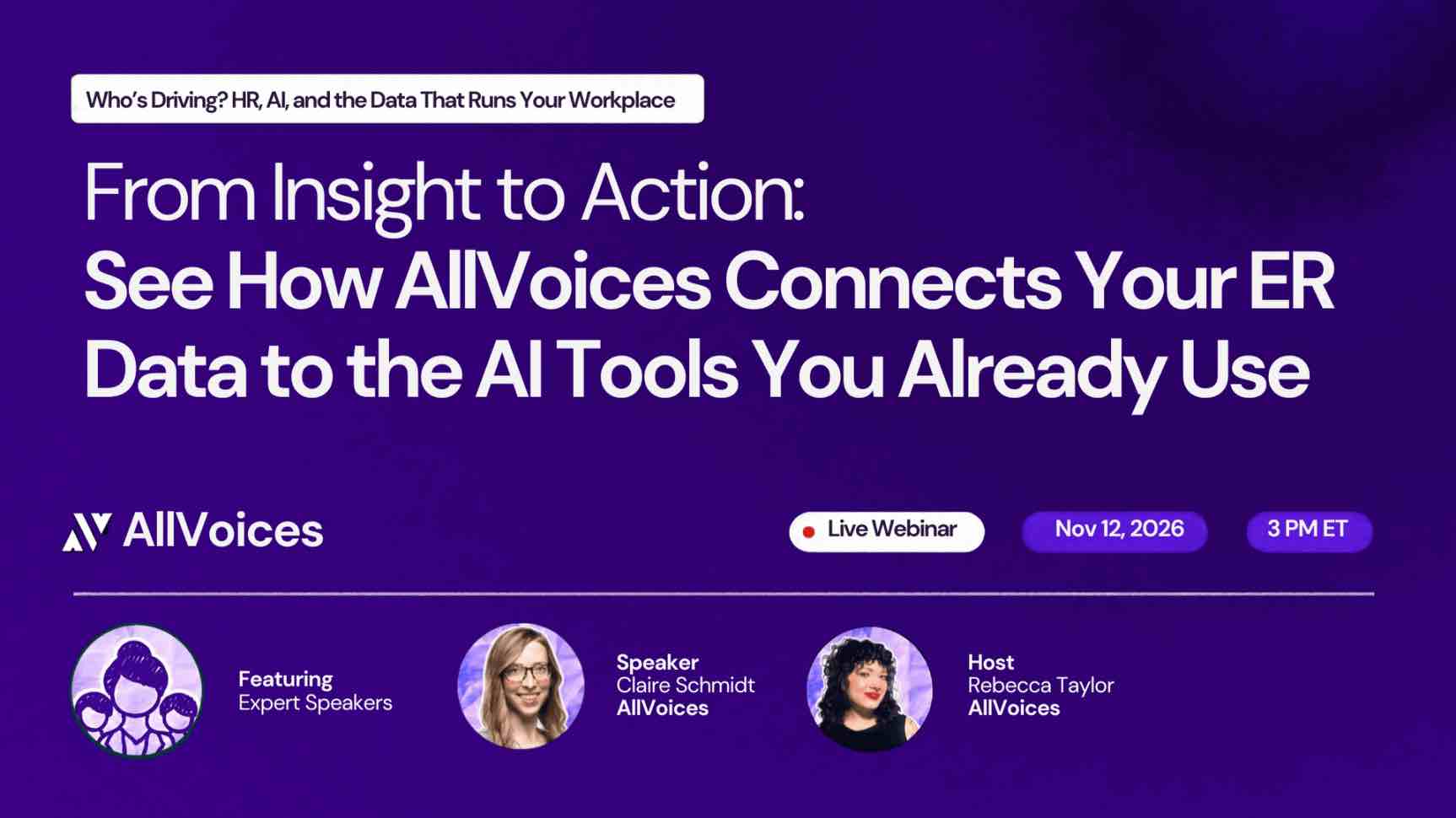
See how AllVoices supports HR and DEI teams who want to back up relational intelligence with real operational measurement and resolution infrastructure.

Our next webinar
Frequently asked questions

Got more questions? Email us at support@allvoices.co and we'll respond ASAP.

No items found.
Frequently asked questions

Got more questions? Email us at support@allvoices.co and we'll respond ASAP.

No items found.
Relational Intelligence with Mia Ellis, Global Head of Diversity, Equity, and Inclusion at Mendix
Episode 342
About This Episode
In this episode of Reimagining Company Culture, we’re chatting with Mia Ellis, Global Head of Diversity, Equity, and Inclusion at Mendix. Mia has over 13 years of experience in the higher education, healthcare, and retail industry working with adult learners in the community and with people leaders in a variety of corporate environments. Tune in to learn Mia’s thoughts on measuring belonging, holding folks to be accountable, intentionally thinking about global DEI, and more!
About The Guest
Mia Ellis is the Global Head of Diversity, Equity, and Inclusion at Mendix, a Siemens company. In her current role, she leads DEI initiatives for several areas of the business across the globe. She has over 13 years of experience in the higher education, healthcare, and retail industry working with adult learners in the community and with people leaders in a variety of corporate environments. She holds a bachelor’s degree in marketing, an MBA in Global Business, an MPS in Organizational Development and Change Management and is currently working towards her doctorate in Adult Learning and Development at Northwestern State University. Her research interests also include organizational psychology, human behavior, and emotions research. On a personal level, Mia is an avid traveler, reader, animal lover, and foodie. She is originally from New Jersey but currently resides in Pittsburgh, PA with her husband and two cats.
Episode Transcription

The DEI leaders who actually move outcomes share an underrated skill: relational intelligence. The ability to read what is happening between people, anticipate what will land or backfire, and build the relationships that change minds. Mia Ellis, Global Head of Diversity, Equity, and Inclusion at Mendix, brings the lens to Reimagining Company Culture in a way that gives the field something more useful than the standard DEI vocabulary.

Mia's background spans higher education, healthcare, and retail before her current role at a Siemens company. The cross-industry experience produces the right kind of skepticism. Frameworks that travel poorly between contexts get exposed; the operational disciplines that hold up across industries earn their place in the strategy.

What Relational Intelligence Means in Practice

Relational intelligence is the discipline of understanding how decisions land across different audiences. The DEI announcement that excited the executive committee may have produced fear in the middle-management layer. The diversity goal that the board endorsed may have undermined a long-tenured manager who feels their work is being delegitimized. Reading those dynamics is the work.

McKinsey research on diversity, equity, and inclusion on the inclusion sentiment gap reinforces the relevance. Diversity sentiment is broadly positive while inclusion sentiment is broadly negative, which means the operational reality is more contested than the demographic representation suggests. Relational intelligence is what surfaces the contestation.

Measuring Belonging With Operational Discipline

Mia's argument is that belonging has to be measured to be managed. Survey questions specifically about belonging. Retention and internal mobility cuts by demographic. Qualitative pulse signals from skip-level interviews. ER pattern data by manager. The metrics together produce a picture that any single signal would miss.

The infrastructure matters. DEI programs with operational measurement produce different outcomes than programs that operate on intuition.

What Is the Difference Between Engagement and Belonging?

Engagement is whether people are showing up effectively. Belonging is whether they feel they fit. Companies can have high engagement and low belonging if the dominant culture rewards a narrow profile. Measuring both surfaces the gap.

How Do You Hold People Leaders Accountable to Inclusion Outcomes?

Tie the outcomes to manager scorecards. Track promotion rate, retention rate, and skip-level engagement scores by manager and team. Companies that publish these dashboards internally produce different leadership behavior than companies that keep them in HR.

The Cross-Industry Lessons

Mia's cross-industry path produces useful comparisons. Healthcare DEI work looks different than tech DEI work; both look different than retail DEI work. The lesson is that operational disciplines travel; specific tactics do not. Companies that import frameworks without adaptation usually produce friction in both directions.

What Actually Works for DEI Outcomes

Build Relational Intelligence in the DEI Function

The hires that matter are the people who can read the room and adapt the message. The pure researchers struggle without the relational skill; the pure relationship-builders struggle without the operational rigor. The combination is what produces durable outcomes.

Tie Inclusion Goals to Manager Scorecards

Goals without consequences produce activity without outcomes. Manager scorecards that include inclusion outcomes produce different leadership behavior than scorecards that do not.

Use Anonymous Channels for the Patterns Surveys Cannot Catch

Anonymous reporting matters disproportionately for inclusion concerns. The surveys cannot capture what people will not raise in their own name.

Where Employee Relations Fits

ER is the function that catches the inclusion failures that produce formal cases. A purpose-built case management platform handles those cases. Pattern data informs the relational-intelligence work and the structural-change priorities.

How AI Surfaces Patterns Relational Intelligence Cannot Catch

Vera, the AllVoices AI co-pilot, surfaces patterns across cases that human relational intelligence would miss working case by case. The patterns inform the next quarter's priorities.

Frequently Asked Questions About DEI Measurement

What is the most useful DEI metric for executives?

Promotion rate by demographic by level. The metric captures both representation and advancement in a single signal that boards understand.

How often should belonging surveys run?

Quarterly is the floor for most companies. Pulse surveys on specific belonging questions can run monthly between full cycles.

How do you handle a manager whose team scores low on belonging?

Coaching, calibration audit, and structural change if needed. The companies that protect the manager without intervening produce predictable retention failures.

Should DEI report to HR or to the CEO?

Either structure can work. The structure matters less than the operating cadence and the relationship between DEI and HR.

How does relational intelligence get developed in DEI hires?

Through deliberate exposure to cross-functional partnerships, executive-committee experience, and structured reflection. Some of it is hireable; some of it has to be built through experience.

The Bottom Line for HR Leaders

Mia's framing of relational intelligence as a core DEI competency is the right altitude. The companies that produce sustained DEI outcomes have leaders who can read the dynamics, adjust the message, and hold the operational discipline. The combination compounds.

Gallup's State of the Global Workplace report continues to show that engagement varies dramatically across organizations and across teams within organizations. The variance often correlates with manager quality and inclusion practices, both of which are downstream of relational intelligence in the leadership team.

How These Disciplines Hold Up at Different Company Sizes

The operational disciplines described here scale differently across organization sizes. Mid-market companies tend to feel the pressure first because they are growing past the informal practices that worked at smaller scale. Enterprise companies feel the pressure differently: their existing infrastructure is solid, but it can ossify around legacy patterns that no longer serve a modern workforce. Both face the same underlying challenge of balancing structure with humanity.

The pattern that holds across sizes is that the work is operational rather than aspirational. Companies that treat the people function as a real operating discipline produce different retention, engagement, and case-resolution outcomes than companies that treat it as a soft function. Talent management done with operational rigor produces compounding returns that announcement-driven approaches never match.

The compounding effect of consistent operational discipline shows up in the data over multi-year horizons. Companies that have built the infrastructure tend to see improving retention, faster issue resolution, and steadier engagement scores year over year. The investment is unglamorous; the cumulative outcome is significant for any people team measuring real business impact.

The patterns that travel across companies share a common feature: they treat the work as a multi-year operational discipline rather than a quarterly campaign. Companies that have done this consistently produce retention curves that diverge from peer-group averages within three to four years. The investment is significant, the returns are durable, and the cost of skipping the work is paid in attrition, lost institutional knowledge, and the eventual scramble to rebuild what could have been preserved with consistent attention.

The discipline also produces second-order effects that compound. ER cases tend to drop in volume as upstream interventions take hold. Engagement scores stabilize across business units that previously diverged. Internal mobility broadens because the people who would have left now stay long enough to advance. Each second-order effect feeds back into the first-order numbers, which is why the operational version of this work compounds while the announcement version dissipates.

See how AllVoices supports HR and DEI teams who want to back up relational intelligence with real operational measurement and resolution infrastructure.

Want to learn more?
See the power of AllVoices today
Thank you! We look forward to meeting you soon
Oops! Something went wrong while submitting the form.
Frequently asked questions

Got more questions? Email us at support@allvoices.co and we'll respond ASAP.

No items found.
Frequently asked questions

Got more questions? Email us at support@allvoices.co and we'll respond ASAP.

No items found.