About This Episode
In this episode of Reimagining Company Culture, we’re chatting with Khady Gaye, Manager of HR Corporate at United. Khady is an HR leader, DEI advocate and authentic storyteller who stands by the mantra “Inclusion is the solution to exclusion”
About The Guest
Born and raised in Ghent, with her roots in Senegal, Khady is currently based in Chicago and considers herself a citizen of the world. She holds Master's degrees in translation and HRM. Having started her professional life in local HR, she now works at the international level and has held many different positions along the way.
Episode Breakdown

Khady Gaye has built her HR career across Senegal, Belgium, and the United States, which gives her a useful vantage on what burnout looks like when you strip it of one country’s vocabulary. At United, she manages HR Corporate work with a clear thesis. Burnout is not a personal failure. It is a workload, culture, and manager behavior problem, and organizations that treat it as a wellness app line-item will keep losing their best people.

Our conversation with Khady focused on how People teams can build welcoming cultures that prevent burnout rather than mop it up after the fact. She connected burnout to belonging in a way most wellbeing programs miss: if employees feel like outsiders, they carry a cognitive load their colleagues do not, and they burn faster.

Below, we translate Khady’s point of view into a structural playbook HR leaders can apply.

Why Burnout Is a Workload and Culture Problem, Not a Resilience Gap

Khady’s starting point is that every burnout program that frames the problem as individual resilience is pointed at the wrong target. People burn out because the system is producing more cognitive load than the recovery time built into the system can absorb. Resilience coaching does not change that arithmetic.

The research aligns. McKinsey’s analysis of employee burnout found that toxic workplace behavior is the single biggest predictor of burnout and that eliminating high-toxicity climates would cut burnout risk by a factor of eight. That finding reframes the fix. Burnout is produced by systems. It must be solved by systems.

This is the frame the AllVoices company culture solutions operating model starts from. You cannot coach one employee at a time out of an environment that manufactures exhaustion.

How Belonging Lowers the Burnout Curve

Khady spends real time on the link between belonging and endurance. Employees who feel like they belong conserve the cognitive energy that outsiders burn through navigating subtle exclusion. The result is not a moral statement. It is a measurable difference in sustained performance.

She points out three patterns that manufacture non-belonging. First, meetings where only the loudest voices count as contribution. Second, informal decisions made in side channels that exclude people who were hired remote or are in minority groups. Third, feedback systems that reward agreement rather than sharpness. Each one quietly taxes the people who do not fit the default pattern.

What does a welcoming culture look like in daily practice

Decisions are documented where every stakeholder can see them. Meeting formats balance verbal and written input. Managers invite dissent and do not punish it. Onboarding builds cross-functional relationships rather than leaving newcomers to absorb norms through osmosis. None of this is revolutionary. The hard part is the discipline to do it weekly.

How do you measure belonging without overclaiming

Use short targeted items in your pulse survey. Ask whether employees feel their voice is heard in meetings, whether they know who to talk to when something feels wrong, and whether they see people like them at the level they are trying to reach. Pair those items with employee engagement scores to see how the two move together.

What Actually Works to Prevent Burnout

Principle 1: Make workload visible before you make it lighter

Most managers cannot accurately describe the load on their teams. Khady recommends a simple quarterly workload mapping exercise where each employee lists the projects they own, the projects they support, and the meetings that consume their week. Managers read those maps and make cuts. You cannot prevent burnout from a load you have never actually counted.

Principle 2: Coach managers on the behaviors that produce toxicity

Gallup’s research puts managers at up to 70 percent of the variance in team engagement. The manager behaviors that produce burnout are observable and coachable. Public criticism, unclear priorities, unresponsive escalation, and favoritism all show up in ER intake. When data and insights reporting connects case themes back to specific managers, coaching becomes targeted rather than generic.

Principle 3: Treat recovery time as a production input

Sustained output requires recovery time. That means actual PTO usage rather than policy, cadence rules for evening and weekend messages, and explicit norms about response times. Organizations that ignore recovery time end up paying for it in attrition within 18 months.

Where Employee Relations Fits in Burnout Prevention

Employee Relations intake is the most sensitive burnout signal most companies ignore. Spikes in bullying, workload complaints, and manager-behavior concerns precede engagement score drops by one to two quarters. A People team that watches ER trend data as a leading indicator can intervene before the culture hardens.

The AllVoices HR case management platform gives ER teams the ability to tag cases by category and business unit, so repeat patterns surface early. Paired with Vera, the AI co-pilot for employee relations, intake-to-insight time compresses, which means the data reaches decision-makers while the pattern is still reversible.

How should ER and wellbeing teams share data

Agree on a common taxonomy. Review themes monthly. Set thresholds that trigger a targeted wellbeing intervention. If intake volume in a business unit jumps without a clear driver, that is a signal for a targeted pulse or a facilitated team conversation, not a generic mindfulness webinar.

Frequently Asked Questions About Employee Burnout

Why do individual wellness programs rarely move the burnout needle

Because they do not change the system producing the load. A meditation app cannot offset an unsustainable project plan, an unclear priority list, or a manager who punishes boundaries. Programs that help are the ones that reduce sources of load. Programs that ask employees to absorb more get low uptake and low impact.

What are the earliest signals a team is heading toward burnout

Higher meeting counts, slower email response, shorter PTO blocks, more sick days, and a rise in ER intake about workload or manager behavior. Engagement scores usually confirm the pattern after these early signals, not before. If your program waits for the survey, you are always reacting.

How do managers unintentionally accelerate burnout

By assigning without cutting, by responding inconsistently to concerns, and by modeling behaviors they claim to discourage. A manager who sends late-night Slack messages while telling the team to unplug produces exactly the opposite culture they intended. Managers do not fix burnout with speeches. They fix it with observable behavior.

Can flexibility alone prevent burnout

No. Flexibility is necessary but insufficient. A flexible schedule inside a toxic culture still produces burnout. The combination that works is flexibility plus clear priorities plus a manager who actively reduces load plus a visible path for raising concerns.

How does belonging connect to burnout

Employees who feel like outsiders carry extra cognitive load managing micro-signals of exclusion. Over time that load contributes to exhaustion, cynicism, and reduced output, which are the three clinical markers of burnout. Building belonging is a direct burnout-prevention investment, not a soft one.

The Bottom Line for HR Leaders

Khady’s argument is not that burnout is unsolvable. It is that most programs aim at the wrong level of the system. Individual tools cannot outrun an unsustainable environment. Fixing burnout means mapping workload, coaching manager behavior, building genuine belonging, and using ER data as a leading indicator rather than a rearview mirror.

The companies that get this right will spend less on turnover, produce more sustained output, and build the kind of reputation that makes recruiting easier. The ones that do not will keep cycling through wellness initiatives while their best people quietly plan their exit.

To see how AllVoices brings case intake, analytics, and welfare signals into one view so burnout is visible before it becomes attrition, request a walkthrough from our team.
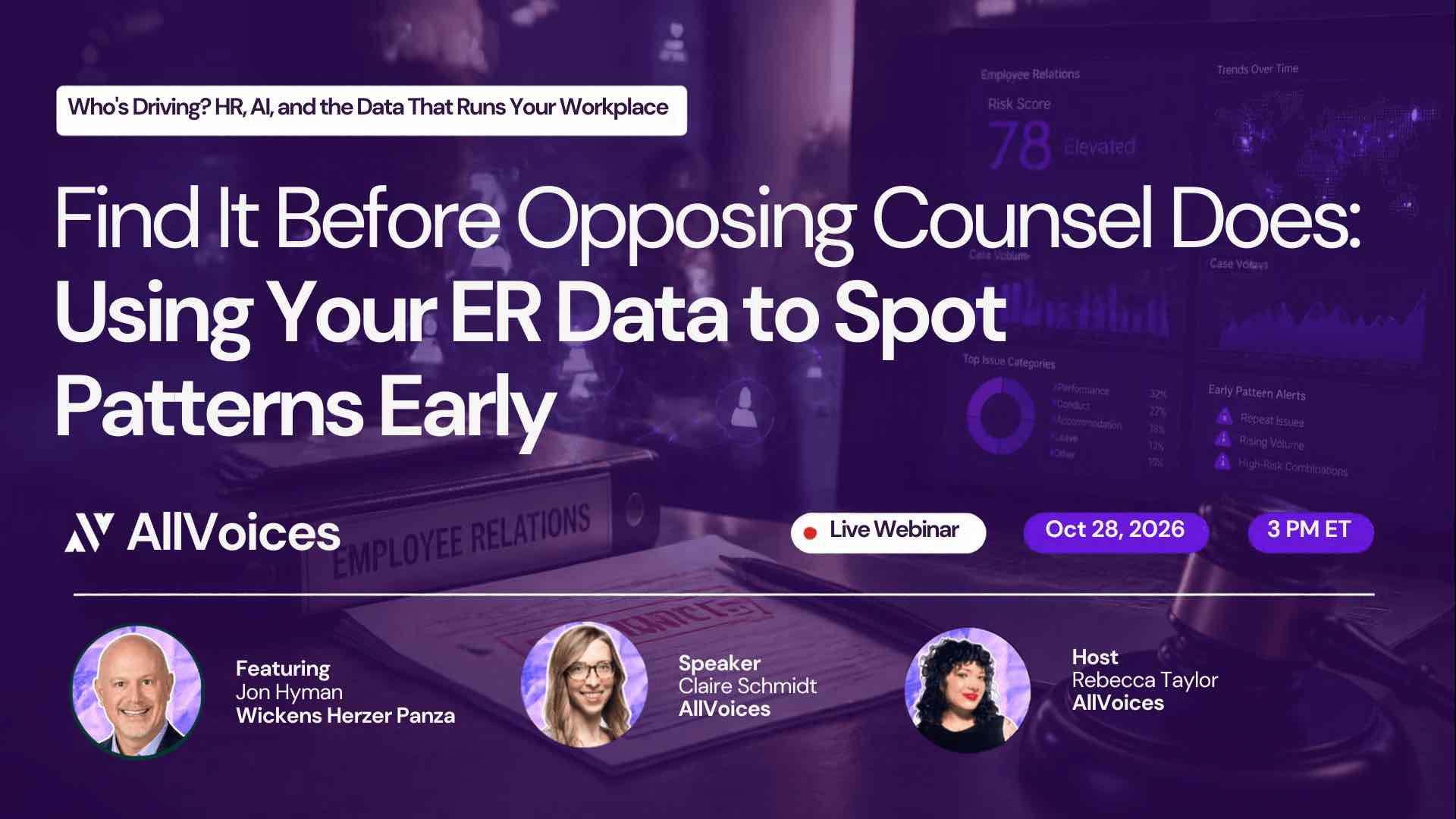
Our next webinar
Frequently asked questions

Got more questions? Email us at support@allvoices.co and we'll respond ASAP.

No items found.
Frequently asked questions

Got more questions? Email us at support@allvoices.co and we'll respond ASAP.

No items found.
Welcoming Company Cultures and Addressing Burnout with Khady Gaye
Episode 64
About This Episode
In this episode of Reimagining Company Culture, we’re chatting with Khady Gaye, Manager of HR Corporate at United. Khady is an HR leader, DEI advocate and authentic storyteller who stands by the mantra “Inclusion is the solution to exclusion”
About The Guest
Born and raised in Ghent, with her roots in Senegal, Khady is currently based in Chicago and considers herself a citizen of the world. She holds Master's degrees in translation and HRM. Having started her professional life in local HR, she now works at the international level and has held many different positions along the way.
Episode Transcription

Khady Gaye has built her HR career across Senegal, Belgium, and the United States, which gives her a useful vantage on what burnout looks like when you strip it of one country’s vocabulary. At United, she manages HR Corporate work with a clear thesis. Burnout is not a personal failure. It is a workload, culture, and manager behavior problem, and organizations that treat it as a wellness app line-item will keep losing their best people.

Our conversation with Khady focused on how People teams can build welcoming cultures that prevent burnout rather than mop it up after the fact. She connected burnout to belonging in a way most wellbeing programs miss: if employees feel like outsiders, they carry a cognitive load their colleagues do not, and they burn faster.

Below, we translate Khady’s point of view into a structural playbook HR leaders can apply.

Why Burnout Is a Workload and Culture Problem, Not a Resilience Gap

Khady’s starting point is that every burnout program that frames the problem as individual resilience is pointed at the wrong target. People burn out because the system is producing more cognitive load than the recovery time built into the system can absorb. Resilience coaching does not change that arithmetic.

The research aligns. McKinsey’s analysis of employee burnout found that toxic workplace behavior is the single biggest predictor of burnout and that eliminating high-toxicity climates would cut burnout risk by a factor of eight. That finding reframes the fix. Burnout is produced by systems. It must be solved by systems.

This is the frame the AllVoices company culture solutions operating model starts from. You cannot coach one employee at a time out of an environment that manufactures exhaustion.

How Belonging Lowers the Burnout Curve

Khady spends real time on the link between belonging and endurance. Employees who feel like they belong conserve the cognitive energy that outsiders burn through navigating subtle exclusion. The result is not a moral statement. It is a measurable difference in sustained performance.

She points out three patterns that manufacture non-belonging. First, meetings where only the loudest voices count as contribution. Second, informal decisions made in side channels that exclude people who were hired remote or are in minority groups. Third, feedback systems that reward agreement rather than sharpness. Each one quietly taxes the people who do not fit the default pattern.

What does a welcoming culture look like in daily practice

Decisions are documented where every stakeholder can see them. Meeting formats balance verbal and written input. Managers invite dissent and do not punish it. Onboarding builds cross-functional relationships rather than leaving newcomers to absorb norms through osmosis. None of this is revolutionary. The hard part is the discipline to do it weekly.

How do you measure belonging without overclaiming

Use short targeted items in your pulse survey. Ask whether employees feel their voice is heard in meetings, whether they know who to talk to when something feels wrong, and whether they see people like them at the level they are trying to reach. Pair those items with employee engagement scores to see how the two move together.

What Actually Works to Prevent Burnout

Principle 1: Make workload visible before you make it lighter

Most managers cannot accurately describe the load on their teams. Khady recommends a simple quarterly workload mapping exercise where each employee lists the projects they own, the projects they support, and the meetings that consume their week. Managers read those maps and make cuts. You cannot prevent burnout from a load you have never actually counted.

Principle 2: Coach managers on the behaviors that produce toxicity

Gallup’s research puts managers at up to 70 percent of the variance in team engagement. The manager behaviors that produce burnout are observable and coachable. Public criticism, unclear priorities, unresponsive escalation, and favoritism all show up in ER intake. When data and insights reporting connects case themes back to specific managers, coaching becomes targeted rather than generic.

Principle 3: Treat recovery time as a production input

Sustained output requires recovery time. That means actual PTO usage rather than policy, cadence rules for evening and weekend messages, and explicit norms about response times. Organizations that ignore recovery time end up paying for it in attrition within 18 months.

Where Employee Relations Fits in Burnout Prevention

Employee Relations intake is the most sensitive burnout signal most companies ignore. Spikes in bullying, workload complaints, and manager-behavior concerns precede engagement score drops by one to two quarters. A People team that watches ER trend data as a leading indicator can intervene before the culture hardens.

The AllVoices HR case management platform gives ER teams the ability to tag cases by category and business unit, so repeat patterns surface early. Paired with Vera, the AI co-pilot for employee relations, intake-to-insight time compresses, which means the data reaches decision-makers while the pattern is still reversible.

How should ER and wellbeing teams share data

Agree on a common taxonomy. Review themes monthly. Set thresholds that trigger a targeted wellbeing intervention. If intake volume in a business unit jumps without a clear driver, that is a signal for a targeted pulse or a facilitated team conversation, not a generic mindfulness webinar.

Frequently Asked Questions About Employee Burnout

Why do individual wellness programs rarely move the burnout needle

Because they do not change the system producing the load. A meditation app cannot offset an unsustainable project plan, an unclear priority list, or a manager who punishes boundaries. Programs that help are the ones that reduce sources of load. Programs that ask employees to absorb more get low uptake and low impact.

What are the earliest signals a team is heading toward burnout

Higher meeting counts, slower email response, shorter PTO blocks, more sick days, and a rise in ER intake about workload or manager behavior. Engagement scores usually confirm the pattern after these early signals, not before. If your program waits for the survey, you are always reacting.

How do managers unintentionally accelerate burnout

By assigning without cutting, by responding inconsistently to concerns, and by modeling behaviors they claim to discourage. A manager who sends late-night Slack messages while telling the team to unplug produces exactly the opposite culture they intended. Managers do not fix burnout with speeches. They fix it with observable behavior.

Can flexibility alone prevent burnout

No. Flexibility is necessary but insufficient. A flexible schedule inside a toxic culture still produces burnout. The combination that works is flexibility plus clear priorities plus a manager who actively reduces load plus a visible path for raising concerns.

How does belonging connect to burnout

Employees who feel like outsiders carry extra cognitive load managing micro-signals of exclusion. Over time that load contributes to exhaustion, cynicism, and reduced output, which are the three clinical markers of burnout. Building belonging is a direct burnout-prevention investment, not a soft one.

The Bottom Line for HR Leaders

Khady’s argument is not that burnout is unsolvable. It is that most programs aim at the wrong level of the system. Individual tools cannot outrun an unsustainable environment. Fixing burnout means mapping workload, coaching manager behavior, building genuine belonging, and using ER data as a leading indicator rather than a rearview mirror.

The companies that get this right will spend less on turnover, produce more sustained output, and build the kind of reputation that makes recruiting easier. The ones that do not will keep cycling through wellness initiatives while their best people quietly plan their exit.

To see how AllVoices brings case intake, analytics, and welfare signals into one view so burnout is visible before it becomes attrition, request a walkthrough from our team.

Want to learn more?
See the power of AllVoices today
Thank you! We look forward to meeting you soon
Oops! Something went wrong while submitting the form.
Frequently asked questions

Got more questions? Email us at support@allvoices.co and we'll respond ASAP.

No items found.
Frequently asked questions

Got more questions? Email us at support@allvoices.co and we'll respond ASAP.

No items found.