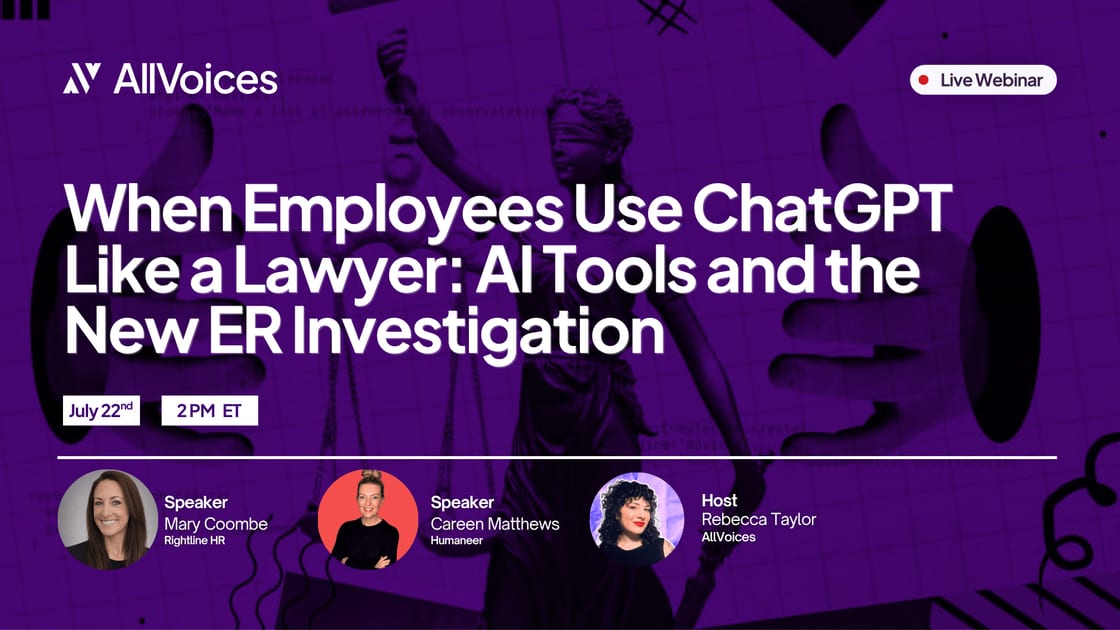
When Employees Use ChatGPT Like a Lawyer: AI Tools and the New ER Investigation
Employees now show up to investigations having already drafted their grievance, looked up the statutes they think apply, and pressure-tested the whole story with ChatGPT, all before HR schedules a single interview. AI-generated complaints have quietly moved the starting line of employee relations work, and most teams are still adjusting to what that means in practice. The complaint that lands on your desk is no longer a rough first draft. It is a rehearsed, researched, and confidently framed argument that arrived before the conversation did.
The change is subtle enough to miss and big enough to reshape how you run a case. The facts underneath a complaint have not changed. What has changed is the speed, the polish, and the certainty an employee brings to the table, along with the much smaller margin you now have to get your process right.
On July 22, Rebecca Taylor of AllVoices hosted a conversation built to look at this shift from two angles that rarely share a room. Mary Coombe is a practicing general counsel and the founder of Rightline HR, an internal investigations playbook. She reviews investigation files after the fact, which means she sees exactly which ones survive legal scrutiny and which ones come apart under it.
Careen Matthews is the CEO and co-founder of Humaneer, an AI-powered HR platform, and she leads a global community of nearly 2,000 HR professionals. She reads this shift less as a legal exposure story and more as a capacity story. Between the two of them, they mapped what is actually different now, what has not changed at all, and what your team should do about both.
How can you tell when a complaint was written with AI?
You often cannot tell for certain, and both panelists warned against building your process on a guess. The signals are real, but they are soft, and treating a hunch as a verdict creates its own risk. The most useful tell is language that does not fit the person in front of you.
Legalese is the clearest one. Complaints used to sound like the people who wrote them: plain, specific, and rooted in what actually happened to them. When a grievance suddenly cites a statute by name, references a policy standard, or reaches for the kind of framing an employee would almost never use on their own, that gap is worth noticing. Coombe has watched it change over fifteen years of reviewing files.
Most employees ten years ago were not citing statutes or the Civil Rights Act. They were explaining, in their own words, what happened. - Mary Coombe, general counsel and founder of Rightline HR
The detail that makes this a genuine signal is that the legal profession spent years working in the opposite direction, stripping the jargon out to sound more human. So when dense legal language reappears in a frontline complaint, it stands out precisely because it runs against the grain of how real people describe their own problems.
The second tell is emotional distance. A complaint someone wrote themselves usually carries the reason they came forward, because the situation is personal to them. An AI draft tends to read very differently.
AI just doesn't give you that same emotion. It's a lot more formulaic, a lot more clinical, a little bit removed from the situation. - Mary Coombe
This is also where the guessing gets dangerous, and Coombe was careful about it. Some employees keep a deliberately neutral tone because they want to be taken seriously, not because a machine wrote for them. Rebecca raised that exact point during the session: a person working hard not to sound "hysterical" can come across as clinical for entirely human reasons. A flat, buttoned-up tone is a reason to pay closer attention. It is not, on its own, a conclusion.
Matthews sees the same pattern arrive as packaging rather than word choice. Instead of a short message that opens a dialogue, HR now often receives a complete, structured case on first contact.
It becomes fully formed rather than that conversational piece to gather what's actually happened. It comes all at once. - Careen Matthews, CEO and co-founder of Humaneer
The practical effect is a different rhythm of intake. A fully formed complaint lands with more urgency and gives you less room to ask the clarifying questions that used to come first, which is part of why these cases feel heavier from the very first email.
Does using AI make a complaint more legitimate?
No. Using AI changes the volume and the packaging of a complaint, not the truth underneath it. Your job is still to establish what actually happened, and that job looks the same regardless of the tool the employee used to write it up.
Unless you're following that process, regardless of how the complaint came about, you're not actually determining what's true and what's false. - Careen Matthews
Coombe added the part that matters months later, when a case is challenged. The complaint itself is rarely what gets scrutinized. The investigation behind it is.
It's not necessarily the complaint that gets looked at down the line. It's the investigation. - Mary Coombe
There is a real edge for the other side here, and it is worth understanding. Coombe noted that plaintiff's attorneys are seeing the same shift, and a more sophisticated opening complaint can hand them stronger allegations to lead with from day one. They almost do not have to build the argument themselves, which pressures the organization into a firmer response earlier than it used to. A complaint can look more formidable on arrival. Whether it holds up still depends entirely on how sound your investigation is.
The trap sitting underneath the polish is certainty. When employees build their case with a chatbot, the tool tends to agree with them at every turn, so they arrive convinced of the outcome before you have asked a single question.
AI has basically agreed with them through the entire process. So they're coming to it from a place of, I just want the outcome now because I know what the outcome's going to be. - Careen Matthews
That certainty quietly adds a task to HR's plate. Rebecca pointed out that you are now often educating the employee mid-process, explaining that the outcome the tool implied may not be the outcome the facts support. That is extra tension layered onto an already tense moment, and it is worth planning for rather than absorbing on the fly. A strong workplace investigation process matters more here, not less, because the finding has to be free to disagree with the complaint and still stand up.
It is also why the ending sometimes looks nothing like the beginning. Because employees feed AI a partial version of events and get ideas fed back that may not match their actual situation, the substantiated finding can diverge sharply from the original allegation. That is not the complaint failing. That is the process doing its job.
The panel kept circling one distinction throughout the session. The inputs look different, but the discipline that makes a case defensible does not. Here is how the before and after line up.
| Before AI-assisted complaints | After AI-assisted complaints |
|---|---|
| Concerns arrived as a conversation or a short note | Complaints arrive fully formed, citing statutes and precedents |
| Tone was personal and emotional | Tone is neutral, formulaic, and clinical |
| Volume was manageable case by case | Volume is rising, pushing teams to triage |
| Gaps in a file were hard for the other side to spot | Gaps are easy to surface by running the file through AI |
| The process was the standard | The process is the standard, with far less room for error |
Are AI-generated complaints increasing HR's workload?
Yes. The barrier to filing has dropped, and volume has climbed with it, which is straining teams that already had full plates. Matthews said this is the clearest trend she hears across her community.
The barrier to entry now is so low for people to make a complaint that we have seen an increase in them. - Careen Matthews
She shared one concrete example from a conversation the day before the session. The organization reported that complaints had jumped by 55%, with the team estimating that roughly 90% of them were AI-assisted. The increase was large enough that they had to build a triage step just to keep pace. That is one company's experience rather than an industry benchmark, but it matches the direction other teams are describing.
The harder problem is capacity, not raw volume. Every additional complaint still has to be investigated fully, and no team gets extra hours in the day to do it. When the number of open cases climbs, something else quietly gets dropped, and that tradeoff is where the real exposure sits. Teams that try to absorb the increase without a system to manage a growing caseload of investigations tend to be the ones who let a step slip.
Matthews also flagged an early policy response from Australia, where she is based. She said complainants filing with the Fair Work Commission now have to declare whether AI was used, and that failing to disclose it can put a claim at risk. Treat that as her account from the session rather than settled law everywhere, but it is a useful sign of where disclosure norms may be heading, much like the expectation that an advertisement be labeled as one.
There is an upside buried in the flood, too. Matthews framed the wave of structured complaints as an unusually clear source of signal about employee sentiment, provided you have somewhere to capture and connect it. The information is arriving in a format you might not have chosen. It is still information.
How should you run an investigation when the employee already pre-lawyered it?
Run the same process you always would. If it is solid and you actually follow it, a pre-argued complaint does not change the steps. What it changes is how little room you now have to be sloppy.
What does change is that you have far less wiggle room for mistakes. Any holes or gaps in your investigation are a lot easier to find and a lot easier to exploit than they used to be. - Mary Coombe
The reason is straightforward. The same tools that helped the employee write the complaint can be pointed straight at your file. An employee, or a plaintiff's attorney, can run an investigation record through AI and surface every missing interview, undocumented decision, and skipped step in seconds. Gaps that once stayed buried are now trivial to find. That raises the stakes on the fundamentals:
- Plan the investigation before you start. Map your scope, your witness sequencing, and your interview questions up front so the file has a spine, not just a stack of notes.
- Document your reasoning, not just your conclusions. A finding without documented reasoning reads as an assertion, and anyone reviewing the file should be able to reach the same conclusion you did from what is written down.
- Ask what outcome the employee wants, early. It tells you where to start, it surfaces how much risk the person is carrying, and it gently prompts them to think through what they are actually asking for. It is a data point, never a directive.
- Keep retaliation follow-up in the file. Retaliation remains the most frequently filed charge with the EEOC, and the risk shifts rather than ends when a case closes, so document what you watched for and when.
Why your documentation has to exist before the complaint arrives
Coombe's sharpest warning was about timing, and it is the one to tape to your monitor.
Your attorney can only help you so much. By the time it gets to the attorney, it's already done, and they can't create what isn't there. - Mary Coombe
You cannot retrofit a consistent process once you are already in a lawsuit. You cannot recreate documentation that was never written, and trying to do so, Coombe noted, usually causes more harm than the gap it was meant to cover. Everyone needs to know their role, the intake has to be handled the same way no matter who takes the call, and the documentation has to be in place before the complaint ever lands.
There is one more trap worth naming plainly. During the session, an attendee suggested using AI to summarize the AI-written complaint. Stack enough of that together and your intake summary, your case notes, and the original grievance are all machine-generated, and you end up with the robots talking to each other. The context that keeps a file defensible is stubbornly human: the interview, the demeanor, and the credibility read.
What only a human can still do in an investigation
The credibility assessment is where human judgment stays decisive, and it is the part AI cannot replicate. Body language, tone, and the feel of a conversation still factor into how much weight you give what someone tells you. Coombe made the point that even a refusal to engage becomes usable information rather than a dead end.
When an employee will only communicate by email so they can keep running answers through AI, that choice does not stop the investigation. It becomes part of the credibility assessment, something you can weigh openly when you decide how much weight to give their account. Demeanor is a small piece of the picture, but it is a piece a chatbot simply cannot see.
Holding that judgment steady across a rising caseload is its own discipline. A central place to document every case the same way is what keeps the twentieth investigation as consistent and defensible as the first, and consistency stops being a nice-to-have the moment volume climbs.
What HR teams should stop assuming about AI-generated complaints
Stop assuming an AI-written complaint is adversarial, exaggerated, or hollow. The panel's closing advice all pointed the same direction: check your own bias before you read the file. Coombe's version was to meet the complaint with openness instead of dread.
Don't assume that it's all bad. Employees are trying to learn too. A lot of them feel like they've had a bad experience with HR, and they're doing what they feel like they need to do to be taken seriously. They're trying to be heard. - Mary Coombe
The reframe underneath that is important. Reaching for AI to find the words is often a workaround for a trust gap, not an opening attack. If the direct path to HR had felt safe, many employees would have taken it. The tool is frequently a symptom of the relationship, not a weapon against it.
Matthews took the tool itself off the moral scale entirely.
It's not good. It's not bad. It's a communication. - Careen Matthews
She was candid that the bias is real inside HR circles, where AI complaints tend to get met with a groan and a comment about how long they will take. Her push was to notice that reaction, set it down, and then see the person and follow the process anyway.
The data argues against dismissing these complaints on sight. AllVoices platform figures shared during the session showed that 58% of cases are substantiated, which means a complaint that arrives polished and AI-assisted is just as likely to be real as one scrawled out in a hurry. Judging it by its packaging is precisely how you miss the substantiated half.
See how AllVoices keeps every investigation consistent
Rising complaint volume only works against you when your process is inconsistent. See how teams document, manage, and connect every case in one place.
Request a demoThe throughline held steady from the first minute to the last. AI has changed how complaints show up, but it has not changed what makes an investigation hold up. Keep the process airtight, keep a real human on the other side of the table, and the tool an employee used to draft their complaint stops being the thing that decides the case. Used well, as Matthews put it, AI can make the work more human, not less.
Frequently asked questions
Can you tell if a complaint was written by AI?
Not reliably. The common signals are legal language the employee would not normally use, a neutral or clinical tone, and a fully formed complaint that arrives all at once instead of as a conversation. Because you often cannot be sure, run your standard process regardless of how the complaint was written.
Are AI-generated complaints valid?
Using AI does not make a complaint more or less legitimate. It changes the volume and the packaging, not the underlying facts. A thorough investigation is what determines whether a concern is substantiated, no matter how the complaint was drafted.
Do you need to change your investigation process for AI complaints?
No. If your process is solid, the steps stay the same. What changes is your margin for error, because gaps in a file are now easy to surface by running it through AI. That makes consistent planning, documented reasoning, and retaliation follow-up more important than before.
How should HR respond to a complaint written with ChatGPT?
Treat it like any other complaint. Check any bias about how it was written, investigate the facts fully, and show up as a human in the interviews. The employee likely used the best tool they had to be taken seriously, and the investigation still decides the outcome.
Why are AI-generated complaints increasing?
AI has lowered the barrier to filing, so more employees feel able to put a concern into words and submit it. One organization cited during the session reported a 55% jump in complaints. The bigger challenge is capacity, since every complaint still has to be investigated fully.
Can AI be used against your investigation file?
Yes. An employee or a plaintiff's attorney can run an investigation record through AI and surface missing interviews, undocumented decisions, and skipped steps in seconds. The defense is a complete, consistent file that documents your reasoning at every step, built before a complaint arrives rather than after.
Stay up to date on Employee Relations news
Sign up to our newsletter
.svg)
.svg)