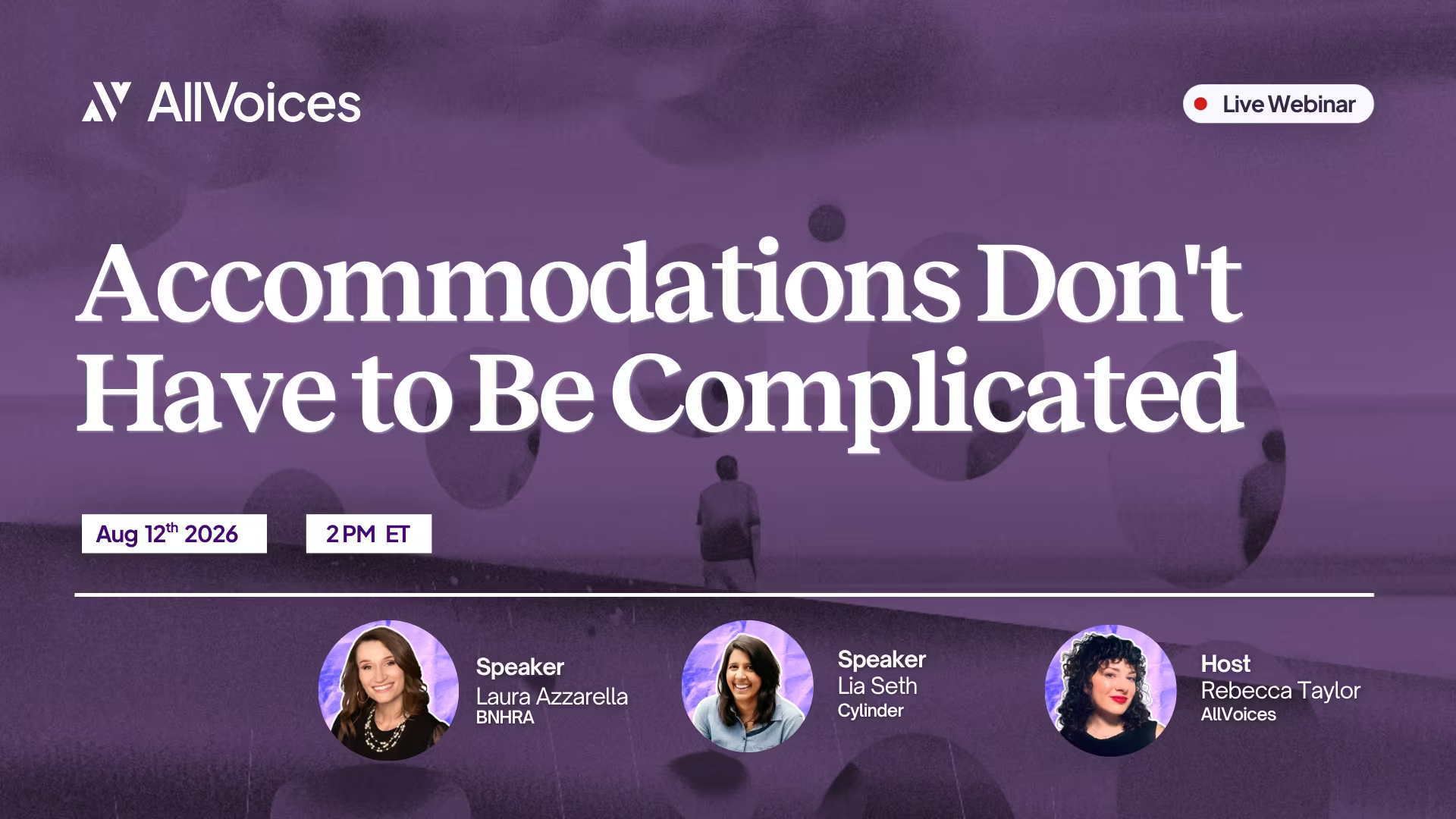
Accommodations Don't Have to Be Complicated
Most workplace accommodations are a short conversation and a small adjustment. They get treated like a legal event anyway, and that gap between how simple the average request is and how heavy it feels to the manager receiving it was the subject of this session.
On August 12, Rebecca Taylor of AllVoices sat down with two people who see accommodations from opposite ends of the org chart. Laura Azzarella is an HR leader and president of the Buffalo Niagara Human Resource Association, with a career across manufacturing, higher education, and the public sector. Lia Seth is HR director at Cylinder, a longtime disability advocate, and an ambulatory wheelchair user who has sat on both sides of an accommodation request.
The session opened with a poll. Which of these counts as a workplace accommodation: eyeglasses, advance notice before a schedule change, permission to join meetings by phone instead of video, or all of the above? Almost every attendee picked all of the above, which is correct, and which is also the whole argument.
What follows is where manager fear actually comes from, how to separate reasonable from unreasonable, how little documentation you really need, and what the EEOC changed in 2026 about remote work requests.
What counts as a workplace accommodation?
Far more than most managers assume. An accommodation is any adjustment that lets someone do their job in an environment that was not built for them, which covers eyeglasses, a modified schedule, written instructions instead of verbal ones, a stool at a checkout counter, and a wheelchair.
Seth's LinkedIn post asking whether glasses count as special treatment is what started this conversation. Her argument is that some accommodations have become so ordinary they stopped registering as accommodations at all.
Glasses are a medical accommodation. They're a device that allows the wearer to see or read in a world designed for people who see and read. - Lia Seth, HR director at Cylinder
She offered a second version of the same idea that lands faster with skeptical managers. Picture an office cooled to 62 degrees. One person calls it perfect and another keeps gloves and a blanket at their desk.
People have different needs because they have different bodies. - Lia Seth
Azzarella named the reason glasses feel different from every other reasonable accommodation. The employee handles it entirely on their own. They book the appointment, buy the frames, and solve the problem before it ever reaches HR.
Everything else arrives as a request, and requests feel like risk. The cost data says otherwise. In the Job Accommodation Network's employer survey, 61% of accommodations cost nothing at all, and the ones that do carry a one-time cost run a median of $300.
We're here to tell you the interactive process is not the villain that you're making it out to be. - Laura Azzarella, president, Buffalo Niagara Human Resource Association
Why do managers panic about setting a precedent?
Because they hear the request as a fairness problem instead of a job design problem. Approving one accommodation creates no legal precedent. What you owe your employees is a consistent process, not identical outcomes.
Seth pointed out that the fairness objection collapses the moment you apply it to something familiar. No manager tells an employee they cannot wear glasses because nobody else on the team wears glasses.
It's this idea of if they get it, then everyone will want it. But that's not really a reasonable way to think about accommodations, because not everyone has the same needs.- Lia Seth
She has had a manager tell her not to bring her wheelchair to client events. Her response reframes what the manager is actually asking for: if the wheelchair stays home, so does she on the days she needs it.
Azzarella laid out the legal mechanics behind the fear, and they point the opposite direction from what managers expect. There is no precedent because every request is an individualized assessment.
There's no legal precedent, but it is an individualized assessment process. So what you need is consistency, and the interactive process has to be the thing that's consistent. - Laura Azzarella
Her example is the one to keep. If one employee asks to use a wheelchair and you approve it on the spot, then a second employee asks and you send them through extensive physician documentation, you have created disparate treatment. The inconsistency is the exposure, not the approval.
Seth added the other half. Two people can request the same accommodation and get different answers when the jobs are different.
- A cashier who uses a wheelchair at the register and a forklift operator in the warehouse are not the same conversation
- Essential functions decide what is possible in the current role
- A no on one specific request does not end the process, it changes what the process is looking for
When an employee points at a coworker's approved accommodation and asks for the same thing, that is not a threat. As Azzarella put it, if you already did it for someone else, chances are it is reasonable.
How do you decide whether an accommodation is reasonable?
Compare it against the real alternative, not against the status quo. The bar for calling something unreasonable is high, and inconvenient is not the same as unreasonable.
Seth's clearest example involved an employee with provider paperwork who needed to drop from 25 hours of external meetings a week to 17. The manager asked what happens if the business says no.
Your choice is not between we grant them seventeen hours or they continue to work twenty five hours. Your choice is between we grant them seventeen hours or they work zero. - Lia Seth
The employee was not making a demand. They were offering the company a version of themselves that still works, and the alternative to that version was a medical leave of absence.
Interactive means nobody is held hostage in either direction. You can counter with a three month trial and a reassessment. You can accept the reduced hours but specify which hours, so core Thursday meetings stay covered.
Azzarella drew the line on genuine undue hardship under the Americans with Disabilities Act. You are not obligated to rebuild a building when a workable option already exists.
We're not trying to make major modifications to a building when another feasible option exists. -Laura Azzarella
Inconvenience is a different category, and she was blunt about it. An employee with a seizure disorder who cannot predict a flare may need scheduling flexibility and backup coverage. That is harder to staff. It is not undue hardship, and employers built exactly this kind of coverage during COVID quarantines.
A forklift operator with an ambulatory condition might move into a comparable logistics clerk role at comparable pay. The employee may not love the change. What protects you is being able to show your reasoning.
As long as you can logically describe why you got from point A to point B and what that looked like, you are by and large alright. It's just when you've got pretext, and you try to do something but you really want to do this, that all those things unravel in court. - Laura Azzarella
Four questions to run before you call something unreasonable:
- What are the actual essential functions of this role, as written in the job description?
- What is the real alternative if we say no, and what does that cost us?
- Is there a comparable role, a trial period, or a temporary version that works?
- Can I write down how I got from the request to the decision in plain language?
Do you need a doctor's note or a diagnosis to approve an accommodation?
No. You need to understand the limitation and what would help, not the name of the condition. Requiring a diagnosis is where teams create risk while trying to reduce it.
Seth keeps her documentation bar deliberately low, because she knows what getting documentation actually involves. A specialist referral can mean waiting months for a fifteen minute appointment, while the employee works without the accommodation the entire time.
I don't want you to have to make a special appointment. I don't want you to take all this time out of your calendar and your work and your life to try to drive to one state over where the nearest specialist has the closest availability. That's not a good use of anybody's time. -Lia Seth
What she accepts instead: a forwarded patient portal message from a primary care provider confirming the specific need. No signature, no form, no appointment. A screenshot in the file does the same work as a notarized letter and costs the employee nothing.
One attendee reported being required to complete an eight page document for a single accommodation. That is the kind of process that generates the complaint it was built to prevent.
Documentation does earn its place in some cases. Lifting restrictions that change during a recovery are worth confirming in writing, because a note saying 10 pounds last month and 25 pounds this month tells you when to revisit the arrangement.
Mental health requests are where this breaks down most often. Azzarella named the pattern directly: because nobody can see the condition, managers quietly question whether it is real.
I think that there is a level of suspicion from management naturally. I think as a society, we need to work through that. - Laura Azzarella
Attendees described exactly this in the chat, including CEOs demanding proof of an anxiety diagnosis before approving anything. The answer that ends the argument is not empathy. It is that you are not permitted to require it, and asking anyway is what creates the liability.
Can you require someone to return to the office when they have an accommodation?
Not through a blanket policy. Essential functions decide it, and wanting people in the building is not an essential function.
Azzarella was the sharpest she got all session on this point. A return to office mandate does not override an accommodation obligation, and the reason the employer wants people back matters.
You cannot say that somebody who's in an accounting role, who's been working from home for the last couple of years, now is required to return back to the office just because of vibes. Understand your request for everybody to collaborate is not an essential function. - Laura Azzarella
The federal guidance backs the individualized approach. In February 2026, the EEOC and the Office of Personnel Management issued joint FAQs on telework accommodations, written for federal agencies but applying the same ADA standards private employers work under.
Read it in both directions, because it does not hand either side a clean win:
- Agencies cannot revoke telework accommodations automatically because of a return to office policy, and each request needs an individualized assessment
- Telework is not automatically reasonable, and the governing question is whether remote work is necessary to perform essential functions
- Pandemic era flexibility did not permanently redefine essential functions, and an employer may reassess an accommodation when circumstances genuinely change
- Employees are entitled to an accommodation that works, not the specific one they prefer
Seth's split is the practical version. An accounting manager running month end close alone on complex spreadsheets probably does not need to be in the building. An office manager who receives packages and meets on-site vendors is a different story.
How do you keep performance separate from an accommodation request?
Run them as two tracks. Manage performance on output and let the employee raise the accommodation connection if there is one.
The performance conversation should never be the same thing as the accommodation conversation. If they are related, let the employee bring that up. - Lia Seth
Her coaching for managers is one question, asked with curiosity instead of suspicion. Not "is your accommodation not working," but "how can I help you be successful."
An attendee raised the hardest version of this: an employee about to enter a performance improvement plan requested a full supine workstation for their home office. That happens. It is also rarer than the policy most teams build in response to it.
Both panelists landed in the same place. Grant a reasonable version on a trial basis, keep measuring output, and let the performance data answer the question.
If this had been one of those few people who was trying to game the system, that would become apparent through their performance. Very quickly you'd realize their output is sloppy, they're really not getting things done, they're falling far behind their peers. -Lia Seth
Azzarella flagged the failure mode on the employer side. When an employee becomes hard to schedule around, the temptation is to treat them as a problem and look for an exit, which looks a great deal like a manager quietly pushing someone out. The bar for defending that decision is high, and the employee usually knows better than you what would actually work.
What to tell a manager who is scared of setting a precedent
Ask them who the hesitation is protecting. Both panelists were given one sentence to hand a practitioner walking into that conversation tomorrow, and they went in the same direction from different angles.
I would ask who is this for. Is it just for our comfort? Is it for us to do things the way that we've always done them before? Or is it so that we can maybe make a change and everybody's a little bit better off? - Laura Azzarella
Everyone in this conversation is a human. There will be a solution that will work for everyone, but you have to go through the interactive process to find it. -Lia Seth
Conviction is easier to hold when the file backs you up. Handling every request the same way, asking the same questions, and recording the reasoning is what lets you approve one request and decline another without either decision looking arbitrary.
During the session, Rebecca noted that AllVoices is building an accommodations workflow for exactly this reason, because setting precedent and running the interactive process are the two pain points ER teams name most, and both are really documentation problems.
The throughline held from the poll to the last minute. Accommodations are not a legal minefield you tiptoe through, they are a retention decision you make on purpose, and the fear around them costs more than the accommodations ever will. Keep the process consistent, keep the paperwork light, and treat the person across the table like an adult who knows their own body.
Stay up to date on Employee Relations news
Sign up to our newsletter
.svg)
.svg)