About This Episode
In this episode of Reimagining Company Culture, we’re chatting with Jen Paxton, VP of People at Smile.io. Over the past 10 years, she has developed a passion for building and scaling startups (3 of which led to successful acquisitions); giving employees the structure and support they need to flourish and grow.
About The Guest
Jen Paxton (she/her/hers) heads up all things People at Smile as their VP, People. Over the past 10 years, she has developed a passion for building and scaling startups (3 of which led to successful acquisitions); giving employees the structure and support they need to flourish and grow. She loves coaching managers, fostering a culture of feedback, and building out programs that will help build a sense of belonging. Jen is a mom of two girls, loves being outdoors, eating tacos, and drinking her weight in loose teas.
Episode Breakdown

Jen Paxton has built her HR career around the question of what it takes for people to do their best work. On Reimagining Company Culture, she joined us to talk about the practical systems and habits that help people show up fully at work.

Her view is that helping people do their best work is the central HR job. Everything else, including hiring, performance management, and recognition, serves that core purpose. The HR programs that lose sight of it tend to produce the most friction inside organizations.

Why Most HR Programs Get Disconnected From People's Best Work

HR programs often grow disconnected from the question they were designed to answer. Performance management becomes paperwork. Engagement surveys become quarterly chores. Onboarding becomes logistics. Gartner research on employee experience found that only 29 percent of employees believe HR understands what they need.

Jen described the trap. HR teams focus on running programs and lose track of whether the programs are actually helping people do better work. The fix is to start with the work itself and design backward.

Her framing is that employee engagement is the output of getting many small things right. Clear roles, capable managers, manageable workloads, and real recognition all combine to produce engagement that translates into best work.

What also matters is treating each employee as an individual. The conditions that help one person do their best work do not always help another. Strong HR systems give managers the tools to tailor support without losing consistency.

How Do You Build Systems That Support People's Best Work?

What is the first move for HR teams that want to invest here?

Jen recommends spending time with the actual work. HR teams that observe what employees do daily, the friction they encounter, and the moments where their work flows produce stronger programs than HR teams that operate from policy documents.

How do you balance individual support with organizational consistency?

By giving managers strong frameworks with room to tailor. Coaching for managers on how to support different personalities, work styles, and life situations produces stronger engagement than rigid one-size-fits-all programs.

What Actually Works in Supporting Best Work

Start with the work, not the program

HR programs that begin with policy language and end at the employee feel disconnected. Programs that begin by observing the actual work and end with structural support produce stronger outcomes.

Make manager skill the central investment

Most employees experience HR through their manager. Management training on how to support best work produces faster culture change than any centralized program.

Build feedback loops that inform program design

Programs that get reviewed only against their own metrics drift over time. Programs that get reviewed against employee experience data and qualitative feedback stay aligned with what people actually need.

Where Employee Relations Fits

ER systems are where blocks to best work surface. AllVoices' HR solution and our employee helpline product give HR a clear way to surface concerns that prevent people from doing their best work.

How does ER tooling support best work?

It catches the moments where the work environment is breaking down for individuals or teams. Concerns about manager behavior, unrealistic expectations, or interpersonal friction, when aggregated, point to where HR investment will have the most impact on best work.

Frequently Asked Questions About People's Best Work

What does best work mean in an HR context?

It is the level of contribution employees can make when they have clear roles, capable managers, manageable workloads, and the support to bring their full capability to the work.

Why do most HR programs lose sight of best work?

Because programs scale by becoming standardized, and standardization tends to drift away from individual needs. Strong HR teams maintain individual focus inside scaled programs.

What is the manager's role in best work?

Managers are the primary translators between organizational systems and individual employees. Their skill in supporting different work styles, life situations, and growth needs determines whether HR programs land.

How do you measure whether people are doing their best work?

Through engagement scores, manager NPS, voluntary attrition, internal mobility, and qualitative feedback. No single metric captures it. Pattern recognition across multiple signals does.

How do you handle employees who are clearly not doing their best work?

With honesty about expectations and support for what might be missing. Performance issues are often capability gaps, role mismatches, or life circumstances that need acknowledgment, not punishment.

What kills best work fastest?

Manager behavior that undermines confidence, unrealistic workloads that produce burnout, and lack of recognition that signals contribution is invisible.

The Bottom Line for HR Leaders

Jen's framing is a useful corrective for any HR team that has built sophisticated programs without seeing people's actual experience improve. Best work is the central HR question. Programs that lose sight of it tend to produce friction rather than enabling capability.

The leaders who get this right share a few habits. They start with the work, not the program. They make manager skill the central investment. They build feedback loops that inform program design. And they treat best work as the metric that matters most.

Companies that hold this discipline see engagement compound, retention improve, and the kind of organizational capability that comes from people working at full capacity over long horizons.

Industry research keeps reinforcing this view. SHRM research on workplace priorities shows that employee experience is one of the top HR concerns. Strong HR programs treat best work as the experience metric that matters most.

Across the conversation, the throughline was that HR is in service of the work and the people doing it. Programs designed in service of HR itself drift quickly. Programs designed in service of best work hold their alignment over years.

The HR teams that build this discipline well also tend to develop a stronger seat at the strategic table. Leaders who can show how HR investments translate into best work and business outcomes earn the budgets and credibility to do more.

Strong programs also produce a quieter cultural strength. Employees who feel supported in doing their best work develop deeper organizational pride and loyalty than employees who feel processed by HR systems.

Strong programs also produce documentation and case studies that become useful internal teaching tools across years. The accumulated learning becomes a resource for future cohorts of leaders, and that knowledge transfer is part of what makes the work sustainable through executive transitions.

The companies that hold this work through hard quarters end up with cultures that are recognizably different from peer companies. Employees notice, candidates notice, and customers notice. That distinctiveness becomes part of the brand and influences both retention and hiring outcomes for years.

Strong programs also produce a quieter recruiting benefit. Candidates research how companies handle this kind of work before joining, and the patterns become known in tight talent markets.

The throughline across the conversation was that real change is operational, not symbolic. Cultures that build the discipline through years of consistent practice end up with workforces that hold under pressure and produce stronger outcomes than cultures relying on values statements alone.

Companies that handle this work well also develop internal expertise that pays back across cycles. The leaders, managers, and HR partners who develop the muscle become more valuable across the organization, and that expertise is what sustains the work through executive transitions and budget shocks.

The strongest programs also document their methodology so the work survives leadership transitions and continues to compound across years.

See how AllVoices supports HR teams helping people do their best work.
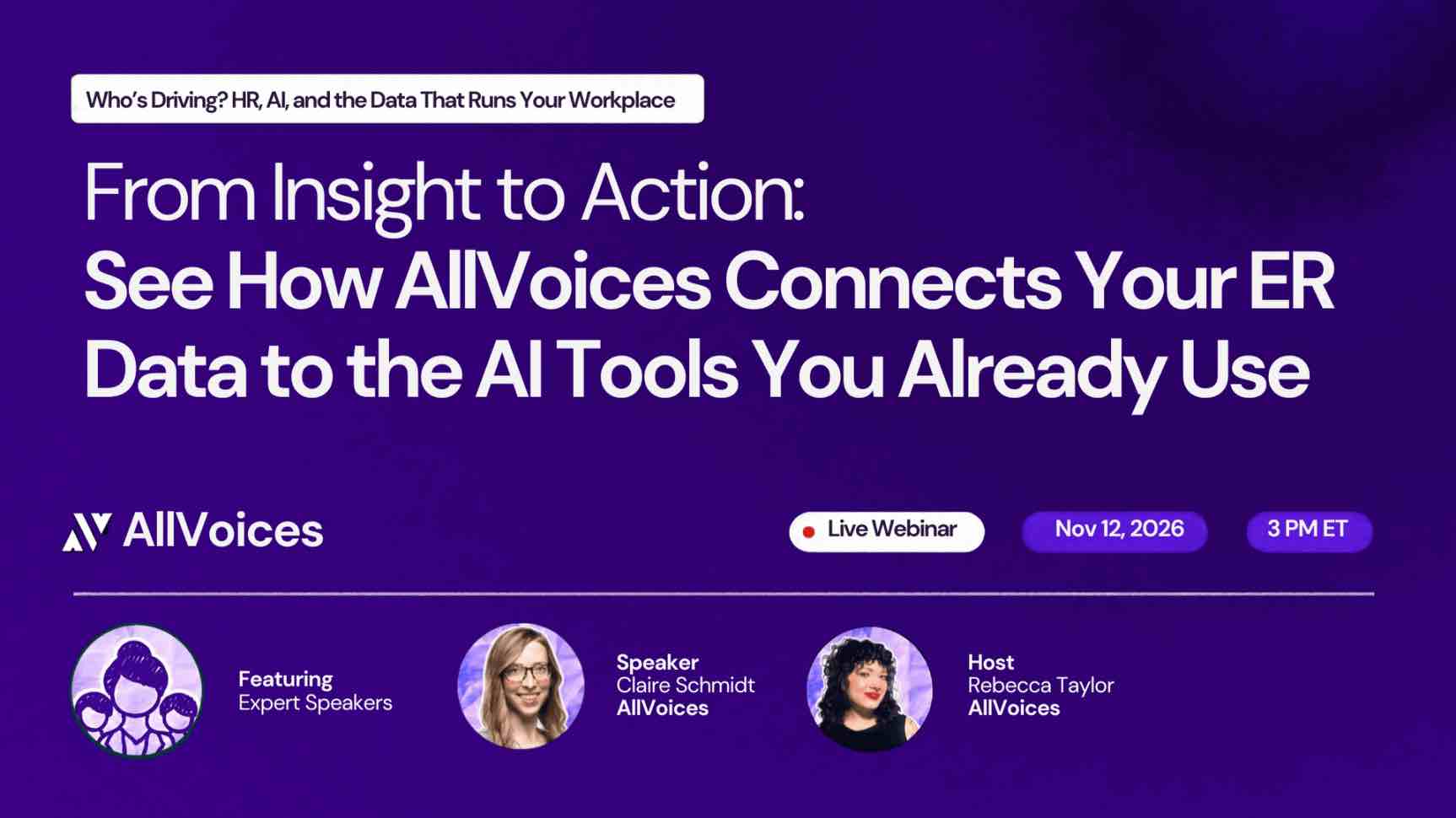
Our next webinar
Frequently asked questions

Got more questions? Email us at support@allvoices.co and we'll respond ASAP.

No items found.
Frequently asked questions

Got more questions? Email us at support@allvoices.co and we'll respond ASAP.

No items found.
Jen Paxton, VP of People at Smile.io - Empowering People’s Best Work
Episode 150
About This Episode
In this episode of Reimagining Company Culture, we’re chatting with Jen Paxton, VP of People at Smile.io. Over the past 10 years, she has developed a passion for building and scaling startups (3 of which led to successful acquisitions); giving employees the structure and support they need to flourish and grow.
About The Guest
Jen Paxton (she/her/hers) heads up all things People at Smile as their VP, People. Over the past 10 years, she has developed a passion for building and scaling startups (3 of which led to successful acquisitions); giving employees the structure and support they need to flourish and grow. She loves coaching managers, fostering a culture of feedback, and building out programs that will help build a sense of belonging. Jen is a mom of two girls, loves being outdoors, eating tacos, and drinking her weight in loose teas.
Episode Transcription

Jen Paxton has built her HR career around the question of what it takes for people to do their best work. On Reimagining Company Culture, she joined us to talk about the practical systems and habits that help people show up fully at work.

Her view is that helping people do their best work is the central HR job. Everything else, including hiring, performance management, and recognition, serves that core purpose. The HR programs that lose sight of it tend to produce the most friction inside organizations.

Why Most HR Programs Get Disconnected From People's Best Work

HR programs often grow disconnected from the question they were designed to answer. Performance management becomes paperwork. Engagement surveys become quarterly chores. Onboarding becomes logistics. Gartner research on employee experience found that only 29 percent of employees believe HR understands what they need.

Jen described the trap. HR teams focus on running programs and lose track of whether the programs are actually helping people do better work. The fix is to start with the work itself and design backward.

Her framing is that employee engagement is the output of getting many small things right. Clear roles, capable managers, manageable workloads, and real recognition all combine to produce engagement that translates into best work.

What also matters is treating each employee as an individual. The conditions that help one person do their best work do not always help another. Strong HR systems give managers the tools to tailor support without losing consistency.

How Do You Build Systems That Support People's Best Work?

What is the first move for HR teams that want to invest here?

Jen recommends spending time with the actual work. HR teams that observe what employees do daily, the friction they encounter, and the moments where their work flows produce stronger programs than HR teams that operate from policy documents.

How do you balance individual support with organizational consistency?

By giving managers strong frameworks with room to tailor. Coaching for managers on how to support different personalities, work styles, and life situations produces stronger engagement than rigid one-size-fits-all programs.

What Actually Works in Supporting Best Work

Start with the work, not the program

HR programs that begin with policy language and end at the employee feel disconnected. Programs that begin by observing the actual work and end with structural support produce stronger outcomes.

Make manager skill the central investment

Most employees experience HR through their manager. Management training on how to support best work produces faster culture change than any centralized program.

Build feedback loops that inform program design

Programs that get reviewed only against their own metrics drift over time. Programs that get reviewed against employee experience data and qualitative feedback stay aligned with what people actually need.

Where Employee Relations Fits

ER systems are where blocks to best work surface. AllVoices' HR solution and our employee helpline product give HR a clear way to surface concerns that prevent people from doing their best work.

How does ER tooling support best work?

It catches the moments where the work environment is breaking down for individuals or teams. Concerns about manager behavior, unrealistic expectations, or interpersonal friction, when aggregated, point to where HR investment will have the most impact on best work.

Frequently Asked Questions About People's Best Work

What does best work mean in an HR context?

It is the level of contribution employees can make when they have clear roles, capable managers, manageable workloads, and the support to bring their full capability to the work.

Why do most HR programs lose sight of best work?

Because programs scale by becoming standardized, and standardization tends to drift away from individual needs. Strong HR teams maintain individual focus inside scaled programs.

What is the manager's role in best work?

Managers are the primary translators between organizational systems and individual employees. Their skill in supporting different work styles, life situations, and growth needs determines whether HR programs land.

How do you measure whether people are doing their best work?

Through engagement scores, manager NPS, voluntary attrition, internal mobility, and qualitative feedback. No single metric captures it. Pattern recognition across multiple signals does.

How do you handle employees who are clearly not doing their best work?

With honesty about expectations and support for what might be missing. Performance issues are often capability gaps, role mismatches, or life circumstances that need acknowledgment, not punishment.

What kills best work fastest?

Manager behavior that undermines confidence, unrealistic workloads that produce burnout, and lack of recognition that signals contribution is invisible.

The Bottom Line for HR Leaders

Jen's framing is a useful corrective for any HR team that has built sophisticated programs without seeing people's actual experience improve. Best work is the central HR question. Programs that lose sight of it tend to produce friction rather than enabling capability.

The leaders who get this right share a few habits. They start with the work, not the program. They make manager skill the central investment. They build feedback loops that inform program design. And they treat best work as the metric that matters most.

Companies that hold this discipline see engagement compound, retention improve, and the kind of organizational capability that comes from people working at full capacity over long horizons.

Industry research keeps reinforcing this view. SHRM research on workplace priorities shows that employee experience is one of the top HR concerns. Strong HR programs treat best work as the experience metric that matters most.

Across the conversation, the throughline was that HR is in service of the work and the people doing it. Programs designed in service of HR itself drift quickly. Programs designed in service of best work hold their alignment over years.

The HR teams that build this discipline well also tend to develop a stronger seat at the strategic table. Leaders who can show how HR investments translate into best work and business outcomes earn the budgets and credibility to do more.

Strong programs also produce a quieter cultural strength. Employees who feel supported in doing their best work develop deeper organizational pride and loyalty than employees who feel processed by HR systems.

Strong programs also produce documentation and case studies that become useful internal teaching tools across years. The accumulated learning becomes a resource for future cohorts of leaders, and that knowledge transfer is part of what makes the work sustainable through executive transitions.

The companies that hold this work through hard quarters end up with cultures that are recognizably different from peer companies. Employees notice, candidates notice, and customers notice. That distinctiveness becomes part of the brand and influences both retention and hiring outcomes for years.

Strong programs also produce a quieter recruiting benefit. Candidates research how companies handle this kind of work before joining, and the patterns become known in tight talent markets.

The throughline across the conversation was that real change is operational, not symbolic. Cultures that build the discipline through years of consistent practice end up with workforces that hold under pressure and produce stronger outcomes than cultures relying on values statements alone.

Companies that handle this work well also develop internal expertise that pays back across cycles. The leaders, managers, and HR partners who develop the muscle become more valuable across the organization, and that expertise is what sustains the work through executive transitions and budget shocks.

The strongest programs also document their methodology so the work survives leadership transitions and continues to compound across years.

See how AllVoices supports HR teams helping people do their best work.

Want to learn more?
See the power of AllVoices today
Thank you! We look forward to meeting you soon
Oops! Something went wrong while submitting the form.
Frequently asked questions

Got more questions? Email us at support@allvoices.co and we'll respond ASAP.

No items found.
Frequently asked questions

Got more questions? Email us at support@allvoices.co and we'll respond ASAP.

No items found.