
About This Episode
In this episode of Reimagining Company Culture, we’re chatting with Madhavi Bhasin, VP of Diversity, Inclusion, and Belonging at Okta. Madhavi is a change leader with over 15 years of experience in successfully managing global programs focused on creating inclusive spaces and processes, social impact, and capacity building.
About The Guest
Madhavi is a change leader with over 15 years of experience in successfully managing global programs focused on creating inclusive spaces and processes, social impact, and capacity building. She is passionate about designing approaches for driving equity in the workplace and change management focused on inclusion. Currently she is leading Okta’s diversity, inclusion and belonging strategy.Prior to joining Okta, Madhavi led a global technology entrepreneurship program for young girls (ages 10-18) at Technovation. Outside her fun work life, Madhavi loves to meditate and listen to imaginary tales from her son in elementary school.
Episode Breakdown

Madhavi Bhasin has spent her career building talent and learning programs at companies that operate across continents, including her current work at Okta. On Reimagining Company Culture, she pushed back on the idea that global means uniform. Her argument is that the best development programs are built from the local up, not the headquarters down.

That framing is timely. Most distributed companies still build talent strategy from a single office and assume the program will travel. It rarely does. The signals that engage an engineer in Bangalore are different from the signals that engage one in Dublin, and the assumption that a single playbook fits both has cost a lot of organizations a lot of attrition.

Why Global Talent Programs Fail Without Local Context

The pattern Bhasin has watched repeatedly is a centrally designed program landing in a region with no advance ground work. Local leaders feel handed an obligation rather than a tool. Employees see another corporate ritual that does not apply to their week. The program technically launches and substantively dies.

The fix is upstream. Bring local managers into the design conversation. Test the language and examples with people who actually have to deliver them. Pick a regional pilot before going wide, and resource the rollout instead of leaving it to a calendar invite.

How Distributed Companies Should Approach Manager Development

What Skills Should Managers Build First in a Global Org?

Coaching, written communication, and async decision-making lead the list. Harvard Business Review's research on managers as coaches found that the shift from director to coach correlates with stronger team retention and faster onboarding for new hires. Distributed teams amplify the effect because there are fewer hallway conversations to fall back on.

How Do You Build Real Mentoring Across Time Zones?

Pair early, scope tightly, and give the mentee a real outcome to drive. AllVoices customers running structured virtual mentoring programs report that six-month engagements outperform open-ended ones because both parties have something to point at when the time is up.

What Actually Works When You Scale Talent Programs

Localize the Examples, Not the Principles

The principles of feedback, recognition, and growth conversations translate. The examples do not. A US-coded story about negotiating a promotion will land differently in Tokyo or São Paulo. Rewrite for local context.

Make Managers the Primary Channel

Corporate L&D teams cannot reach a global workforce one webinar at a time. Managers can, every day, in one-on-ones. Equip them with short, repeatable practices instead of long courses.

Measure What Changed, Not What Was Delivered

Completion rates are vanity metrics. Track behavior change, retention by cohort, and promotion velocity. Pair the data with pulse surveys that ask whether managers are practicing what was trained.

Where Employee Relations Fits in a Distributed Organization

Talent programs do not exist in a vacuum. The minute a manager has to deliver a hard conversation, employee relations becomes the visible hand of the People function. Centralizing intake through a single case management workflow means a complaint in one region does not get lost when the local HRBP changes.

Why Centralized ER Helps Global Talent Strategy

Centralized ER produces the data trail that local leaders need to spot patterns. Without it, a recurring problem in one office can hide for quarters. A consolidated ER function gives global People leaders the visibility to ask the right questions early.

Frequently Asked Questions About Global Talent Development

How big should a global talent team be?

Smaller than most leaders think, if managers are doing their part. The team's job is to design, equip, and measure. The delivery should sit with people leaders. Lean teams of three to five can support thousands of employees when the operating model is right.

What is the biggest mistake when scaling a learning program globally?

Translating the words and calling it localized. Real localization rebuilds examples, adjusts pacing for cultural norms around feedback, and tests the program with regional pilots before mass rollout.

How do you measure ROI on talent development?

Pair quantitative measures like internal mobility, time to fill, and retention with qualitative signals from structured employee feedback. The combination tells you whether the program is changing how the organization works.

Should global companies use one performance review system?

One framework, yes. One frozen template, no. Allow regional adjustment to language, examples, and rating cadence while keeping the core competencies stable.

How do you keep mentoring programs from becoming corporate theater?

Tie them to outcomes. A mentee should leave with a defined skill, project, or career step. Mentor pairs should sunset on a schedule rather than drift indefinitely.

How Time Zones Reshape Talent Programs

A program that takes ninety minutes in San Francisco can take three hours in a distributed setting because the asynchronous overhead is real. The People functions that scale globally treat time zones as a design constraint, not an afterthought.

The practical move is to build programs in modular chunks that can be consumed asynchronously and discussed synchronously in regional cohorts. The discussion produces depth. The async delivery produces reach. Combined, the format works.

What Local Champions Actually Do

Local champions translate corporate intent into regional action. They flag the cultural nuances that headquarters cannot see. They build trust with the workforce because they share context the central team does not. McKinsey research on leadership at scale consistently identifies these middle-layer champions as the difference between programs that take and programs that bounce.

Why Compensation Should Sit Outside the Talent Program

Talent development and pay are related but distinct. Conflating them creates incentive distortions where employees pursue training for the raise rather than the skill. Keep the conversations separate so each can do its work cleanly.

What is the right cadence for global engagement surveys?

Twice a year for the deep instrument, monthly pulses for the targeted topics, and event-triggered for moments like reorgs and leadership changes. Local timing should adjust for regional holidays and quarter-end pressure.

How do you build career paths that work across geographies?

Define the core competencies globally, allow regional variation in role titles and progression cadence, and make internal mobility transparent enough that employees can see paths beyond their region. The combination produces both consistency and flexibility.

How does AllVoices fit into a global talent strategy?

By centralizing employee relations data across regions while respecting local privacy requirements. Connected HR infrastructure gives global People leaders the visibility to spot patterns and the tools to act on them consistently.

The Bottom Line for HR Leaders

Bhasin's argument is that scale is not the enemy of localization. It is the reason localization matters more. The bigger the company gets, the easier it becomes to ship a uniform program that lands flat everywhere.

The People leaders who win at global scale spend their early dollars on listening. They invest in regional pilots, build managers as the primary channel, and treat ER as a data source, not a cost center.

Done well, the result is a talent strategy that adapts to local realities while staying coherent across the company.

The work is iterative. Run the listening, watch the data, adjust the operating rhythm, and repeat. The People functions that build this discipline produce compounding gains across retention, performance, and the organizational resilience that shows up most clearly in the hardest quarters.

Modern employee relations infrastructure closes the gap between what leaders intend and what employees experience. The companies that invest in that infrastructure now will hold their advantage as the broader market catches up.

See how AllVoices supports global People teams running ER and engagement programs at scale.
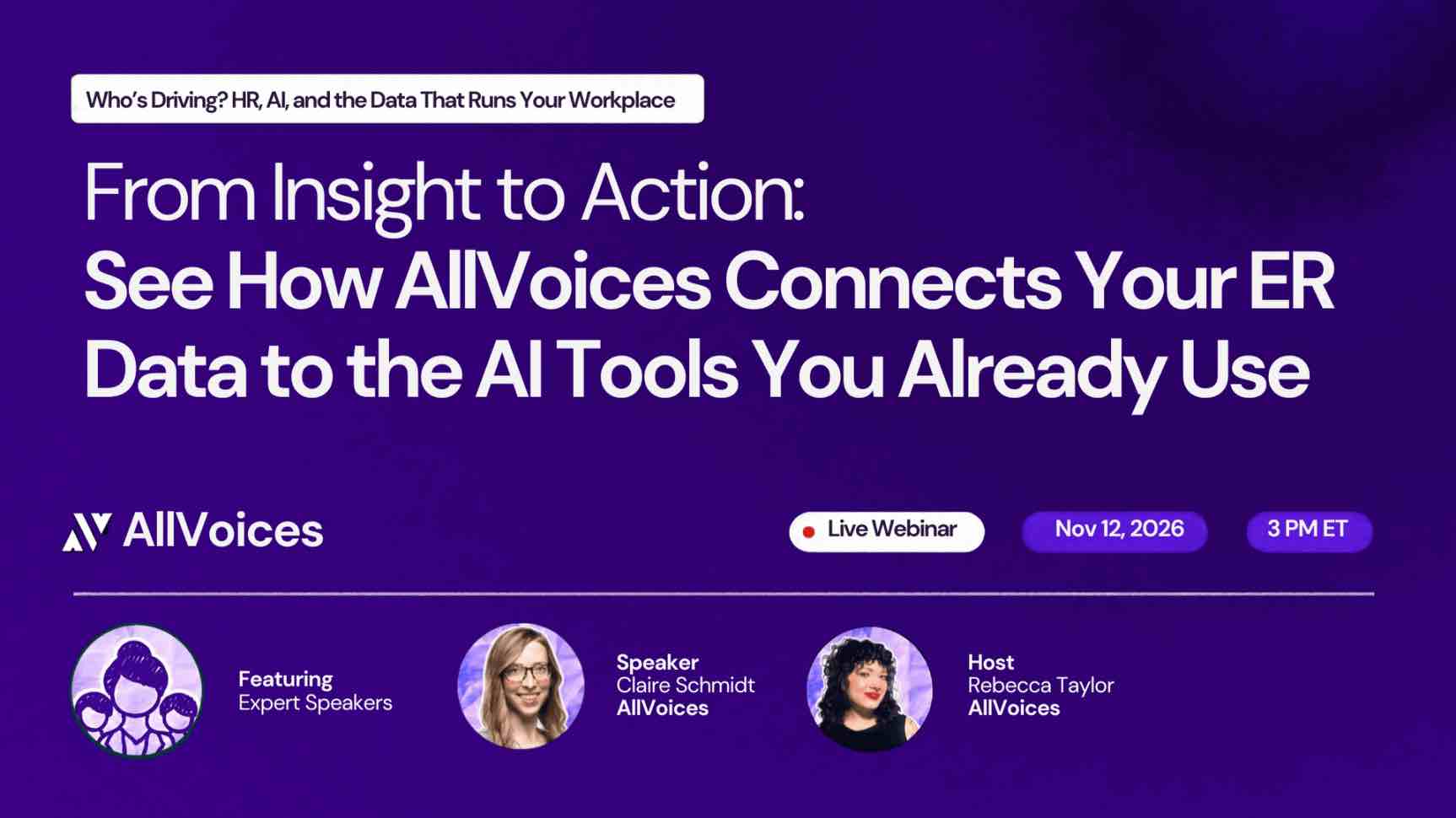
Our next webinar
Frequently asked questions

Got more questions? Email us at support@allvoices.co and we'll respond ASAP.

No items found.
Frequently asked questions

Got more questions? Email us at support@allvoices.co and we'll respond ASAP.

No items found.
Okta VP of Diversity, Inclusion, and Belonging, Madhavi Bhasin - A Comprehensive DEI Lens
Episode 117
About This Episode
In this episode of Reimagining Company Culture, we’re chatting with Madhavi Bhasin, VP of Diversity, Inclusion, and Belonging at Okta. Madhavi is a change leader with over 15 years of experience in successfully managing global programs focused on creating inclusive spaces and processes, social impact, and capacity building.
About The Guest
Madhavi is a change leader with over 15 years of experience in successfully managing global programs focused on creating inclusive spaces and processes, social impact, and capacity building. She is passionate about designing approaches for driving equity in the workplace and change management focused on inclusion. Currently she is leading Okta’s diversity, inclusion and belonging strategy.Prior to joining Okta, Madhavi led a global technology entrepreneurship program for young girls (ages 10-18) at Technovation. Outside her fun work life, Madhavi loves to meditate and listen to imaginary tales from her son in elementary school.
Episode Transcription

Madhavi Bhasin has spent her career building talent and learning programs at companies that operate across continents, including her current work at Okta. On Reimagining Company Culture, she pushed back on the idea that global means uniform. Her argument is that the best development programs are built from the local up, not the headquarters down.

That framing is timely. Most distributed companies still build talent strategy from a single office and assume the program will travel. It rarely does. The signals that engage an engineer in Bangalore are different from the signals that engage one in Dublin, and the assumption that a single playbook fits both has cost a lot of organizations a lot of attrition.

Why Global Talent Programs Fail Without Local Context

The pattern Bhasin has watched repeatedly is a centrally designed program landing in a region with no advance ground work. Local leaders feel handed an obligation rather than a tool. Employees see another corporate ritual that does not apply to their week. The program technically launches and substantively dies.

The fix is upstream. Bring local managers into the design conversation. Test the language and examples with people who actually have to deliver them. Pick a regional pilot before going wide, and resource the rollout instead of leaving it to a calendar invite.

How Distributed Companies Should Approach Manager Development

What Skills Should Managers Build First in a Global Org?

Coaching, written communication, and async decision-making lead the list. Harvard Business Review's research on managers as coaches found that the shift from director to coach correlates with stronger team retention and faster onboarding for new hires. Distributed teams amplify the effect because there are fewer hallway conversations to fall back on.

How Do You Build Real Mentoring Across Time Zones?

Pair early, scope tightly, and give the mentee a real outcome to drive. AllVoices customers running structured virtual mentoring programs report that six-month engagements outperform open-ended ones because both parties have something to point at when the time is up.

What Actually Works When You Scale Talent Programs

Localize the Examples, Not the Principles

The principles of feedback, recognition, and growth conversations translate. The examples do not. A US-coded story about negotiating a promotion will land differently in Tokyo or São Paulo. Rewrite for local context.

Make Managers the Primary Channel

Corporate L&D teams cannot reach a global workforce one webinar at a time. Managers can, every day, in one-on-ones. Equip them with short, repeatable practices instead of long courses.

Measure What Changed, Not What Was Delivered

Completion rates are vanity metrics. Track behavior change, retention by cohort, and promotion velocity. Pair the data with pulse surveys that ask whether managers are practicing what was trained.

Where Employee Relations Fits in a Distributed Organization

Talent programs do not exist in a vacuum. The minute a manager has to deliver a hard conversation, employee relations becomes the visible hand of the People function. Centralizing intake through a single case management workflow means a complaint in one region does not get lost when the local HRBP changes.

Why Centralized ER Helps Global Talent Strategy

Centralized ER produces the data trail that local leaders need to spot patterns. Without it, a recurring problem in one office can hide for quarters. A consolidated ER function gives global People leaders the visibility to ask the right questions early.

Frequently Asked Questions About Global Talent Development

How big should a global talent team be?

Smaller than most leaders think, if managers are doing their part. The team's job is to design, equip, and measure. The delivery should sit with people leaders. Lean teams of three to five can support thousands of employees when the operating model is right.

What is the biggest mistake when scaling a learning program globally?

Translating the words and calling it localized. Real localization rebuilds examples, adjusts pacing for cultural norms around feedback, and tests the program with regional pilots before mass rollout.

How do you measure ROI on talent development?

Pair quantitative measures like internal mobility, time to fill, and retention with qualitative signals from structured employee feedback. The combination tells you whether the program is changing how the organization works.

Should global companies use one performance review system?

One framework, yes. One frozen template, no. Allow regional adjustment to language, examples, and rating cadence while keeping the core competencies stable.

How do you keep mentoring programs from becoming corporate theater?

Tie them to outcomes. A mentee should leave with a defined skill, project, or career step. Mentor pairs should sunset on a schedule rather than drift indefinitely.

How Time Zones Reshape Talent Programs

A program that takes ninety minutes in San Francisco can take three hours in a distributed setting because the asynchronous overhead is real. The People functions that scale globally treat time zones as a design constraint, not an afterthought.

The practical move is to build programs in modular chunks that can be consumed asynchronously and discussed synchronously in regional cohorts. The discussion produces depth. The async delivery produces reach. Combined, the format works.

What Local Champions Actually Do

Local champions translate corporate intent into regional action. They flag the cultural nuances that headquarters cannot see. They build trust with the workforce because they share context the central team does not. McKinsey research on leadership at scale consistently identifies these middle-layer champions as the difference between programs that take and programs that bounce.

Why Compensation Should Sit Outside the Talent Program

Talent development and pay are related but distinct. Conflating them creates incentive distortions where employees pursue training for the raise rather than the skill. Keep the conversations separate so each can do its work cleanly.

What is the right cadence for global engagement surveys?

Twice a year for the deep instrument, monthly pulses for the targeted topics, and event-triggered for moments like reorgs and leadership changes. Local timing should adjust for regional holidays and quarter-end pressure.

How do you build career paths that work across geographies?

Define the core competencies globally, allow regional variation in role titles and progression cadence, and make internal mobility transparent enough that employees can see paths beyond their region. The combination produces both consistency and flexibility.

How does AllVoices fit into a global talent strategy?

By centralizing employee relations data across regions while respecting local privacy requirements. Connected HR infrastructure gives global People leaders the visibility to spot patterns and the tools to act on them consistently.

The Bottom Line for HR Leaders

Bhasin's argument is that scale is not the enemy of localization. It is the reason localization matters more. The bigger the company gets, the easier it becomes to ship a uniform program that lands flat everywhere.

The People leaders who win at global scale spend their early dollars on listening. They invest in regional pilots, build managers as the primary channel, and treat ER as a data source, not a cost center.

Done well, the result is a talent strategy that adapts to local realities while staying coherent across the company.

The work is iterative. Run the listening, watch the data, adjust the operating rhythm, and repeat. The People functions that build this discipline produce compounding gains across retention, performance, and the organizational resilience that shows up most clearly in the hardest quarters.

Modern employee relations infrastructure closes the gap between what leaders intend and what employees experience. The companies that invest in that infrastructure now will hold their advantage as the broader market catches up.

See how AllVoices supports global People teams running ER and engagement programs at scale.

Want to learn more?
See the power of AllVoices today
Thank you! We look forward to meeting you soon
Oops! Something went wrong while submitting the form.
Frequently asked questions

Got more questions? Email us at support@allvoices.co and we'll respond ASAP.

No items found.
Frequently asked questions

Got more questions? Email us at support@allvoices.co and we'll respond ASAP.

No items found.


