About This Episode
In this episode of Reimagining Company Culture, we’re chatting with Ryan Lathrum, Global Diversity & Inclusion Director at Spin. Ryan’s passion for and commitment to Diversity and Inclusion work is personal. He is a cis-gender white gay man. While Ryan recognizes his identity carries a lot of privilege in certain spaces, his goal is to always use that privilege to uplift and bring others with him.
About The Guest
Ryan Lathrum is a Diversity and Inclusion leader with over 10 years of experience. Ryan is the Global Director of Diversity and Inclusion at Spin, a micro-mobility company based in San Francisco. Prior to joining Spin, Ryan was the Senior Director of Diversity and Inclusion at Wunderkind, a martech start-up based in New York City. Ryan’s passion for and commitment to Diversity and Inclusion work is personal. He is a cis-gender white gay man. While Ryan recognizes his identity carries a lot of privilege in certain spaces, his goal is to always use that privilege to uplift and bring others with him. Ryan’s ability to be an advocate for employees while providing strategic insight for leadership has allowed him to create impactful, and sustainable DEI initiatives. Ryan also loves wine, food (mainly his husband's Sunday dinner creations and anything he makes from his homeland of Ghana), trying new cocktail creations, his family (Ryan is obviously the favorite uncle), and doing his best to stay in shape.
Episode Breakdown

On the AllVoices Reimagining Company Culture podcast, we sat down with Ryan Lathrum, Global Diversity & Inclusion Director at Spin, to dig into creating brave spaces for DEI conversations. Ryan Lathrum is a Diversity and Inclusion leader with over 10 years of experience. Ryan is the Global Director of Diversity and Inclusion at Spin, a micro-mobility company based in San Francisco. Prior to joining Spin, Ryan was the Senior Director of Diversity and Inclusion at Wunderkind, a martech start-up based in New York City.

The conversation moves past the usual talking points. Instead of treating brave spaces as an HR theme, Ryan Lathrum treats it as an operational discipline that sits in the daily decisions managers make about people, priorities, and trust. Below, the takeaways HR leaders, employee relations specialists, and executive teams will find most useful.

The discussion below pulls on several threads from the episode and connects them to current research and what AllVoices sees across hundreds of People teams.

What Brave Spaces Looks Like in Practice

Brave Spaces is one of those words HR teams use freely, but the on-the-ground version is much messier. In the conversation with Ryan Lathrum, several patterns showed up that mirror what McKinsey research on diverse leadership performance also highlights about effective people work. The gap between the slide-deck version and the daily practice is where most programs fall apart.

The data backs the case. Gallup's State of the Global Workplace data shows that organizations treating brave spaces as a real discipline outperform peers on engagement, retention, and the cultural metrics that matter most over a multi-year horizon. Companies that treat it as messaging see short-term lift and long-term decline.

For HR leaders building DEI programs, that means starting with the everyday touchpoints where brave spaces either lands or fails: hiring loops, onboarding, manager 1:1s, and performance conversations. These are the places where intention turns into experience, and where employees decide whether they trust the company enough to stay, speak up, and do their best work.

The pattern across high-functioning HR teams is consistent. They write fewer policies, run more pilots, and spend more time in conversation with managers who are actually doing the work. That discipline is harder than rolling out a campaign, but it is the difference between brave spaces as a phrase and brave spaces as a result.

How HR Teams Make Brave Spaces Operational

The shift from concept to operation is where most teams stall. Two questions usually surface in workshops with People leaders.

Where should brave spaces live in the org?

Ownership matters. Programs that sit only with HR rarely get traction. The strongest organizations pair central ownership in HR with distributed accountability across people managers, with a feedback loop into leadership. Employee Relations can help build the capacity to run that distributed model without losing visibility, and gives the People team a single place to track what is actually happening.

What does success look like in 12 months?

Most teams need a one-year mark with concrete outcomes: a measurable change in inclusion scores, a defined set of policy and process changes, and named owners for the work. Without that, the program drifts and budget questions become harder to defend. The honest version of a 12-month plan also includes two or three things you tried and decided not to repeat.

What Actually Works When You Lead Brave Spaces

Three patterns repeat across People teams that get this work right. The principles cut across industry and company size.

Set the rules of engagement before the conversation

Brave spaces need ground rules everyone agrees to. Without that, dialogue collapses into defensiveness.

Make the discomfort productive

Discomfort is a signal, not a problem. The goal is to move through it toward understanding, not avoid it.

Equip leaders to hold the room

Most managers were never trained to facilitate hard conversations. Skill-building has to come before the conversation, not after it goes sideways.

These three principles also depend on the underlying culture. Without a baseline of psychological safety, most operational changes get rejected by the organization's immune system. Build the foundation first.

Where Employee Relations Fits Into Brave Spaces

Whatever the topic, employee relations sits underneath. Brave Spaces programs that ignore the ER reality get blindsided by a case that should have been resolved early. AllVoices builds investigations management and HR case management so HR teams can connect the surface-level work on brave spaces to the deeper work of resolving issues, tracking patterns, and acting on what employees raise. The two are tightly linked: when employees see issues handled fairly, they trust the rest of the work too.

How ER data informs Brave Spaces strategy

Issue patterns, response times, and resolution outcomes give HR a clearer picture than survey data alone. When the ER data is integrated into anonymous reporting workflows, leaders can see how brave spaces translates into the lived experience of employees who raise concerns, and what to do about it. The teams that move fastest tend to review case themes monthly and feed those insights into the broader people strategy, instead of treating ER as a separate, reactive function.

Frequently Asked Questions About Brave Spaces

What's the difference between safe spaces and brave spaces?

Safe spaces aim to protect people from harm during sensitive conversations. Brave spaces ask people to engage with discomfort to produce real change. Both have a place, but DEI work usually needs the second.

How do you start brave space conversations at work?

Begin with shared agreements about confidentiality, listening, and accountability. Frame the goal clearly, choose a skilled facilitator, and give people language for naming impact without attacking intent.

Are brave spaces only for DEI work?

No. The same model works for any conversation where stakes are high and disagreement is expected, including post-mortems, organizational change, and feedback culture rollouts.

How do you handle pushback on brave space conversations?

Acknowledge it. Pushback often signals fear of saying the wrong thing or being misunderstood. Address that directly with skill-building, examples, and consistent leadership modeling.

What happens after a brave space conversation?

Document what you heard, share commitments publicly, and follow up. Conversations without follow-through erode trust faster than not having them at all.

The Bottom Line for HR Leaders

Brave Spaces is not a posture. It's a set of decisions, repeated over time, by people who control budgets, promotions, calendars, and the daily experience of work. The HR leaders who get traction stop treating this as a campaign and start treating it as ongoing operational practice. That reframing matters because it changes how you measure success and where you put your energy week to week.

That shift requires data, follow-through, and a clear point of view. McKinsey research on diverse leadership performance and the broader research community make the business case clearer every year. The companies that act on it consistently win on retention, culture, and outcomes that show up on the financial statement. The ones that keep treating the work as branding tend to lose ground quietly, then noisily.

The conversation with Ryan Lathrum is a useful reminder that the work is doable. None of it requires a huge HR team or a massive budget. It requires clear thinking, consistent execution, and the willingness to adjust when the data tells you to. Pair that mindset with the right tooling and the right partners, and brave spaces stops being aspirational and becomes a measurable part of how the business runs.

Want to see how AllVoices supports HR teams running this work? Book a demo.
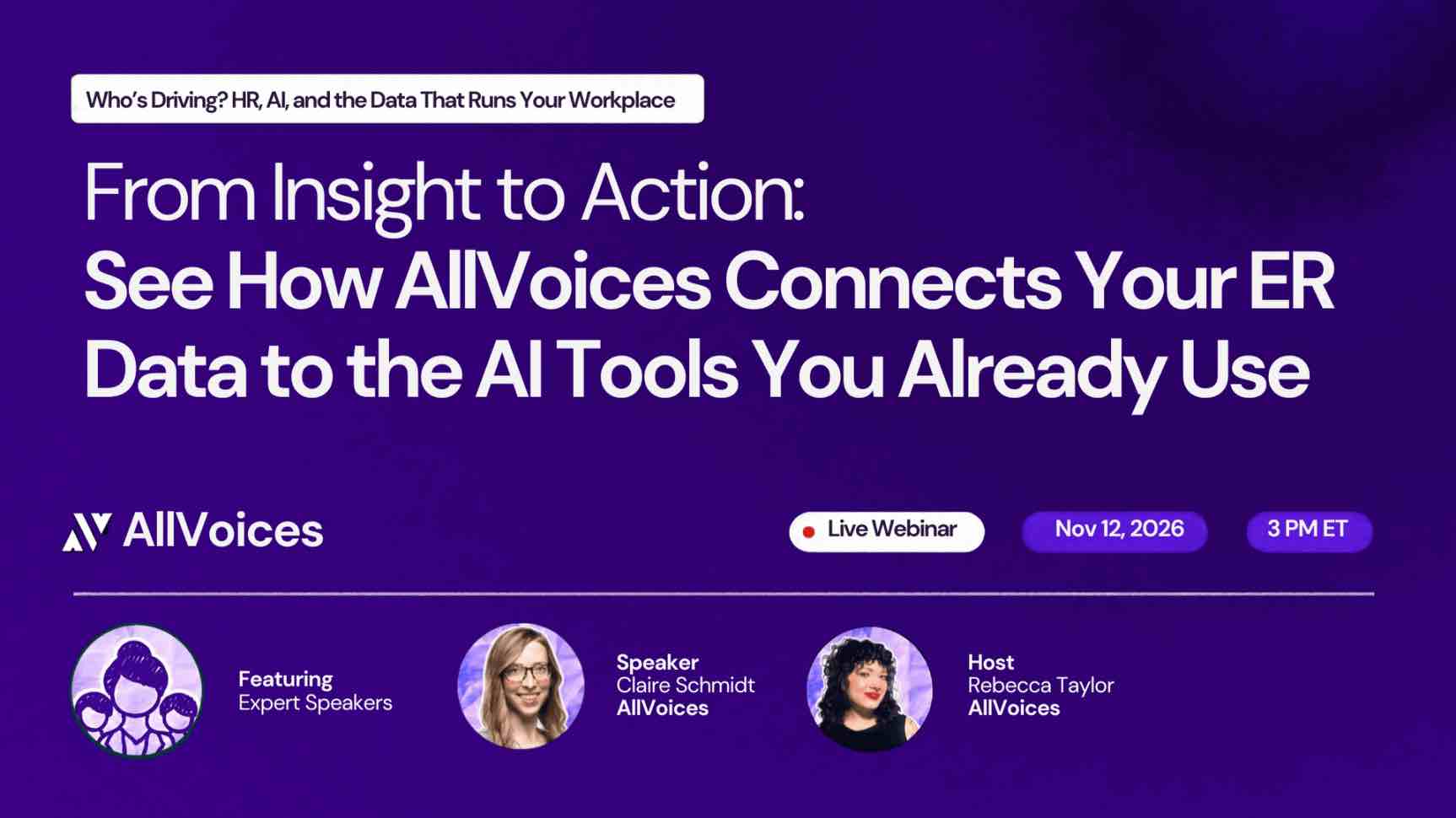
Our next webinar
Frequently asked questions

Got more questions? Email us at support@allvoices.co and we'll respond ASAP.

No items found.
Frequently asked questions

Got more questions? Email us at support@allvoices.co and we'll respond ASAP.

No items found.
Ryan Lathrum, Global Diversity & Inclusion Director at Spin - Creating Brave Spaces
Episode 270
About This Episode
In this episode of Reimagining Company Culture, we’re chatting with Ryan Lathrum, Global Diversity & Inclusion Director at Spin. Ryan’s passion for and commitment to Diversity and Inclusion work is personal. He is a cis-gender white gay man. While Ryan recognizes his identity carries a lot of privilege in certain spaces, his goal is to always use that privilege to uplift and bring others with him.
About The Guest
Ryan Lathrum is a Diversity and Inclusion leader with over 10 years of experience. Ryan is the Global Director of Diversity and Inclusion at Spin, a micro-mobility company based in San Francisco. Prior to joining Spin, Ryan was the Senior Director of Diversity and Inclusion at Wunderkind, a martech start-up based in New York City. Ryan’s passion for and commitment to Diversity and Inclusion work is personal. He is a cis-gender white gay man. While Ryan recognizes his identity carries a lot of privilege in certain spaces, his goal is to always use that privilege to uplift and bring others with him. Ryan’s ability to be an advocate for employees while providing strategic insight for leadership has allowed him to create impactful, and sustainable DEI initiatives. Ryan also loves wine, food (mainly his husband's Sunday dinner creations and anything he makes from his homeland of Ghana), trying new cocktail creations, his family (Ryan is obviously the favorite uncle), and doing his best to stay in shape.
Episode Transcription

On the AllVoices Reimagining Company Culture podcast, we sat down with Ryan Lathrum, Global Diversity & Inclusion Director at Spin, to dig into creating brave spaces for DEI conversations. Ryan Lathrum is a Diversity and Inclusion leader with over 10 years of experience. Ryan is the Global Director of Diversity and Inclusion at Spin, a micro-mobility company based in San Francisco. Prior to joining Spin, Ryan was the Senior Director of Diversity and Inclusion at Wunderkind, a martech start-up based in New York City.

The conversation moves past the usual talking points. Instead of treating brave spaces as an HR theme, Ryan Lathrum treats it as an operational discipline that sits in the daily decisions managers make about people, priorities, and trust. Below, the takeaways HR leaders, employee relations specialists, and executive teams will find most useful.

The discussion below pulls on several threads from the episode and connects them to current research and what AllVoices sees across hundreds of People teams.

What Brave Spaces Looks Like in Practice

Brave Spaces is one of those words HR teams use freely, but the on-the-ground version is much messier. In the conversation with Ryan Lathrum, several patterns showed up that mirror what McKinsey research on diverse leadership performance also highlights about effective people work. The gap between the slide-deck version and the daily practice is where most programs fall apart.

The data backs the case. Gallup's State of the Global Workplace data shows that organizations treating brave spaces as a real discipline outperform peers on engagement, retention, and the cultural metrics that matter most over a multi-year horizon. Companies that treat it as messaging see short-term lift and long-term decline.

For HR leaders building DEI programs, that means starting with the everyday touchpoints where brave spaces either lands or fails: hiring loops, onboarding, manager 1:1s, and performance conversations. These are the places where intention turns into experience, and where employees decide whether they trust the company enough to stay, speak up, and do their best work.

The pattern across high-functioning HR teams is consistent. They write fewer policies, run more pilots, and spend more time in conversation with managers who are actually doing the work. That discipline is harder than rolling out a campaign, but it is the difference between brave spaces as a phrase and brave spaces as a result.

How HR Teams Make Brave Spaces Operational

The shift from concept to operation is where most teams stall. Two questions usually surface in workshops with People leaders.

Where should brave spaces live in the org?

Ownership matters. Programs that sit only with HR rarely get traction. The strongest organizations pair central ownership in HR with distributed accountability across people managers, with a feedback loop into leadership. Employee Relations can help build the capacity to run that distributed model without losing visibility, and gives the People team a single place to track what is actually happening.

What does success look like in 12 months?

Most teams need a one-year mark with concrete outcomes: a measurable change in inclusion scores, a defined set of policy and process changes, and named owners for the work. Without that, the program drifts and budget questions become harder to defend. The honest version of a 12-month plan also includes two or three things you tried and decided not to repeat.

What Actually Works When You Lead Brave Spaces

Three patterns repeat across People teams that get this work right. The principles cut across industry and company size.

Set the rules of engagement before the conversation

Brave spaces need ground rules everyone agrees to. Without that, dialogue collapses into defensiveness.

Make the discomfort productive

Discomfort is a signal, not a problem. The goal is to move through it toward understanding, not avoid it.

Equip leaders to hold the room

Most managers were never trained to facilitate hard conversations. Skill-building has to come before the conversation, not after it goes sideways.

These three principles also depend on the underlying culture. Without a baseline of psychological safety, most operational changes get rejected by the organization's immune system. Build the foundation first.

Where Employee Relations Fits Into Brave Spaces

Whatever the topic, employee relations sits underneath. Brave Spaces programs that ignore the ER reality get blindsided by a case that should have been resolved early. AllVoices builds investigations management and HR case management so HR teams can connect the surface-level work on brave spaces to the deeper work of resolving issues, tracking patterns, and acting on what employees raise. The two are tightly linked: when employees see issues handled fairly, they trust the rest of the work too.

How ER data informs Brave Spaces strategy

Issue patterns, response times, and resolution outcomes give HR a clearer picture than survey data alone. When the ER data is integrated into anonymous reporting workflows, leaders can see how brave spaces translates into the lived experience of employees who raise concerns, and what to do about it. The teams that move fastest tend to review case themes monthly and feed those insights into the broader people strategy, instead of treating ER as a separate, reactive function.

Frequently Asked Questions About Brave Spaces

What's the difference between safe spaces and brave spaces?

Safe spaces aim to protect people from harm during sensitive conversations. Brave spaces ask people to engage with discomfort to produce real change. Both have a place, but DEI work usually needs the second.

How do you start brave space conversations at work?

Begin with shared agreements about confidentiality, listening, and accountability. Frame the goal clearly, choose a skilled facilitator, and give people language for naming impact without attacking intent.

Are brave spaces only for DEI work?

No. The same model works for any conversation where stakes are high and disagreement is expected, including post-mortems, organizational change, and feedback culture rollouts.

How do you handle pushback on brave space conversations?

Acknowledge it. Pushback often signals fear of saying the wrong thing or being misunderstood. Address that directly with skill-building, examples, and consistent leadership modeling.

What happens after a brave space conversation?

Document what you heard, share commitments publicly, and follow up. Conversations without follow-through erode trust faster than not having them at all.

The Bottom Line for HR Leaders

Brave Spaces is not a posture. It's a set of decisions, repeated over time, by people who control budgets, promotions, calendars, and the daily experience of work. The HR leaders who get traction stop treating this as a campaign and start treating it as ongoing operational practice. That reframing matters because it changes how you measure success and where you put your energy week to week.

That shift requires data, follow-through, and a clear point of view. McKinsey research on diverse leadership performance and the broader research community make the business case clearer every year. The companies that act on it consistently win on retention, culture, and outcomes that show up on the financial statement. The ones that keep treating the work as branding tend to lose ground quietly, then noisily.

The conversation with Ryan Lathrum is a useful reminder that the work is doable. None of it requires a huge HR team or a massive budget. It requires clear thinking, consistent execution, and the willingness to adjust when the data tells you to. Pair that mindset with the right tooling and the right partners, and brave spaces stops being aspirational and becomes a measurable part of how the business runs.

Want to see how AllVoices supports HR teams running this work? Book a demo.

Want to learn more?
See the power of AllVoices today
Thank you! We look forward to meeting you soon
Oops! Something went wrong while submitting the form.
Frequently asked questions

Got more questions? Email us at support@allvoices.co and we'll respond ASAP.

No items found.
Frequently asked questions

Got more questions? Email us at support@allvoices.co and we'll respond ASAP.

No items found.