About This Episode
In this episode of Reimagining Company Culture, we’re chatting with Anee Korme, Director at The Raben Group’s DEI Practice. Anne is a passionate diversity advocate and educator with over 11 years of experience working in the diversity, equity, and inclusion space and its intersection with public higher education. Tune in to learn Anee’s thoughts on patterns in equity work across orgs, the role of private organizations to create equity, the key pillars of psychological safety, and more!
About The Guest
Anee Korme (she/her) serves as a Director in The Raben Group’s diversity, equity, and inclusion practice. She is a passionate diversity advocate and educator with over 11 years of experience working in the diversity, equity, and inclusion space and its intersection with public higher education. Before joining Raben, Anee served as the Associate Director for Student Diversity and Development at Towson University, where she provided subject matter expertise on issues related to racial bias and organizational dynamics, while delivering training programs for staff, faculty, and students. Additionally, she served as adjunct faculty at the University, teaching undergraduate and graduate courses on diversity, equity and inclusion. Anee previously worked as an agent for change at Southern Illinois University; University of Maryland College Park; the David C. Driskell Center for African American Art and Culture; the State Superintendent of Education in Washington, DC; and the National Council for Community and Education Partnerships. Throughout her career, she has developed and implemented more than 100 millennial and Generation Z-based diversity workshops, pieces of training, and seminars. Anee also provided strategic policies, training, and expertise for clients including PepsiCo/Frito-Lay Pacific Northwest Women’s Forum, Johns Hopkins University Office of Student Engagement and the Maryland State Department of Education, Division of Early Childhood, through her private firm.
Episode Breakdown

Few People functions get the conversation about DEI as a core value right on the first try. In a recent episode of the Reimagining Company Culture podcast, Anee Korme sat down to talk through how that work actually shows up day to day, where most teams stall, and what shifts when leaders take it seriously.

This piece pulls together the practical takeaways from that conversation alongside current research from primary HR sources. Treat it as a working reference for People leaders, Employee Relations specialists, and managers who want to move past slogans on DEI as core value.

Most blog posts on DEI as core value stop at definitions. The conversation with Anee Korme did the opposite. They walked through the mistakes that look reasonable in a planning doc but fall apart in execution, and the small habits that quietly carry teams through the harder seasons.

Anee Korme (she/her) serves as a Director in The Raben Group’s diversity, equity, and inclusion practice. She is a passionate diversity advocate and educator with over 11 years of experience working in the diversity, equity, and inclusion space and its intersection with public higher education. Before joining Raben, Anee served as the Associate Director for Student Diversity and Development at Towson University, where she provided subject matter expertise on issues related to racial bias and organizational dynamics

What It Means to Treat DEI as a Core Value

This is where a focused AllVoices DEI solution pays off, Strong programs start with the boring stuff: defining what good looks like, agreeing on a few shared signals, and building the muscle to act on them. In practice, that means moving past buzzwords on DEI as core value and putting structure behind the work.

That structure has to be built on real data, not vibes. According to McKinsey's Diversity Matters Even More report, diversity-financial performance link strengthening. The pattern is consistent across industries and team sizes.

It also helps to share a common vocabulary across People, managers, and executives. If your team is still aligning on basics like inclusion, that work belongs in front of the strategy conversation, not behind it.

Where Most People Teams Get Stuck on Dei As Core Value

Why do good intentions stall before action?

Most teams know what they want. The break point is usually in the operating model: who owns what, what the cadence is, and how decisions get made when something hard surfaces.

As Harvard Business Review's case for intersectional inclusion highlights, intersectional approach surfaces hidden disparities. That tracks with what most People leaders see in their own data.

What separates one-off effort from durable practice?

Durable practice depends on systems that outlast a single champion. Tying the work to diversity and to specific manager behaviors is what carries it through reorgs and budget cycles.

The teams that get this right build a small set of shared rituals: a regular review of cases, a clear path for escalation, and an honest accounting of what changed because of the work.

What Actually Works

Principle 1: Make the work visible

Visibility is the cheapest intervention available to a People team. When the work is in front of managers, employees, and the executive team, behavior changes without a memo.

That can mean a monthly People dashboard, a quarterly trends review, or a simple summary of what got resolved and what stalled. The point is that it lives somewhere people see.

Principle 2: Build feedback loops that get used

Feedback is only useful if it produces a response. The teams that get the most from surveys, focus groups, and listening sessions are the ones that close the loop visibly and quickly.

Tying intake to pay equity and to a clear case workflow means you can show employees what happened with their input, not just thank them for it.

Principle 3: Hold leaders accountable in public

Accountability is the part most cultures avoid. The People function that builds public review of leader behavior, not just employee behavior, gets a different result.

That looks like leadership scorecards, calibrated 360s, and direct conversation about what shifts when a specific leader is involved. None of it is comfortable. All of it works.

Where Employee Relations Fits

Most of these conversations live in the Employee Relations function, whether the team calls it that or not. The work shows up as concerns, escalations, investigations, and trend analysis that has to feed back into how the company actually runs.

A AllVoices DEI hotline gives ER a single place to track intake, document decisions, and surface patterns that would otherwise stay in spreadsheets. Pairing that with AllVoices workplace investigation tools keeps the work auditable when the volume picks up.

How does ER own this work without becoming the bottleneck?

The ER function does its best work when it is positioned as a partner to the business, not just a compliance backstop. That positioning is what turns a complaint queue into an early warning system.

Tools alone do not create the partnership. The structure around them, the cadence, the trust built with managers, the relationship with legal and Finance, is what makes ER a real strategic function.

Frequently Asked Questions About Dei As Core Value

What is DEI as core value, and why does it matter for HR?

At its most useful, DEI as core value is shorthand for a set of behaviors and structures that change how work feels day to day. People teams care because it shows up in retention, employee relations caseloads, and how quickly a new hire becomes productive.

How do People leaders measure progress on DEI as core value?

The most reliable measures are the ones that already live in your stack: ER case volume by category, manager effectiveness scores, retention by tenure, and engagement indices. Pair them with qualitative input from focus groups and skip-level conversations.

What's the biggest mistake teams make on DEI as a core value?

They treat it as a campaign instead of a practice. A launch event without a quarterly cadence and a clear owner does not survive the first reorg. Operationalizing the work is what makes it stick.

How does this connect to Employee Relations work?

ER teams sit at the intersection of intake, investigation, and trend analysis. When the data from those workflows gets back to managers and leaders quickly, the rest of the People function can act earlier.

Where should a small People team start?

Start with one signal you can measure and one ritual you can keep. A monthly trends review or a quarterly leader scorecard beats an ambitious plan that never lands. Add scope only after the first ritual is sticking.

The Bottom Line for HR Leaders

The throughline in Anee Korme's conversation is that practice beats theory. Every team has access to frameworks. The teams that move forward are the ones that translate the framework into a small number of standing rituals their managers can keep without a calendar reminder.

For People leaders watching budgets, the case is the same. Cut the work that does not show up in manager behavior or in employee relations data. Double down on the work that does. The signal-to-noise ratio in the People function is what most teams underrate.

Practical next steps look modest from the outside. Pick one signal you already collect, like ER case volume by category or new-hire 90-day retention. Pick one ritual to act on it, like a monthly trends review with senior leaders. Stick with both for two quarters before adding anything new. The People teams that compound results year over year are the ones that keep their commitments small enough to actually keep.

See what changes when intake, investigations, and analytics live in one place.
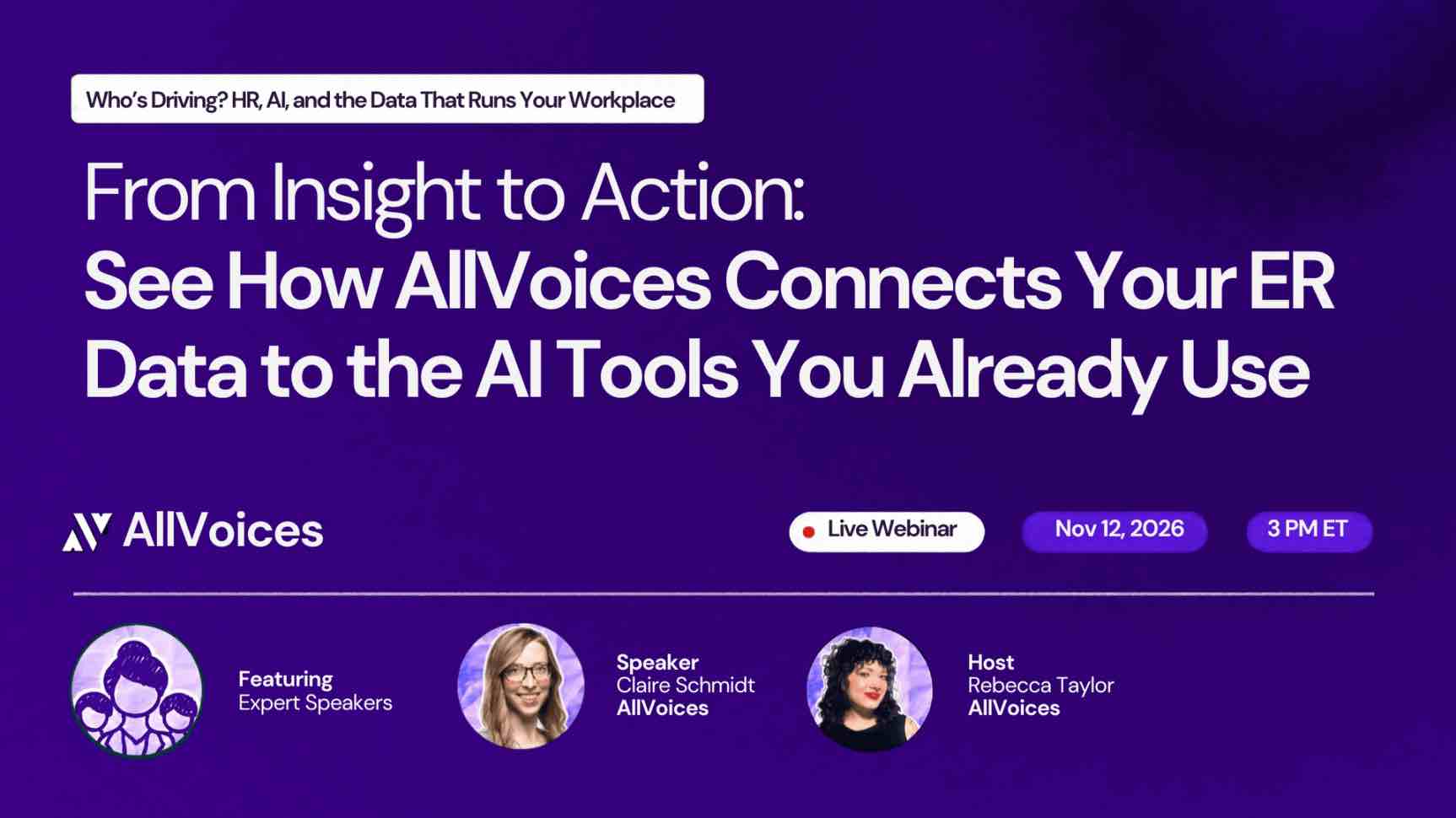
Our next webinar
Frequently asked questions

Got more questions? Email us at support@allvoices.co and we'll respond ASAP.

No items found.
Frequently asked questions

Got more questions? Email us at support@allvoices.co and we'll respond ASAP.

No items found.
Director at The Raben Group’s DEI Practice, Anee Korme - Equity as a Value
Episode 235
About This Episode
In this episode of Reimagining Company Culture, we’re chatting with Anee Korme, Director at The Raben Group’s DEI Practice. Anne is a passionate diversity advocate and educator with over 11 years of experience working in the diversity, equity, and inclusion space and its intersection with public higher education. Tune in to learn Anee’s thoughts on patterns in equity work across orgs, the role of private organizations to create equity, the key pillars of psychological safety, and more!
About The Guest
Anee Korme (she/her) serves as a Director in The Raben Group’s diversity, equity, and inclusion practice. She is a passionate diversity advocate and educator with over 11 years of experience working in the diversity, equity, and inclusion space and its intersection with public higher education. Before joining Raben, Anee served as the Associate Director for Student Diversity and Development at Towson University, where she provided subject matter expertise on issues related to racial bias and organizational dynamics, while delivering training programs for staff, faculty, and students. Additionally, she served as adjunct faculty at the University, teaching undergraduate and graduate courses on diversity, equity and inclusion. Anee previously worked as an agent for change at Southern Illinois University; University of Maryland College Park; the David C. Driskell Center for African American Art and Culture; the State Superintendent of Education in Washington, DC; and the National Council for Community and Education Partnerships. Throughout her career, she has developed and implemented more than 100 millennial and Generation Z-based diversity workshops, pieces of training, and seminars. Anee also provided strategic policies, training, and expertise for clients including PepsiCo/Frito-Lay Pacific Northwest Women’s Forum, Johns Hopkins University Office of Student Engagement and the Maryland State Department of Education, Division of Early Childhood, through her private firm.
Episode Transcription

Few People functions get the conversation about DEI as a core value right on the first try. In a recent episode of the Reimagining Company Culture podcast, Anee Korme sat down to talk through how that work actually shows up day to day, where most teams stall, and what shifts when leaders take it seriously.

This piece pulls together the practical takeaways from that conversation alongside current research from primary HR sources. Treat it as a working reference for People leaders, Employee Relations specialists, and managers who want to move past slogans on DEI as core value.

Most blog posts on DEI as core value stop at definitions. The conversation with Anee Korme did the opposite. They walked through the mistakes that look reasonable in a planning doc but fall apart in execution, and the small habits that quietly carry teams through the harder seasons.

Anee Korme (she/her) serves as a Director in The Raben Group’s diversity, equity, and inclusion practice. She is a passionate diversity advocate and educator with over 11 years of experience working in the diversity, equity, and inclusion space and its intersection with public higher education. Before joining Raben, Anee served as the Associate Director for Student Diversity and Development at Towson University, where she provided subject matter expertise on issues related to racial bias and organizational dynamics

What It Means to Treat DEI as a Core Value

This is where a focused AllVoices DEI solution pays off, Strong programs start with the boring stuff: defining what good looks like, agreeing on a few shared signals, and building the muscle to act on them. In practice, that means moving past buzzwords on DEI as core value and putting structure behind the work.

That structure has to be built on real data, not vibes. According to McKinsey's Diversity Matters Even More report, diversity-financial performance link strengthening. The pattern is consistent across industries and team sizes.

It also helps to share a common vocabulary across People, managers, and executives. If your team is still aligning on basics like inclusion, that work belongs in front of the strategy conversation, not behind it.

Where Most People Teams Get Stuck on Dei As Core Value

Why do good intentions stall before action?

Most teams know what they want. The break point is usually in the operating model: who owns what, what the cadence is, and how decisions get made when something hard surfaces.

As Harvard Business Review's case for intersectional inclusion highlights, intersectional approach surfaces hidden disparities. That tracks with what most People leaders see in their own data.

What separates one-off effort from durable practice?

Durable practice depends on systems that outlast a single champion. Tying the work to diversity and to specific manager behaviors is what carries it through reorgs and budget cycles.

The teams that get this right build a small set of shared rituals: a regular review of cases, a clear path for escalation, and an honest accounting of what changed because of the work.

What Actually Works

Principle 1: Make the work visible

Visibility is the cheapest intervention available to a People team. When the work is in front of managers, employees, and the executive team, behavior changes without a memo.

That can mean a monthly People dashboard, a quarterly trends review, or a simple summary of what got resolved and what stalled. The point is that it lives somewhere people see.

Principle 2: Build feedback loops that get used

Feedback is only useful if it produces a response. The teams that get the most from surveys, focus groups, and listening sessions are the ones that close the loop visibly and quickly.

Tying intake to pay equity and to a clear case workflow means you can show employees what happened with their input, not just thank them for it.

Principle 3: Hold leaders accountable in public

Accountability is the part most cultures avoid. The People function that builds public review of leader behavior, not just employee behavior, gets a different result.

That looks like leadership scorecards, calibrated 360s, and direct conversation about what shifts when a specific leader is involved. None of it is comfortable. All of it works.

Where Employee Relations Fits

Most of these conversations live in the Employee Relations function, whether the team calls it that or not. The work shows up as concerns, escalations, investigations, and trend analysis that has to feed back into how the company actually runs.

A AllVoices DEI hotline gives ER a single place to track intake, document decisions, and surface patterns that would otherwise stay in spreadsheets. Pairing that with AllVoices workplace investigation tools keeps the work auditable when the volume picks up.

How does ER own this work without becoming the bottleneck?

The ER function does its best work when it is positioned as a partner to the business, not just a compliance backstop. That positioning is what turns a complaint queue into an early warning system.

Tools alone do not create the partnership. The structure around them, the cadence, the trust built with managers, the relationship with legal and Finance, is what makes ER a real strategic function.

Frequently Asked Questions About Dei As Core Value

What is DEI as core value, and why does it matter for HR?

At its most useful, DEI as core value is shorthand for a set of behaviors and structures that change how work feels day to day. People teams care because it shows up in retention, employee relations caseloads, and how quickly a new hire becomes productive.

How do People leaders measure progress on DEI as core value?

The most reliable measures are the ones that already live in your stack: ER case volume by category, manager effectiveness scores, retention by tenure, and engagement indices. Pair them with qualitative input from focus groups and skip-level conversations.

What's the biggest mistake teams make on DEI as a core value?

They treat it as a campaign instead of a practice. A launch event without a quarterly cadence and a clear owner does not survive the first reorg. Operationalizing the work is what makes it stick.

How does this connect to Employee Relations work?

ER teams sit at the intersection of intake, investigation, and trend analysis. When the data from those workflows gets back to managers and leaders quickly, the rest of the People function can act earlier.

Where should a small People team start?

Start with one signal you can measure and one ritual you can keep. A monthly trends review or a quarterly leader scorecard beats an ambitious plan that never lands. Add scope only after the first ritual is sticking.

The Bottom Line for HR Leaders

The throughline in Anee Korme's conversation is that practice beats theory. Every team has access to frameworks. The teams that move forward are the ones that translate the framework into a small number of standing rituals their managers can keep without a calendar reminder.

For People leaders watching budgets, the case is the same. Cut the work that does not show up in manager behavior or in employee relations data. Double down on the work that does. The signal-to-noise ratio in the People function is what most teams underrate.

Practical next steps look modest from the outside. Pick one signal you already collect, like ER case volume by category or new-hire 90-day retention. Pick one ritual to act on it, like a monthly trends review with senior leaders. Stick with both for two quarters before adding anything new. The People teams that compound results year over year are the ones that keep their commitments small enough to actually keep.

See what changes when intake, investigations, and analytics live in one place.

Want to learn more?
See the power of AllVoices today
Thank you! We look forward to meeting you soon
Oops! Something went wrong while submitting the form.
Frequently asked questions

Got more questions? Email us at support@allvoices.co and we'll respond ASAP.

No items found.
Frequently asked questions

Got more questions? Email us at support@allvoices.co and we'll respond ASAP.

No items found.