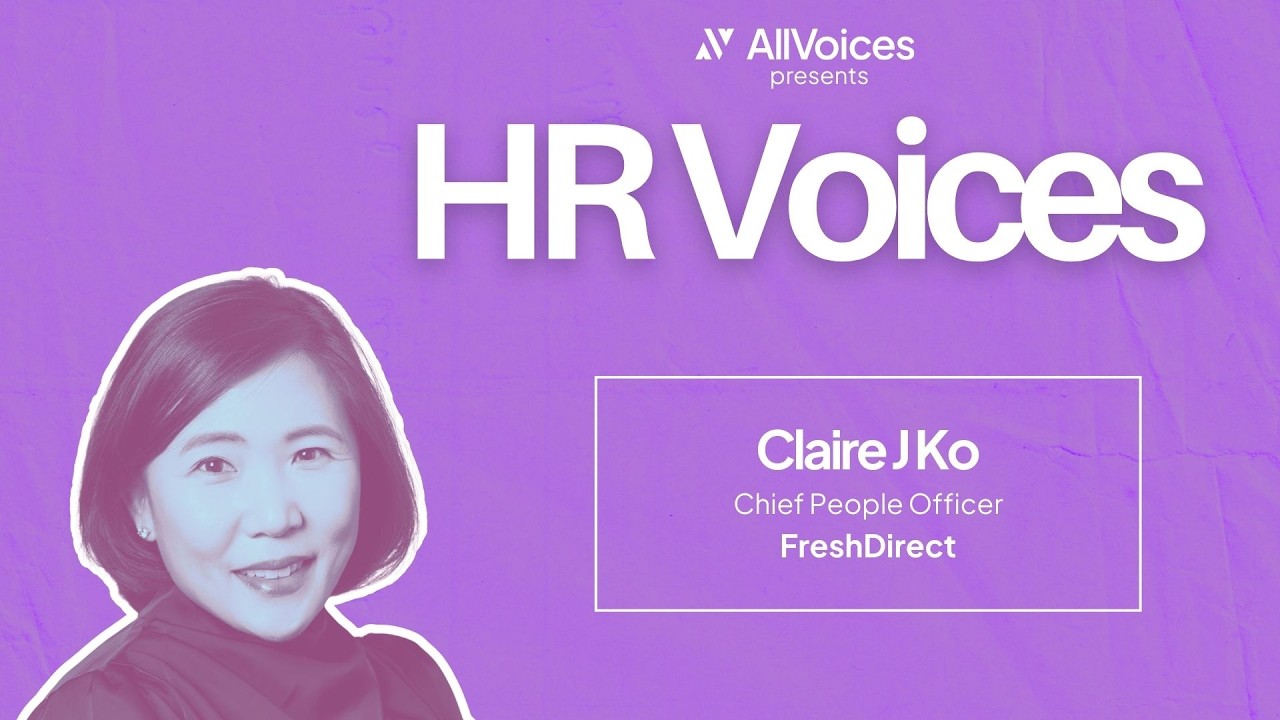

Claire Ko, Chief People Officer at FreshDirect, began her HR Voices conversation with host Rebecca Taylor by explaining what makes the business different. She calls FreshDirect the pioneer of online grocery delivery, and she said more than 90 percent of its produce comes directly from farms and fishermen. It was also about to become the first East Coast online retailer to offer organic fair trade bananas, with $1 from every bunch going back to farmers.
The people side of that model is harder. FreshDirect runs a food production facility, a logistics and delivery network, a merchandising engine, and a tech-enabled corporate office, all under high customer expectations. A people team of roughly twenty supports more than 2,500 employees. It is expected to drive high performance and, at the same time, to be “the emotional safety net for people.” Claire’s answer is a program she designed called Engagement for Success.
Why a Lean People Team Carries So Much Weight
About 300 of FreshDirect’s employees work in corporate roles. The rest sit across production, delivery, and merchandising, and each group brings different interests, demographics, and expectations. Keeping all of them supported is, by Claire’s account, the biggest challenge she faces as a People leader.
The list of what her team owns is long. It reduces cost, raises productivity, drives culture with the management team, handles compliance, manages risk, coaches people, and absorbs emotions. Claire put the core of the job plainly: make sure everyone understands “what winning actually looks like,” give people recognition for the work they do well, and show what that work does for the business.
Her personal challenge is time. She wants more of it with the team, so frustrations get resolved without delay. A lean team cannot add hours; it has to make each conversation count.
What Engagement for Success Changes About Performance
Claire built the program around a gap she saw throughout her career. Reviews tend to cover what someone did well, what they need to improve, and how they will get better. They rarely ask how the person defines success. Someone may not want a senior title at all. They may want to explore other parts of the department, not to transfer, but to understand how the business operates, a career path that runs sideways rather than up.
Engagement for Success puts that question first. Each employee defines what success looks like for them, beyond the job description, and ties it to the impact they make on the department and the company. Claire argues that “high performance without that caring and the vision for long-term success and the impact” does not last. She does not see it as a meaningful level of performance to drive.
The timing matters. Rebecca pointed out that engagement across the workforce is low almost everywhere, and the data agree. Gallup’s State of the Global Workplace report found that global engagement fell to 20 percent in 2025, its lowest level since 2020. Claire’s bet is that engagement grows from a personal definition of success, not from a company-wide slogan.
What Actually Works
Give Employees Ownership of the Monthly Conversation
The program runs on one meeting. Every month, each employee drives a twenty to thirty minute conversation with their manager. For the first meeting, they come prepared to describe what success looks like for them. After that, each session covers the path they are building, the progress they are making, and any obstacles they cannot clear alone.
Claire expects the format to change manager behavior. Managers start to take more interest in what their people want, and they feel obligated to remove the obstacles in the way. The length is deliberate, too. Gallup research on manager conversations found that fifteen to thirty minutes is enough for a meaningful conversation, but only if it happens frequently, which is the case for keeping one-on-ones short and recurring.
Make the Record Part of the Review
Employees record each conversation, and the notes become a track record for the whole year. Claire sees that record as a critical input at review time. It captures more than the KPIs and metrics someone hit; it shows the effort made and the steps taken toward the success the employee defined.
That record changes what the year-end performance review can do. Rebecca added that long-term decisions should not rest on anecdotal evidence. A year of consistent conversations shows themes and patterns, not the recency bias that skews reviews.
Ask Leaders to Build Their Best Team
Calibration season exposes a familiar problem. Managers tell Claire that “everybody in my team are great performers,” and she has to answer that not everyone can be the best performer on one team. The harder question is whether HR understands the level of engagement it should expect.
Her fix is not forcing ratings into fixed tiers. It is a change of perspective. Claire spends time with the senior leadership team and the layers below it, and she hands each leader a magic wand. The prompt asks them to create the best team they can imagine, describe its structure, and name who comes with them. Then she asks what that team would achieve. She emphasizes that the exercise is not about measuring performance or taking action. It is about seeing potential the current view hides.
Where Employee Relations Fits
Rebecca connected the documentation point to what AllVoices sees in its own work. A significant number of cases relate to performance management or performance improvement. Often a manager wants to terminate an employee, HR is the last to find out, and the team has to work backward to learn how things got there.
Monthly records close that gap early. When the ongoing performance management conversation is written down as it happens, People teams can see obstacles and patterns months before a termination request lands. ER teams that keep documented performance conversations in one system start from evidence when friction turns into a case.
Frequently Asked Questions About Engagement for Success at FreshDirect
It is a program Claire Ko designed so each employee defines personal success and works toward it with their manager. Monthly conversations tie that definition to the employee’s impact on the department and the company.
Once a month, for twenty to thirty minutes. The employee drives the meeting, opening with what success looks like, then covering progress and any obstacles the manager needs to help remove.
Roughly twenty people. Claire Ko said the team supports more than 2,500 employees, about 300 of them in corporate roles, across food production, logistics and delivery, merchandising, and a tech-enabled corporate office.
It asks a leader to build the best team they can imagine. Claire has leaders describe its structure, name who comes with them, and explain what it would achieve, which surfaces potential that today’s view misses.
Employees record every monthly conversation, building a track record for the year. At review time, it shows the effort made and the progress toward the employee’s own goals, not only the KPIs and metrics they hit.
The Bottom Line for HR Leaders
Claire’s framing gets more useful as AI reshapes People work. With AI threatening many positions in the people team world, she argues that the strength People leaders bring is “the level of interaction, engagement, and motivations that we can offer to the table.”
Engagement for Success puts that strength on a calendar. A monthly conversation, an employee-owned definition of success, and a written record give a lean team reach that more headcount could not. Claire Ko is betting that this kind of performance lasts.
See how AllVoices helps People teams document performance conversations and spot patterns before they become cases.