About This Episode
In this episode of Reimagining Company Culture, we’re chatting with Ciara Lakhani, Chief People Officer at Dashlane. Previously, she led the People function at Compass while it scaled from 84 to over 400 employees before its IPO.
About The Guest
Ciara currently serves as the Chief People Officer at Dashlane, an app helping everyone easily log in to the accounts they need—anytime, anywhere. Dashlane is an employee-choice-led hybrid workplace, maintaining offices in Paris, New York or Lisbon. Ciara started in New York and moved to Paris during the pandemic in 2020. Previously, she led the People function at Compass while it scaled from 84 to over 400 employees before its IPO. She had her first People start-up role in 2003, but spent 6 years with large global teams at GE in between. Ciara studied Psychology at SUNY Geneseo and has a MBA from the Wharton School at the University of Pennsylvania.
Episode Breakdown

Ciara Lakhani, Chief People Officer at Dashlane, has scaled people functions across global teams, from Compass before its IPO to a hybrid workforce spanning Paris, New York, and Lisbon. Her perspective on people analytics is grounded in operating reality rather than dashboard theory: data is most useful when it changes a decision a leader was about to make.

The wider issue is that most companies have more HR data than they use. Engagement scores, attrition rates, manager effectiveness data, and exit interview themes sit in separate systems and rarely make it into the rooms where decisions get made. The result is a people strategy run on intuition while the data sits unread.

HR leaders who want analytics to matter have to make it part of how decisions get made, not a separate reporting exercise. That requires deliberate design.

Why people analytics has to connect to decisions

The strongest people analytics functions act as a translation layer between data and action. McKinsey's research walks through the pattern; McKinsey's analysis of how people analytics is transforming HR shows that the highest-impact teams build analytics around specific business questions rather than running general reports.

For HR leaders, that means starting with the decision and working backward to the data. AllVoices' data and insights capability helps connect ER, listening, and engagement data to questions leaders are actively trying to answer.

Strong analytics also depend on data quality and trust. People analytics programs that produce inconsistent numbers lose credibility quickly, and once lost, that credibility is hard to rebuild.

Building a people analytics function that holds up

Where should HR teams start with analytics?

Start with two or three high-use questions: why are people leaving from these specific teams, where are managers driving disproportionate engagement gaps, and what is the cost of unfilled roles in the highest-priority functions. Answer those well, and the rest of the analytics agenda follows.

Deloitte's research walks through the maturity curve in detail; Deloitte's high-impact people analytics research describes how organizations move from reporting to predictive insight.

What kinds of decisions does people analytics actually change?

Manager promotions, retention investments, compensation adjustments, succession planning, and DEI program design. Each of these decisions runs better when grounded in data than when made on intuition alone. The trick is making sure the data is in the room when the decision happens.

Pair analytics with workforce planning processes that already exist. Embedding the data in existing decisions is faster than building parallel forums.

What actually works

Tie analytics to the leaders who can act on it

Data without an owner produces nothing. Identify the leader who owns each question, build the analytics with their input, and design the output for their decision rhythm. A monthly report for a leader who reviews these questions monthly is far more useful than a quarterly dashboard nobody reads.

Use KPIs that connect directly to outcomes leaders are evaluated on. Otherwise, the data feels like overhead.

Use listening data, not just system data

Engagement scores, exit interview themes, and ER case patterns add texture that HRIS data alone cannot provide. Combining these sources gives a fuller picture of what is happening on the ground. AllVoices' employee survey tool and pulse surveys create that listening layer.

Triangulating across sources also catches the gap between what employees say in formal surveys and what they raise in anonymous channels. That gap often holds the most important signals.

Protect privacy and trust while you scale

People analytics fails fast if employees feel surveilled. Be transparent about what data is collected, how it is used, and who sees it. Build clear governance and revisit it as the program grows. Trust in the program is what determines whether employees engage with surveys, feedback tools, and listening systems honestly.

Gartner's HR analytics glossary outlines the governance practices to put in place; Gartner's HR analytics overview walks through the foundational concepts.

Where Employee Relations Fits

ER data is one of the richest sources of insight in the company. AllVoices' employee relations function support, paired with our HR case management tool, gives HR leaders structured data on the cases that matter most. Patterns across teams, managers, and locations show up in this data before they appear anywhere else.

How does ER data sharpen people analytics?

It surfaces the qualitative themes that survey data smooths over. A spike in cases tied to a single manager, an emerging pattern around remote and in-office disparities, or a quiet trend in retaliation reports all carry information that engagement scores alone will miss.

Combining ER data with engagement, attrition, and survey data produces a picture leaders can actually act on. That combination is what people analytics is for.

Frequently Asked Questions About People Analytics

What is the difference between HR reporting and people analytics?

Reporting tells you what happened. Analytics helps you decide what to do next. The first is descriptive; the second is decision-focused.

What skills does a people analytics team need?

A mix of statistical skill, business judgment, and HR domain knowledge. The best teams pair analysts with HR leaders who can frame the right questions.

How do you keep analytics from feeling like surveillance?

Be transparent about data collection, use, and governance. Aggregate data wherever possible, and avoid using analytics to make individual punitive decisions without human review.

How does analytics improve retention?

By identifying the teams, managers, and life-cycle moments most likely to produce attrition, and acting on those signals before resignations come in. Predictive insights turn retention from reactive to proactive.

How do you build trust in the data?

Audit it regularly, share methodology openly, and acknowledge limitations. The fastest way to lose credibility is to overclaim certainty and then have the numbers contradicted.

What's the first step for HR leaders who want to put this into practice?

Start with one team and one measurable outcome. Pick a function where the issue shows up sharply and a leader who is willing to model the new practice. Map the current state honestly: what is happening, who feels it, and what would good look like in ninety days. Share that picture with the team, ask them what is missing from your read, and adjust before launching anything formal. The goal of step one is alignment, not activity.

Once the picture is shared, pick two or three changes you can make inside one quarter. Resist the urge to launch a full program. Run the changes, measure the response with simple pulse questions, and report back. The combination of a focused team, a clear measure, and a public commitment to learn is what turns a good idea into a practice that spreads. HR leaders who try to launch everywhere at once usually end up launching nowhere.

Iterate from there. The teams that succeed treat the first cycle as a prototype, not a rollout. They keep what worked, drop what did not, and write down what they learned. By the time the practice expands to the next group, it has been pressure-tested by people who have a stake in seeing it work. That is the unglamorous work of putting any people-strategy idea into practice, and it is also the work that compounds.

The Bottom Line for HR Leaders

Ciara Lakhani's work scaling people functions through hyper-growth makes a clear point. People analytics is most useful when it changes a specific decision a leader was about to make. Build the data around the decisions, embed it in existing rhythms, and pair quantitative data with listening and ER signals. The combination produces insight that moves the company.

Skip that integration, and the dashboard sits unread while decisions get made on intuition. The cost shows up in attrition, mishandled cases, and missed opportunities the company never even sees.
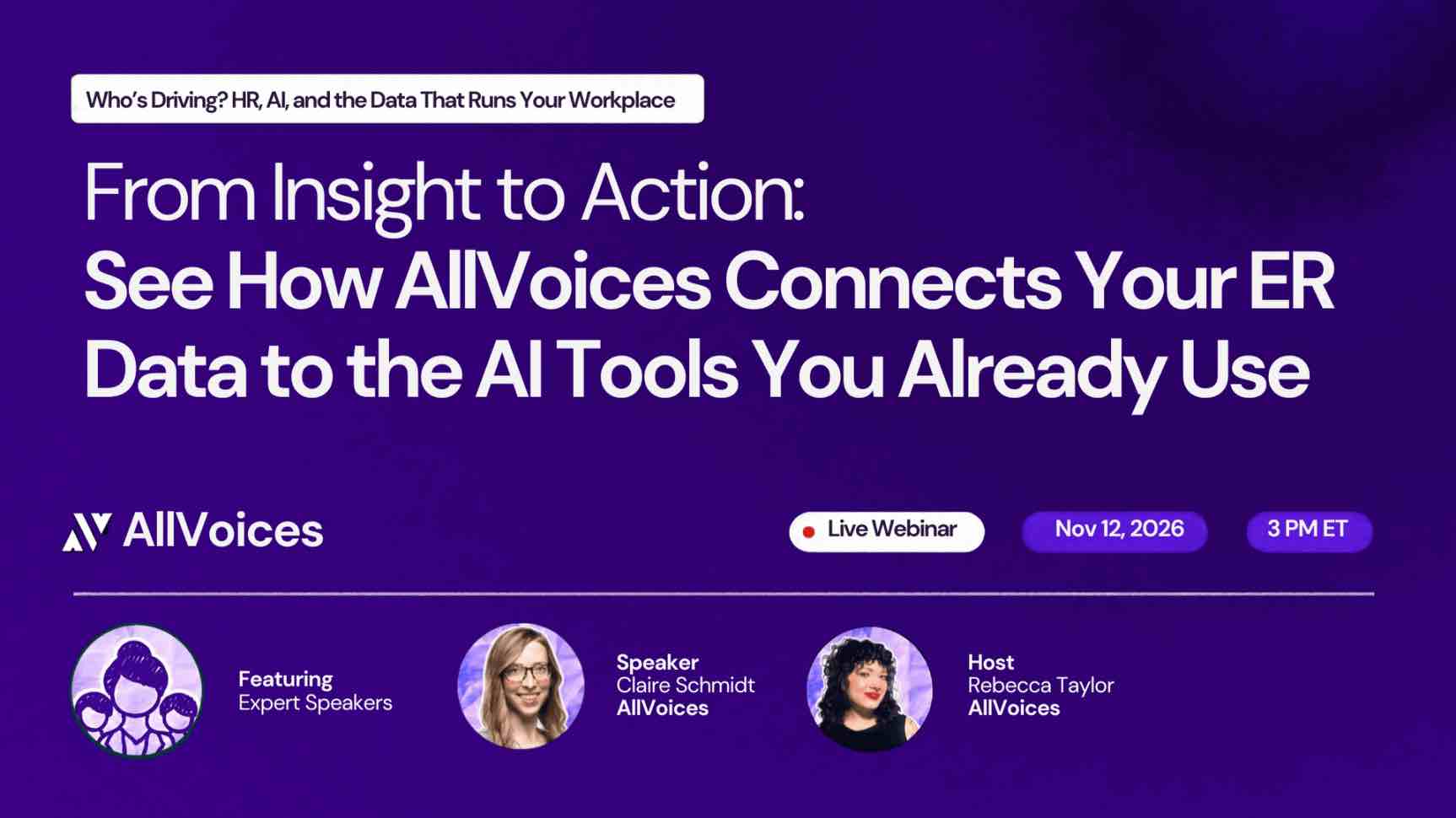
See how AllVoices brings ER, listening, and engagement data into one view for people analytics teams.

Our next webinar
Frequently asked questions

Got more questions? Email us at support@allvoices.co and we'll respond ASAP.

No items found.
Frequently asked questions

Got more questions? Email us at support@allvoices.co and we'll respond ASAP.

No items found.
Ciara Lakhani, Chief People Officer at Dashlane - Harness the Power of People Analytics
Episode 157
About This Episode
In this episode of Reimagining Company Culture, we’re chatting with Ciara Lakhani, Chief People Officer at Dashlane. Previously, she led the People function at Compass while it scaled from 84 to over 400 employees before its IPO.
About The Guest
Ciara currently serves as the Chief People Officer at Dashlane, an app helping everyone easily log in to the accounts they need—anytime, anywhere. Dashlane is an employee-choice-led hybrid workplace, maintaining offices in Paris, New York or Lisbon. Ciara started in New York and moved to Paris during the pandemic in 2020. Previously, she led the People function at Compass while it scaled from 84 to over 400 employees before its IPO. She had her first People start-up role in 2003, but spent 6 years with large global teams at GE in between. Ciara studied Psychology at SUNY Geneseo and has a MBA from the Wharton School at the University of Pennsylvania.
Episode Transcription

Ciara Lakhani, Chief People Officer at Dashlane, has scaled people functions across global teams, from Compass before its IPO to a hybrid workforce spanning Paris, New York, and Lisbon. Her perspective on people analytics is grounded in operating reality rather than dashboard theory: data is most useful when it changes a decision a leader was about to make.

The wider issue is that most companies have more HR data than they use. Engagement scores, attrition rates, manager effectiveness data, and exit interview themes sit in separate systems and rarely make it into the rooms where decisions get made. The result is a people strategy run on intuition while the data sits unread.

HR leaders who want analytics to matter have to make it part of how decisions get made, not a separate reporting exercise. That requires deliberate design.

Why people analytics has to connect to decisions

The strongest people analytics functions act as a translation layer between data and action. McKinsey's research walks through the pattern; McKinsey's analysis of how people analytics is transforming HR shows that the highest-impact teams build analytics around specific business questions rather than running general reports.

For HR leaders, that means starting with the decision and working backward to the data. AllVoices' data and insights capability helps connect ER, listening, and engagement data to questions leaders are actively trying to answer.

Strong analytics also depend on data quality and trust. People analytics programs that produce inconsistent numbers lose credibility quickly, and once lost, that credibility is hard to rebuild.

Building a people analytics function that holds up

Where should HR teams start with analytics?

Start with two or three high-use questions: why are people leaving from these specific teams, where are managers driving disproportionate engagement gaps, and what is the cost of unfilled roles in the highest-priority functions. Answer those well, and the rest of the analytics agenda follows.

Deloitte's research walks through the maturity curve in detail; Deloitte's high-impact people analytics research describes how organizations move from reporting to predictive insight.

What kinds of decisions does people analytics actually change?

Manager promotions, retention investments, compensation adjustments, succession planning, and DEI program design. Each of these decisions runs better when grounded in data than when made on intuition alone. The trick is making sure the data is in the room when the decision happens.

Pair analytics with workforce planning processes that already exist. Embedding the data in existing decisions is faster than building parallel forums.

What actually works

Tie analytics to the leaders who can act on it

Data without an owner produces nothing. Identify the leader who owns each question, build the analytics with their input, and design the output for their decision rhythm. A monthly report for a leader who reviews these questions monthly is far more useful than a quarterly dashboard nobody reads.

Use KPIs that connect directly to outcomes leaders are evaluated on. Otherwise, the data feels like overhead.

Use listening data, not just system data

Engagement scores, exit interview themes, and ER case patterns add texture that HRIS data alone cannot provide. Combining these sources gives a fuller picture of what is happening on the ground. AllVoices' employee survey tool and pulse surveys create that listening layer.

Triangulating across sources also catches the gap between what employees say in formal surveys and what they raise in anonymous channels. That gap often holds the most important signals.

Protect privacy and trust while you scale

People analytics fails fast if employees feel surveilled. Be transparent about what data is collected, how it is used, and who sees it. Build clear governance and revisit it as the program grows. Trust in the program is what determines whether employees engage with surveys, feedback tools, and listening systems honestly.

Gartner's HR analytics glossary outlines the governance practices to put in place; Gartner's HR analytics overview walks through the foundational concepts.

Where Employee Relations Fits

ER data is one of the richest sources of insight in the company. AllVoices' employee relations function support, paired with our HR case management tool, gives HR leaders structured data on the cases that matter most. Patterns across teams, managers, and locations show up in this data before they appear anywhere else.

How does ER data sharpen people analytics?

It surfaces the qualitative themes that survey data smooths over. A spike in cases tied to a single manager, an emerging pattern around remote and in-office disparities, or a quiet trend in retaliation reports all carry information that engagement scores alone will miss.

Combining ER data with engagement, attrition, and survey data produces a picture leaders can actually act on. That combination is what people analytics is for.

Frequently Asked Questions About People Analytics

What is the difference between HR reporting and people analytics?

Reporting tells you what happened. Analytics helps you decide what to do next. The first is descriptive; the second is decision-focused.

What skills does a people analytics team need?

A mix of statistical skill, business judgment, and HR domain knowledge. The best teams pair analysts with HR leaders who can frame the right questions.

How do you keep analytics from feeling like surveillance?

Be transparent about data collection, use, and governance. Aggregate data wherever possible, and avoid using analytics to make individual punitive decisions without human review.

How does analytics improve retention?

By identifying the teams, managers, and life-cycle moments most likely to produce attrition, and acting on those signals before resignations come in. Predictive insights turn retention from reactive to proactive.

How do you build trust in the data?

Audit it regularly, share methodology openly, and acknowledge limitations. The fastest way to lose credibility is to overclaim certainty and then have the numbers contradicted.

What's the first step for HR leaders who want to put this into practice?

Start with one team and one measurable outcome. Pick a function where the issue shows up sharply and a leader who is willing to model the new practice. Map the current state honestly: what is happening, who feels it, and what would good look like in ninety days. Share that picture with the team, ask them what is missing from your read, and adjust before launching anything formal. The goal of step one is alignment, not activity.

Once the picture is shared, pick two or three changes you can make inside one quarter. Resist the urge to launch a full program. Run the changes, measure the response with simple pulse questions, and report back. The combination of a focused team, a clear measure, and a public commitment to learn is what turns a good idea into a practice that spreads. HR leaders who try to launch everywhere at once usually end up launching nowhere.

Iterate from there. The teams that succeed treat the first cycle as a prototype, not a rollout. They keep what worked, drop what did not, and write down what they learned. By the time the practice expands to the next group, it has been pressure-tested by people who have a stake in seeing it work. That is the unglamorous work of putting any people-strategy idea into practice, and it is also the work that compounds.

The Bottom Line for HR Leaders

Ciara Lakhani's work scaling people functions through hyper-growth makes a clear point. People analytics is most useful when it changes a specific decision a leader was about to make. Build the data around the decisions, embed it in existing rhythms, and pair quantitative data with listening and ER signals. The combination produces insight that moves the company.

Skip that integration, and the dashboard sits unread while decisions get made on intuition. The cost shows up in attrition, mishandled cases, and missed opportunities the company never even sees.

See how AllVoices brings ER, listening, and engagement data into one view for people analytics teams.

Want to learn more?
See the power of AllVoices today
Thank you! We look forward to meeting you soon
Oops! Something went wrong while submitting the form.
Frequently asked questions

Got more questions? Email us at support@allvoices.co and we'll respond ASAP.

No items found.
Frequently asked questions

Got more questions? Email us at support@allvoices.co and we'll respond ASAP.

No items found.