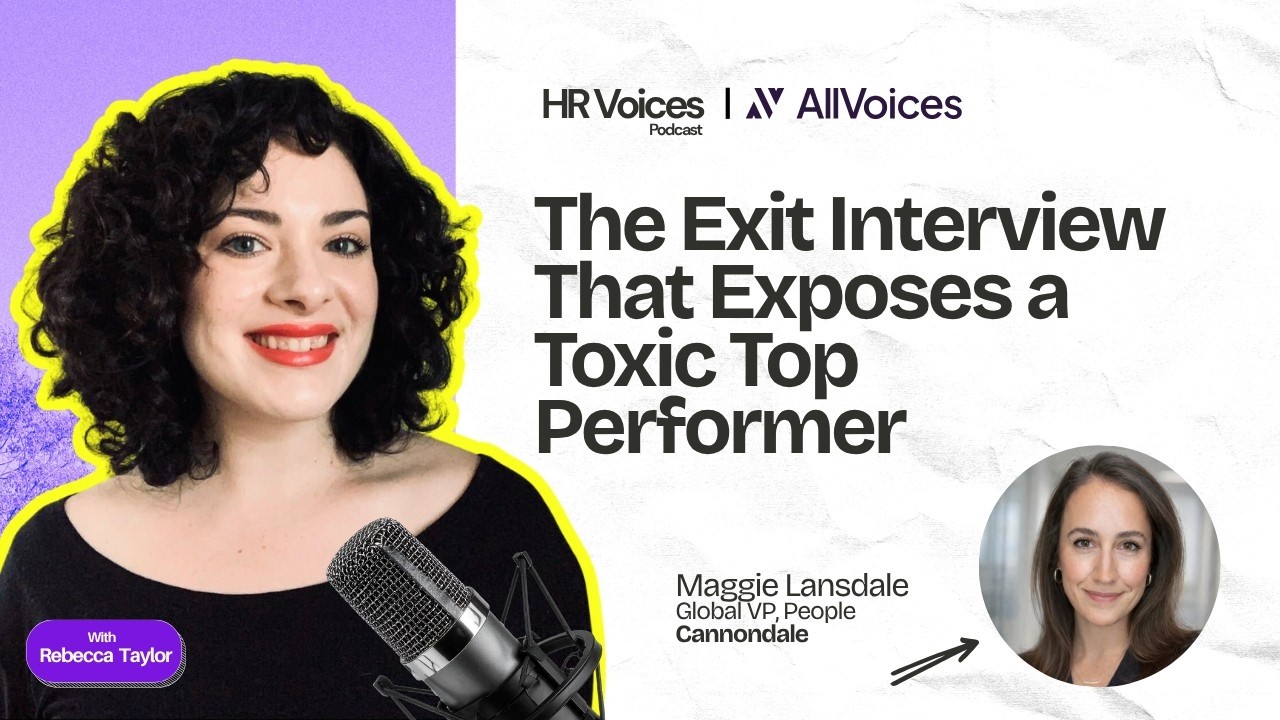

When we sat down with Maggie Lansdale, Global VP of People at Cannondale, host Rebecca Taylor handed her a scenario with no clean exit. A departing employee had used her exit interview to describe dated incidents of a director’s verbal abuse toward junior staff. She never raised any of it while employed. She did not trust the process, and she asked that her name stay out of what came next.
That leaves HR with credible detail, a witness who will not go on record, and a director leadership does not want to lose. Maggie has untangled versions of this case for years. Her first move is not to open a file on the director. It is to ask why the concern waited until her last day.
Why the Honest Feedback Waits for the Exit Interview
Maggie treats the delay as the finding, not the footnote. People hold their feedback until they are leaving because they do not trust the process. Others never learned what the process was. Both point at the same gap.
That makes what an exit interview is for a test of everything upstream of it. Maggie asks what a team has done so employees know where to go. Manager training carries part of that load. Every new manager should learn how a complaint moves, who hears it, and how far confidentiality reaches.
The fear underneath the silence is retaliation. Employees watch a complaint land, then watch the person who raised it appear on a layoff list six months later. Whether those two events are connected matters less than the story people tell about them. How retaliation is legally defined is narrower than the fear. The volume is not: the EEOC logged 54,350 retaliation-based charge receipts in fiscal year 2025, the highest in a series running back to 1992.
What a Top Performer Costs Underneath the Revenue
Leadership reluctance usually has a number attached. Maggie points at the sales director bringing in millions a year, or the account director who is stellar with clients and a problem inside the building. They do one part of the job well. The rest never reaches the revenue line.
She has seen it. In an earlier role, a manager with what she calls mean girl energy took two or three years to move out. The argument that finally worked was replacement cost. Five managers cycled through the seat underneath, staying about eighteen months each, every one rehired at full price. The formula behind employee turnover turned an impression into a figure the CEO could not wave off.
The research agrees. SHRM put the five-year cost of culture-driven turnover at as much as $223 billion, and found 76 percent of Americans say their manager sets the culture. Gallup puts 70 percent of the variance in team engagement on the manager alone.
None of that settles what this director actually did. How workplace bullying differs from harassment is the distinction the investigation has to draw. Rebecca offers the reframe worth keeping. If this director is the best while the team underneath churns, nobody has measured the ceiling yet.
What Actually Works
Start With the Team and Save the Director for Last
Maggie wants more in hand before the director hears anything. She starts with the junior staff named in the account, moves to peers, then to the leaders protecting the role. Running a workplace investigation in that order changes what people are willing to say, because nobody has been warned yet.
The cost is containment. Once junior employees are pulled aside the chatter starts, and early-career staff have rarely been asked to hold something confidential. Maggie is candid that no version of this is clean. When she reaches the director she opens on the pattern rather than the allegation. Three years of departures, the themes those exit interviews shared, and an invitation to account for both.
Write Down the Signal Before It Becomes a Case
One odd comment in an exit interview is not a case. Maggie keeps it anyway, as a data point she and the HR business partner carry into the next review cycle. She watches for it in upward feedback and peer reviews, then presses managers on whether they plan to address it.
Once the word abuse appears, the standard changes and the record belongs somewhere durable. Maggie has run this from a Google Doc. The date, what was said, who is aware, and what was resolved is the minimum. Keeping that history in one structured system for HR cases turns scattered anecdotes into a pattern nobody can dismiss.
Name the Behavior Before Scoping the Response
Verbal abuse and toxic workplace are phrases with legal weight. Employees reach for them without that meaning. Rebecca treats the language as a starting point rather than a finding. What a hostile work environment requires is narrow, and most of what reaches HR does not meet it.
The response still happens. Maggie separates the two questions. One is whether the conduct is severe enough to investigate. The other is whether it is serious enough to demand hard feedback. Both matter.
As a global leader she adds the cultural layer, where directness reads as rudeness and an unanswered email reads as neglect. A manager who replies “okay, thank you” can leave a junior employee certain that nothing they do is good enough.
Where Employee Relations Fits
This scenario is squarely what employee relations owns, which covers the complaints, the investigations, and the judgment in between. The report arrived late because no earlier channel felt safe to use.
At scale the relationship cannot carry that trust, so the process has to. An anonymous reporting channel with two-way follow-up lets an employee raise a concern while still employed and stay unnamed. Maggie notes that a large company may route the same report through an ethics hotline before local HR sees it.
She is firm on one point. Any manager who sees this, on any team, has a duty to report it. The instinct to stay out of it and avoid the drama is what lets the behavior continue.
Frequently Asked Questions About Exit Interview Allegations
The Bottom Line for HR Leaders
Maggie’s framing holds because it refuses the trade leadership keeps offering. A director whose team turns over every eighteen months is not a top performer with a personality problem. The case for saying so gets built in writing over years, not won in one conversation.
Her closing advice to the HR team of one is to find an HR buddy, keep the details anonymized, and call an employment lawyer early. That bill is smaller than the one waiting on the other side.
See how AllVoices helps employee relations teams surface concerns long before the exit interview in a live walkthrough of the platform.