
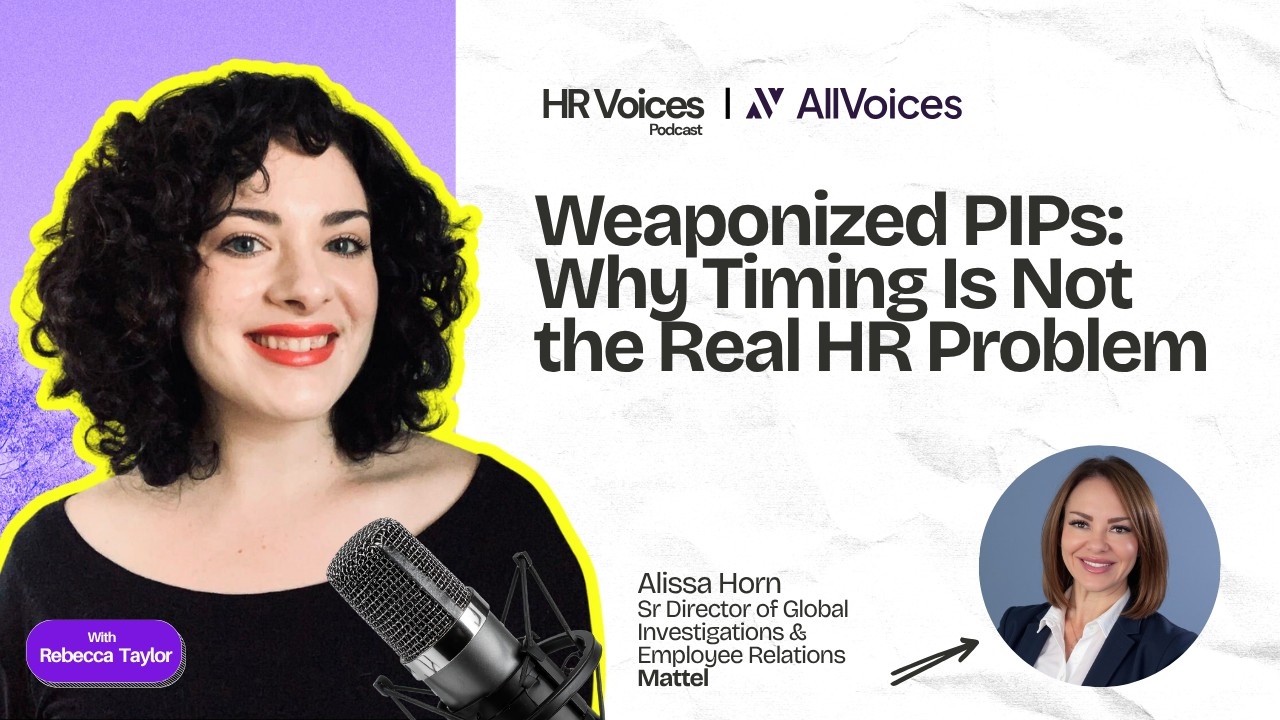

An employee files an ethics complaint about their manager’s expense reports. One week later, that same manager puts them on a performance improvement plan. The performance concerns are real, but nobody ever wrote them down or raised them with the employee. Most HR teams would fixate on the calendar. Alissa Horn, Senior Director of Global Investigations and Employee Relations at Mattel, looks somewhere else first.
When host Rebecca Taylor walked her through the scenario on HR Voices, Alissa set the timing aside and named the gap that worried her more: a PIP that arrives with no coaching, no feedback, and no paper trail behind it. She started her career as an HR business partner before moving into employee relations, so she has sat on both sides of the partnership this scenario puts under strain. Her answers were practical, not theoretical.
Why the Timing Is Not the Biggest Red Flag
Alissa was clear on one point before anything else. Filing a complaint does not place a “bubble of protection” around an employee. People who are not meeting the expectations of their job can still be performance managed, whatever they reported last week. The EEOC’s retaliation guidance makes the same point, noting that protections do not let employees “immunize themselves from consequences for poor performance.”
Timing still matters. Alissa would ask whether the manager even knew about the complaint, and when they first told their HR partner that a PIP was coming. If that conversation predates the complaint, the picture changes.
The larger problem is the process. In Alissa’s view, a PIP is the culmination of earlier coaching, the step that follows several direct conversations where the manager said what was missing and what needed to change. This PIP skipped every one of them. The employee will hear about the problem for the first time in the document that usually precedes an exit. That is where the legal risk of retaliation actually lives. According to the EEOC, retaliation is the most frequently alleged basis of discrimination in the federal sector. A PIP should be delivered with the goal of the employee improving, and a plan with no history behind it reads like a way out.
What Changes When ER Runs Independently
The second risk Alissa flagged was structural: who investigates the complaint. When HR business partners investigate concerns inside the business group they support, a real or perceived conflict of interest follows. She described a senior HR business partner asking a leader pointed questions about a harassment allegation, then sitting beside that same leader in a succession planning meeting an hour later.
An independent investigations function removes that tension. It can report to the CHRO or sit within legal or compliance. The investigator does not support that business leader, knows none of the personalities, and works only from interviews and the evidence in front of them. Alissa even opens interviews by asking people to describe their role, which signals that she has no stake in their business line.
Independence does not mean isolation. When a complaint comes in, Alissa tells the HR business partner and the subject’s manager at a high level. Without that step, two parallel workstreams run blind: the investigator does not know a PIP is coming, and the HR partner does not know a concern was raised. The relationship between the employee relations function and the HR business partner is what connects those facts.
What Actually Works
Make the Manager Notice Early and Brief
Alissa notifies the subject’s manager when an investigation opens. The manager should not hear about it for the first time when findings arrive. The message stays deliberately thin: a concern was raised, people in the business will be interviewed, and the matter is confidential. The reason is protective, not bureaucratic. If the allegations go unsubstantiated, the manager should not be carrying uncorroborated details that permanently change how they see their employee.
Build an Outlier Test Into Every PIP Review
Alissa spots a weaponized PIP by checking for consistency. The first check is whether this manager puts other people on plans without prior coaching, or only this one. The second is whether the company has a documented policy for progressive discipline and whether the manager followed it. The third, which Rebecca added, is whether HR followed it too. The EEOC notes that evidence of selective enforcement “could be sufficient to infer retaliatory motive.” A PIP that breaks the company’s own pattern is the one to question.
Tie the Decision to Someone Who Can Own the Risk
HR makes recommendations; business leaders own the decisions about their employees. When a leader wants to proceed anyway, Alissa weighs something sharper than whether the leader is right: whether this person is senior enough to assume that risk for the organization. If not, the conversation moves up until it reaches someone who can.
Where Employee Relations Fits
Rebecca’s closing point was about records. Answering “is this an outlier” requires complaints, PIPs, and prior performance management conversations to live somewhere they can be compared. The pattern is simple: when the complaint sits in an ethics hotline tool, the PIP sits in a manager’s inbox, and the coaching notes sit nowhere, nobody can see the sequence until an attorney asks for it. Structured HR case management with timestamps lets the investigator and the HR partner see the same timeline, and lets workplace investigation software keep every case running on evidence rather than memory.
Frequently Asked Questions About Weaponized PIPs
Yes, if the performance concerns are real and documented. Alissa and the EEOC agree that a complaint does not shield an employee from performance management. What raises risk is a PIP with no prior coaching, feedback, or documentation behind it.
It depends on the facts, not the timing alone. Alissa would not pause a PIP for timing, but she would push back hard on one issued without any earlier performance conversations, since the employee never had a chance to improve.
Only what they need. Tell the manager a concern was raised, that interviews will happen, and that the matter is confidential. Holding back specifics protects the employee if the allegations turn out to be unsubstantiated.
Look for inconsistency. Check whether this manager or company usually issues PIPs without prior coaching, whether the documented performance process was followed, and when the manager first raised concerns with HR relative to the complaint.
Ideally, someone independent of that business. Alissa recommends an investigations function that reports to the CHRO or to legal, so the investigator is not the same HR partner who works with that manager every week.
The Bottom Line for HR Leaders
Alissa’s framing moves the question from when the PIP happened to what happened before it. A plan built on documented coaching can survive bad timing; a plan with no history cannot survive good timing. Her advice for anyone facing this for the first time is to slow down. “I need to gather some information” is a complete answer, and it is often the right one.
See how AllVoices helps ER teams connect complaints, investigations, and performance records in one place.

.avif)
.avif)
