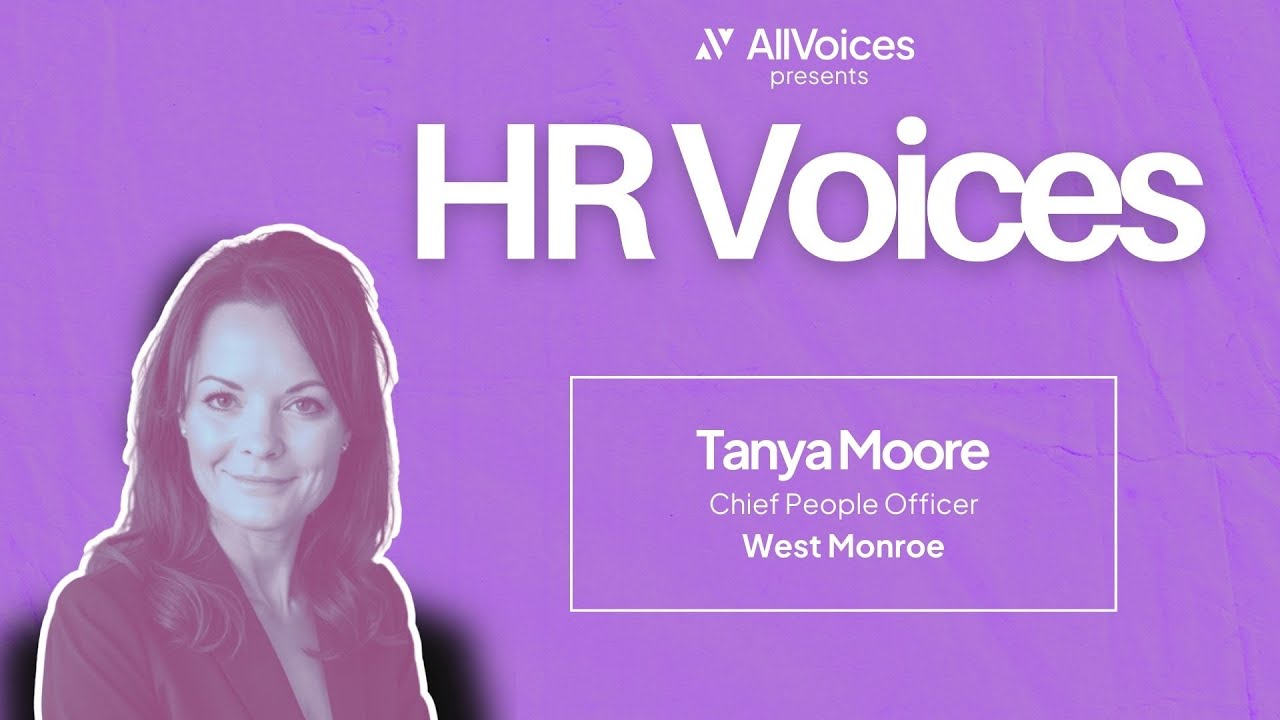

The mandate on People teams keeps rising. Tanya Moore, Chief People Officer at West Monroe, described it on HR Voices as “do more with less, do it better, all while having a fabulous employee experience.” She leads the full people experience at the business and technology consulting firm, which has a little over 2,000 people, from hiring and retention to building skills and planning for leadership succession.
When host Rebecca Taylor asked about her AI strategy, Tanya laid out a sequence, not a slogan. First the whole firm learns what AI is and how to use it. Then a handful of workflows get rebuilt end to end. Through all of it, people stay accountable for what the technology produces. Her view of AI in HR was practical, not futuristic: it speeds up the work only when people pay attention to what it returns.
Why HR Has to Move From Steward to Architect
Tanya described the shift as moving from an administrative steward of HR processes to a “strategic architect.” In practice, that means working with the C-suite and the board on how people need to support where the business is going. It is strategic human resource management with a short clock, because the goal is still that people want to come work there and want to stay working there.
Rebecca asked how HR leaders can think long term when every week brings urgent problems. Tanya offered three answers. The first is structural. At West Monroe, benefits administration, payroll, and similar people operations work sit in a separate organization from her team. Each group can be excellent at its own job, and neither has to do it all.
The second is focus. Pick the couple of things the team will do well, finish them, then pick the next couple. The third is what Tanya calls leapfrogging. Sometimes a step-by-step path makes sense, because the organization is not ready or prerequisites are missing. Other times technology lets a team go from point A to point C much faster. That shift can feel scary, Tanya admitted, and it can also be the most effective move available.
What AI Literacy Looks Like Before the Workflows Change
Last year, West Monroe focused on a baseline of AI literacy across the whole organization, from the CEO down. The goal was that everyone understood what the technology was, where it was going, and how to start using it. Tanya now counts roughly a hundred super users, and she does not use that label casually. These are people experimenting and building custom GPTs.
The literacy work fed client products. One example Tanya gave was Intellio Hopper, an offering that converts client data 80 percent faster, because getting data ready is where many AI efforts stall. Her targets for this year are specific: at least ten new offerings that matter to most clients, and at least three workflows radically reinvented, with five as the hope. The bar is that the entire organization uses each new workflow, not a slice of the consultants.
Most employers are earlier in that journey. SHRM’s State of AI in HR 2026 research, drawn from 1,908 HR professionals, found that just 39 percent of organizations are using AI in their HR functions. The gap is rarely the tools. It is the change management that gets people using them, and AI built for HR work only pays off once that literacy exists.
What Actually Works
Make a Person Accountable for Every Output
Tanya and her colleagues are big believers in what they call human in the loop. The technology gives better insights and faster output, but only when people pay attention to how it works and think hard about what it returns.
Her clearest example came from mergers and acquisitions. In due diligence for a merger, teams pore over thousands of documents before anyone can offer an insight. West Monroe now uses AI to speed that reading, so it can arrive with initial insights instead of asking the client to wait two weeks. The firm does not hand over whatever the tool produces. The time saved goes to deciding what the data means, based on the firm’s experience in that space.
Rebecca added an observation from her own work: human in the loop tends to make employees feel less threatened. They still own the quality of what goes in and the decision about what comes out.
Design AI Prompts Around Blind Spots
One of Tanya’s favorite uses is the simplest. She put her 2026 people strategy into ChatGPT and asked what she was missing, given what the firm knows about West Monroe, its clients, and where the market is heading. It surfaced several good items she had not covered.
Everyone brings a frame shaped by their own skills and experience. A model asked to look for blind spots can make a plan more complete. Rebecca made the case that this matters most for lean teams, where staff reductions have cost People leaders the peer who used to poke holes in a draft. AI does not replace that partner. It beats working alone.
Train Leaders to Model the Learning
Tanya treats modeling as a leader’s job. Leaders use the tools themselves, talk about them with their teams, prioritize which workflows to work on, and experiment openly. She spends eight to ten hours every week learning, from webinars to LinkedIn. West Monroe’s chief AI officer also runs a weekly call that anyone in the firm can join.
Some employees still ask where the time to learn is supposed to come from. Tanya’s answer is a mindset shift: learning is an investment in themselves, not a request from the company, because it is what will “keep us employable.” Gallup’s workplace AI indicator points the same way: employees whose managers actively support AI use are nearly twice as likely to use it frequently.
Where Employee Relations Fits
Tanya’s diligence example has a close parallel in employee relations. Rebecca pointed out that half the battle in an investigation is assembling the documentation. Records can sit in QuickBooks, Salesforce, and email at once.
The fix is the same one Tanya described: put the material in one place, then let people do the thinking. A single record for every HR case gives ER teams that starting point. An AI agent built for ER work, with the team reviewing every step, keeps the human in the loop where the stakes are highest.
Frequently Asked Questions About AI Literacy in HR
Skipping steps when technology allows it. Tanya describes moving from point A to point C instead of one step at a time, when the organization is ready. When prerequisites are missing, a step-by-step path still makes sense.
Roughly a hundred, by Tanya’s count. She reserves the term for people who are experimenting and building custom GPTs, not casual users. They emerged after a year spent raising baseline AI literacy across the firm, CEO included.
It means a person stays responsible for what AI produces. You use the tool to move faster through documents or data, then apply your own judgment to the output. Tanya argues AI improves speed and quality only when people pay close attention.
About eight to ten hours a week. Tanya splits that time across webinars, LinkedIn, and learning from companies further ahead. West Monroe’s chief AI officer also hosts a weekly call open to anyone in the firm.
It can help. At West Monroe, benefits administration and payroll sit in a separate organization from Tanya’s team. That lets each group focus on doing its own work well, instead of one team trying to do everything at once.
The Bottom Line for HR Leaders
Tanya Moore’s framing is a useful order of operations: literacy first, then a few rebuilt workflows, with a person accountable for every result. Companies that keep that order give employees ownership of the output, not fear of the tool.
Her closing note was humility. “No one has this all figured out,” Tanya said, and the way forward is People leaders sharing what they learn with each other.
See how AllVoices helps ER teams move faster on case documentation while people keep the final call.