About This Episode
In this episode of Reimagining Company Culture, we’re chatting with Colin Mincy, Chief People Officer at Human Rights Watch. He oversees recruitment and hiring, international compensation and benefits, performance management, learning and development, and employee and labor relations and is an executive sponsor of the firm’s stress and resilience and DEI work.
About The Guest
Colin Mincy (he/him) is a global HR, talent and work culture thought leader who has enjoyed success in the private and public sector. Currently, Colin is Human Rights Watch’s first Chief People Officer. In 2019, the organization elevated the role to demonstrate the organization’s commitment to implement diversity, equity, and inclusion strategies and to ensure a resilient and thriving staff in ways that reflect the organization’s global role, identity, and mandate. Colin sits on the Executive Committee and directs the organization’s global Human Resources function. He oversees recruitment and hiring, international compensation and benefits, performance management, learning and development, and employee and labor relations and is an executive sponsor of the firm’s stress and resilience and DEI work. Prior to joining Human Rights Watch, Colin was the Director of Culture and Change Management for Open Society - US, and managed human resources operations for Open Society Foundation’s US offices. Colin also worked at the International Rescue Committee leading the regional human resources function for its US and European headquarters. Previously, Colin worked in the finance and technology sector as HR Business Partner Consultant for CFO Americas at Credit Suisse, Head of Human Resources at Tracx, and led SimCorp North America function in New York and Toronto. Colin’s contributions to making the world and his community a better place extend beyond his work at Human Rights Watch. He is a member of CNBC’S Workforce Executive Council, an invitation only exclusive group of CHRO’s, DEI and talent management leaders who regularly contribute ideas and share their expertise on the issues of the day necessary to succeed and thrive in the current ever-changing business and living environment. Colin also is a member of the Board of Directors for Workforce Professionals Training Institute (WPTI), a non-profit training and technical assistance intermediary for New York City’s workforce designed to unite people, programs, and organizations to generating pathways out of poverty through the employment community. He also sits on the Board of Directors for Youth Represent a non-profit organization that works to ensure that young people affected by the criminal justice system are afforded every opportunity to reclaim lives of dignity, self-fulfillment, and engagement in their communities. Additionally, Colin sits on the Advisory Board of Hacking HR and is a founding member of their Experts Council. Hacking HR is a global learning community of HR and business leaders, focused on leading the HR profession through the intersection of future of work, technology, organization, innovation, people, transformation and the impact in HR, the workforce, and the workplace. Since 2007, Colin has given of his time and resources as an advisor and workshop facilitator for INROADS New York/New Jersey, a program that he is alumni of and attributes much of his success to. Colin lives and works in New York City, has four godchildren and is a ramen and karaoke enthusiast.
Episode Breakdown

Colin Mincy, Chief People Officer at Human Rights Watch, became the organization's first executive in that seat as a deliberate choice to put people strategy at the center of a global mission. His work spans recruitment, compensation, performance, learning, and employee relations across countries and time zones, which makes intentional relationships a practical operating requirement, not a soft idea.

The wider issue is that many organizations are still trying to graft relationships onto a structure that was not designed for them. Hybrid schedules, distributed teams, and rapid hiring have stretched what used to happen naturally over coffee or at offsites. HR leaders now have to make connection an explicit part of how the company runs.

Intentional relationships are how culture survives distance, change, and pressure. The question is how to build them with structure rather than hoping they emerge.

Why intentional relationships matter more in distributed work

Connection is now a strategic asset. McKinsey's research on culture in hybrid environments lays out the case clearly; you can read more in McKinsey's analysis of culture in hybrid work. When proximity disappears, leaders have to design for relationship building the same way they design for output.

That design starts with manager habits and team rituals. It also depends on listening at scale, through both formal and informal channels. AllVoices' pulse surveys give people leaders a steady read on how connected employees actually feel, separate from how they say they feel in a town hall.

Intentional relationships also require transformational leadership at the top. Without leaders who model curiosity, follow-up, and accountability, the rest of the system runs on goodwill alone.

Building relationships across difference

How do you keep DEI at the center of relationship work?

Relationships across difference do not happen automatically. Without structure, people gravitate toward those who look, sound, or think like them. HR leaders have to design programs that intentionally cross those lines: cross-functional projects, mentoring across levels, and listening sessions that center voices that usually go unheard.

Pair that with a clear DEI solution backed by data, training, and accountability. HBR's research on diverse teams and psychological safety shows why connection without inclusion does not work.

What does relationship work look like for distributed teams?

It looks like deliberate calendar design. Recurring one-on-ones, structured peer check-ins, and intentional in-person moments matter more than ad-hoc events. Use virtual mentoring programs to give junior staff access to senior leaders across geographies.

For global organizations, build in time-zone awareness. Rotating meeting times and async-first communication keep no single region permanently inconvenienced.

What actually works

Make the manager-employee relationship the unit of work

Almost every meaningful relationship at work runs through a manager. Train managers to invest in their direct reports the same way they invest in their projects. Specific, regular, two-way conversations are the foundation; everything else is decoration.

Use coaching to support managers who need help with the relational side of the role. Some great individual contributors need explicit training to lead.

Build cross-team rituals

Project-based work tends to create silos. Counter that with cross-team rituals: rotating demos, listening hours with senior leaders, and structured relationship-mapping exercises. Even a quarterly hour spent on connection across teams produces better collaboration on the next project.

For HR leaders running global teams, those rituals should account for time zones and language. The goal is not symmetry; it is access.

Treat conflict as a relationship signal

Strong relationships do not mean absence of conflict. They mean that conflict gets surfaced and resolved. Anonymous channels and a structured ER process catch tensions early, before they become resignations. AllVoices' speak-up hotline creates a steady channel for those signals.

When ER teams handle complaints with care, the underlying relationships often recover. When complaints sit, they fester.

Where Employee Relations Fits

Relationship-centered cultures still need formal channels for the moments when something goes wrong. AllVoices' HR case management tool gives ER teams a single record of every concern, response, and resolution, which is what makes follow-through possible at scale. Pair that with an AI co-pilot for ER teams and your ER staff have the time to do the human work.

How does ER protect relational culture?

ER teams act as a stabilizer. When relationships break down, fast and fair handling of concerns prevents collateral damage to nearby teams. Just as importantly, ER patterns reveal where relationship building has not stuck: which managers, which teams, which transitions are producing the most friction.

Those patterns feed directly into manager development, succession planning, and the next round of relationship investments.

Frequently Asked Questions About Intentional Relationships

What is an intentional relationship at work?

It is a working relationship that has been built on purpose, with structured time, follow-up, and shared expectations, rather than relying on proximity or chance encounters.

How do you measure relationship strength inside teams?

Use engagement and pulse data, exit interview themes, ER case patterns, and informal feedback from managers. Trend lines over time matter more than any single metric.

How do you support relationship building across cultures and time zones?

Rotate meeting times, default to async written communication, invest in cross-region travel for moments that matter, and build relationship-mapping into manager onboarding.

How do you handle a manager who is bad at relationships?

Use coaching first, with clear behavioral goals. If the pattern continues, treat it like any other performance issue. Tolerating relational damage erodes trust elsewhere on the team.

How does anonymous reporting fit a relational culture?

It gives people a way to raise concerns without putting their relationships at risk before they know what they are dealing with. Used well, it strengthens the underlying culture rather than replacing it.

What's the first step for HR leaders who want to put this into practice?

Start with one team and one measurable outcome. Pick a function where the issue shows up sharply and a leader who is willing to model the new practice. Map the current state honestly: what is happening, who feels it, and what would good look like in ninety days. Share that picture with the team, ask them what is missing from your read, and adjust before launching anything formal. The goal of step one is alignment, not activity.

Once the picture is shared, pick two or three changes you can make inside one quarter. Resist the urge to launch a full program. Run the changes, measure the response with simple pulse questions, and report back. The combination of a focused team, a clear measure, and a public commitment to learn is what turns a good idea into a practice that spreads. HR leaders who try to launch everywhere at once usually end up launching nowhere.

Iterate from there. The teams that succeed treat the first cycle as a prototype, not a rollout. They keep what worked, drop what did not, and write down what they learned. By the time the practice expands to the next group, it has been pressure-tested by people who have a stake in seeing it work. That is the unglamorous work of putting any people-strategy idea into practice, and it is also the work that compounds.

The Bottom Line for HR Leaders

Colin Mincy's work at Human Rights Watch shows that intentional relationships are infrastructure. They depend on manager habits, team rituals, listening systems, and an ER function that catches the moments when relationships fray.

For HR leaders, the takeaway is straightforward. Connection no longer happens by default. Design for it the same way you design for performance, and the rest of the culture compounds.

See how AllVoices supports the listening and ER work that intentional relationships require.
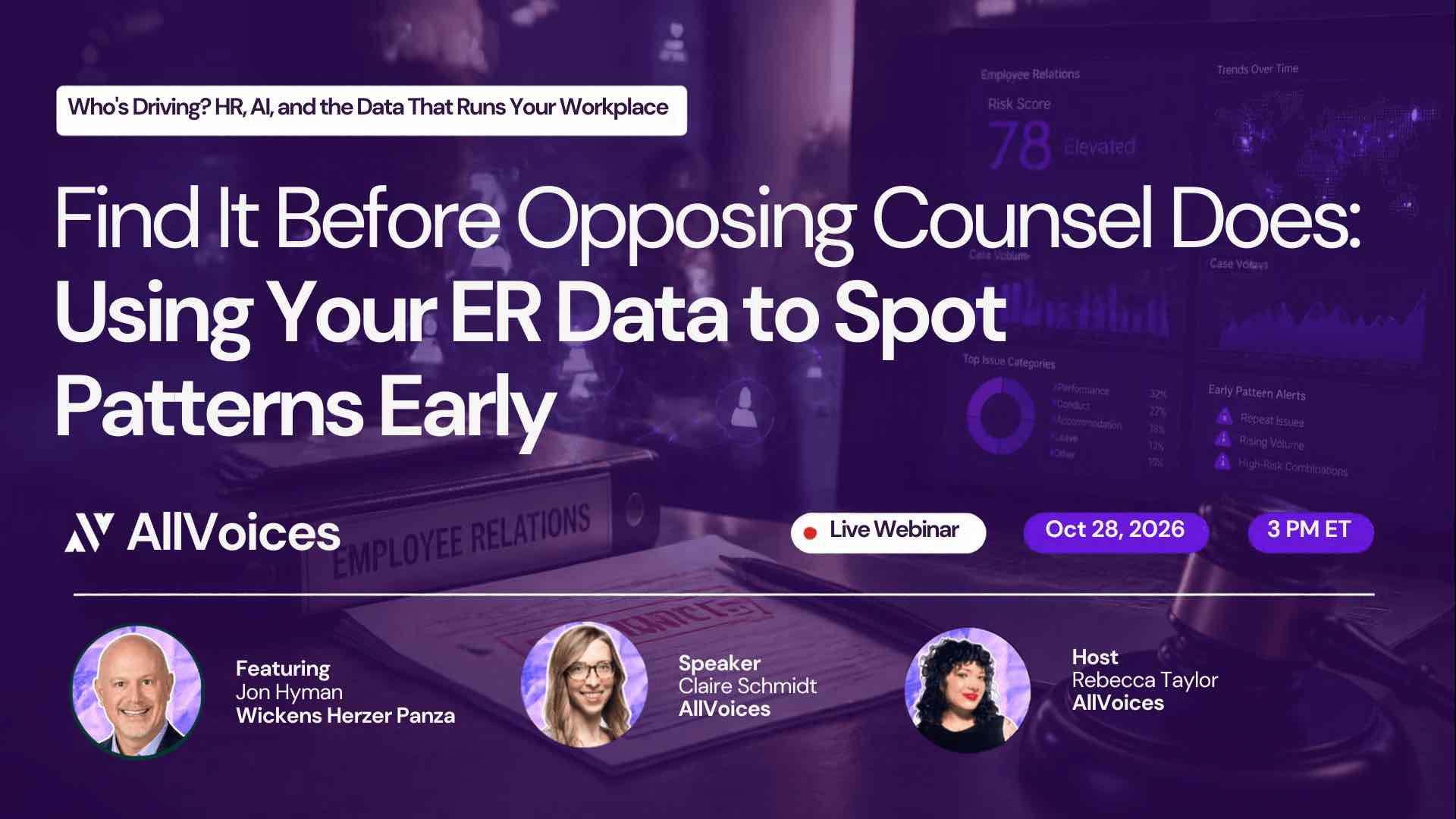
Our next webinar
Frequently asked questions

Got more questions? Email us at support@allvoices.co and we'll respond ASAP.

No items found.
Frequently asked questions

Got more questions? Email us at support@allvoices.co and we'll respond ASAP.

No items found.
Colin Mincy, Chief People Officer at Human Rights Watch - Cultivating Intentional Relationships
Episode 155
About This Episode
In this episode of Reimagining Company Culture, we’re chatting with Colin Mincy, Chief People Officer at Human Rights Watch. He oversees recruitment and hiring, international compensation and benefits, performance management, learning and development, and employee and labor relations and is an executive sponsor of the firm’s stress and resilience and DEI work.
About The Guest
Colin Mincy (he/him) is a global HR, talent and work culture thought leader who has enjoyed success in the private and public sector. Currently, Colin is Human Rights Watch’s first Chief People Officer. In 2019, the organization elevated the role to demonstrate the organization’s commitment to implement diversity, equity, and inclusion strategies and to ensure a resilient and thriving staff in ways that reflect the organization’s global role, identity, and mandate. Colin sits on the Executive Committee and directs the organization’s global Human Resources function. He oversees recruitment and hiring, international compensation and benefits, performance management, learning and development, and employee and labor relations and is an executive sponsor of the firm’s stress and resilience and DEI work. Prior to joining Human Rights Watch, Colin was the Director of Culture and Change Management for Open Society - US, and managed human resources operations for Open Society Foundation’s US offices. Colin also worked at the International Rescue Committee leading the regional human resources function for its US and European headquarters. Previously, Colin worked in the finance and technology sector as HR Business Partner Consultant for CFO Americas at Credit Suisse, Head of Human Resources at Tracx, and led SimCorp North America function in New York and Toronto. Colin’s contributions to making the world and his community a better place extend beyond his work at Human Rights Watch. He is a member of CNBC’S Workforce Executive Council, an invitation only exclusive group of CHRO’s, DEI and talent management leaders who regularly contribute ideas and share their expertise on the issues of the day necessary to succeed and thrive in the current ever-changing business and living environment. Colin also is a member of the Board of Directors for Workforce Professionals Training Institute (WPTI), a non-profit training and technical assistance intermediary for New York City’s workforce designed to unite people, programs, and organizations to generating pathways out of poverty through the employment community. He also sits on the Board of Directors for Youth Represent a non-profit organization that works to ensure that young people affected by the criminal justice system are afforded every opportunity to reclaim lives of dignity, self-fulfillment, and engagement in their communities. Additionally, Colin sits on the Advisory Board of Hacking HR and is a founding member of their Experts Council. Hacking HR is a global learning community of HR and business leaders, focused on leading the HR profession through the intersection of future of work, technology, organization, innovation, people, transformation and the impact in HR, the workforce, and the workplace. Since 2007, Colin has given of his time and resources as an advisor and workshop facilitator for INROADS New York/New Jersey, a program that he is alumni of and attributes much of his success to. Colin lives and works in New York City, has four godchildren and is a ramen and karaoke enthusiast.
Episode Transcription

Colin Mincy, Chief People Officer at Human Rights Watch, became the organization's first executive in that seat as a deliberate choice to put people strategy at the center of a global mission. His work spans recruitment, compensation, performance, learning, and employee relations across countries and time zones, which makes intentional relationships a practical operating requirement, not a soft idea.

The wider issue is that many organizations are still trying to graft relationships onto a structure that was not designed for them. Hybrid schedules, distributed teams, and rapid hiring have stretched what used to happen naturally over coffee or at offsites. HR leaders now have to make connection an explicit part of how the company runs.

Intentional relationships are how culture survives distance, change, and pressure. The question is how to build them with structure rather than hoping they emerge.

Why intentional relationships matter more in distributed work

Connection is now a strategic asset. McKinsey's research on culture in hybrid environments lays out the case clearly; you can read more in McKinsey's analysis of culture in hybrid work. When proximity disappears, leaders have to design for relationship building the same way they design for output.

That design starts with manager habits and team rituals. It also depends on listening at scale, through both formal and informal channels. AllVoices' pulse surveys give people leaders a steady read on how connected employees actually feel, separate from how they say they feel in a town hall.

Intentional relationships also require transformational leadership at the top. Without leaders who model curiosity, follow-up, and accountability, the rest of the system runs on goodwill alone.

Building relationships across difference

How do you keep DEI at the center of relationship work?

Relationships across difference do not happen automatically. Without structure, people gravitate toward those who look, sound, or think like them. HR leaders have to design programs that intentionally cross those lines: cross-functional projects, mentoring across levels, and listening sessions that center voices that usually go unheard.

Pair that with a clear DEI solution backed by data, training, and accountability. HBR's research on diverse teams and psychological safety shows why connection without inclusion does not work.

What does relationship work look like for distributed teams?

It looks like deliberate calendar design. Recurring one-on-ones, structured peer check-ins, and intentional in-person moments matter more than ad-hoc events. Use virtual mentoring programs to give junior staff access to senior leaders across geographies.

For global organizations, build in time-zone awareness. Rotating meeting times and async-first communication keep no single region permanently inconvenienced.

What actually works

Make the manager-employee relationship the unit of work

Almost every meaningful relationship at work runs through a manager. Train managers to invest in their direct reports the same way they invest in their projects. Specific, regular, two-way conversations are the foundation; everything else is decoration.

Use coaching to support managers who need help with the relational side of the role. Some great individual contributors need explicit training to lead.

Build cross-team rituals

Project-based work tends to create silos. Counter that with cross-team rituals: rotating demos, listening hours with senior leaders, and structured relationship-mapping exercises. Even a quarterly hour spent on connection across teams produces better collaboration on the next project.

For HR leaders running global teams, those rituals should account for time zones and language. The goal is not symmetry; it is access.

Treat conflict as a relationship signal

Strong relationships do not mean absence of conflict. They mean that conflict gets surfaced and resolved. Anonymous channels and a structured ER process catch tensions early, before they become resignations. AllVoices' speak-up hotline creates a steady channel for those signals.

When ER teams handle complaints with care, the underlying relationships often recover. When complaints sit, they fester.

Where Employee Relations Fits

Relationship-centered cultures still need formal channels for the moments when something goes wrong. AllVoices' HR case management tool gives ER teams a single record of every concern, response, and resolution, which is what makes follow-through possible at scale. Pair that with an AI co-pilot for ER teams and your ER staff have the time to do the human work.

How does ER protect relational culture?

ER teams act as a stabilizer. When relationships break down, fast and fair handling of concerns prevents collateral damage to nearby teams. Just as importantly, ER patterns reveal where relationship building has not stuck: which managers, which teams, which transitions are producing the most friction.

Those patterns feed directly into manager development, succession planning, and the next round of relationship investments.

Frequently Asked Questions About Intentional Relationships

What is an intentional relationship at work?

It is a working relationship that has been built on purpose, with structured time, follow-up, and shared expectations, rather than relying on proximity or chance encounters.

How do you measure relationship strength inside teams?

Use engagement and pulse data, exit interview themes, ER case patterns, and informal feedback from managers. Trend lines over time matter more than any single metric.

How do you support relationship building across cultures and time zones?

Rotate meeting times, default to async written communication, invest in cross-region travel for moments that matter, and build relationship-mapping into manager onboarding.

How do you handle a manager who is bad at relationships?

Use coaching first, with clear behavioral goals. If the pattern continues, treat it like any other performance issue. Tolerating relational damage erodes trust elsewhere on the team.

How does anonymous reporting fit a relational culture?

It gives people a way to raise concerns without putting their relationships at risk before they know what they are dealing with. Used well, it strengthens the underlying culture rather than replacing it.

What's the first step for HR leaders who want to put this into practice?

Start with one team and one measurable outcome. Pick a function where the issue shows up sharply and a leader who is willing to model the new practice. Map the current state honestly: what is happening, who feels it, and what would good look like in ninety days. Share that picture with the team, ask them what is missing from your read, and adjust before launching anything formal. The goal of step one is alignment, not activity.

Once the picture is shared, pick two or three changes you can make inside one quarter. Resist the urge to launch a full program. Run the changes, measure the response with simple pulse questions, and report back. The combination of a focused team, a clear measure, and a public commitment to learn is what turns a good idea into a practice that spreads. HR leaders who try to launch everywhere at once usually end up launching nowhere.

Iterate from there. The teams that succeed treat the first cycle as a prototype, not a rollout. They keep what worked, drop what did not, and write down what they learned. By the time the practice expands to the next group, it has been pressure-tested by people who have a stake in seeing it work. That is the unglamorous work of putting any people-strategy idea into practice, and it is also the work that compounds.

The Bottom Line for HR Leaders

Colin Mincy's work at Human Rights Watch shows that intentional relationships are infrastructure. They depend on manager habits, team rituals, listening systems, and an ER function that catches the moments when relationships fray.

For HR leaders, the takeaway is straightforward. Connection no longer happens by default. Design for it the same way you design for performance, and the rest of the culture compounds.

See how AllVoices supports the listening and ER work that intentional relationships require.

Want to learn more?
See the power of AllVoices today
Thank you! We look forward to meeting you soon
Oops! Something went wrong while submitting the form.
Frequently asked questions

Got more questions? Email us at support@allvoices.co and we'll respond ASAP.

No items found.
Frequently asked questions

Got more questions? Email us at support@allvoices.co and we'll respond ASAP.

No items found.