About This Episode
In this episode of Reimagining Company Culture, we’re chatting with Erica Raphael, Vice President of People at Muck Rack. Erica has held various positions at art businesses in business development and operations functions, and startup consulting, and was co-founder of Lofty, a venture-backed art and antiques marketplace. Tune in to learn Erica’s thoughts on measuring belongingness, redefining employee engagement, setting up employees for success in a hybrid world, and more!
About The Guest
Erica Raphael is the Vice President of People Operations at Muck Rack, the software platform that enables thousands of organizations to find the right journalists to pitch, report on media coverage and prove the value of their work. In this role, she leads Muck Rack’s talent acquisition, people operations and human resources teams, with a focus on hiring, retaining and growing top talent. She is responsible for building Muck Rack’s talent function from the ground up, more than tripling its headcount in three years. Previously, Erica was the Director of People Operations at Uppercase, a venture-backed marketplace for DC2 brands to launch physical stores. She has held various positions at art businesses in business development and operations functions, and startup consulting, and was co-founder of Lofty, a venture-backed art and antiques marketplace. Erica studied art history and French at Cornell University, and received a Master’s Degree in art business from Sotheby’s Institute of Art. She has certificates in human resources management and compensation studies. She lives with her husband and two children in New York City.
Episode Breakdown

When we sat down with Erica Raphael, Vice President of People at Muck Rack, for this episode of Reimagining Company Culture, she described a job many People leaders will recognize: building a talent function from the ground up while the company tripled in size. Erica had to figure out which engagement metrics actually mattered, what belonging looked like in a hybrid environment, and how to set new hires up for success when the traditional in-office onboarding playbook was gone.

Her answer was practical. Stop treating engagement as a quarterly survey number. Stop treating belonging as an event. Build the operational habits that let a fast-growing company keep both, even as headcount, geography, and seniority levels change every quarter. The conversation kept circling one idea. People strategy is not a philosophy. It is a system that has to be redesigned every time the company does.

Why a Sustainable People Strategy Is Different From a Good HR Plan

Most HR plans focus on what to do this year. A sustainable people strategy focuses on what will still hold up three years from now, when the company has doubled and half the leaders are new. Erica described her approach at Muck Rack as designing for the next stage, not the current one. That mindset changes which programs get built first, which metrics get watched, and which feedback loops get wired into the manager workflow.

Globally, only 21% of employees are engaged at work, the sharpest drop since pandemic lockdowns according to Gallup. That number gets worse when people feel disconnected from purpose at work, with only 30% of employees reporting that their work feels meaningful in recent Gallup polling. Sustainable strategies address that gap by building purpose into the operating model rather than leaving it to chance.

That is why the People function at high-growth companies has shifted from event planning to systems design. Engagement scores, retention rates, and belonging metrics all become outputs of the same underlying machine. If the machine is built right, the outputs improve together. If it is not, no amount of culture programming will close the gap.

Measuring Belonging Without Turning It Into a Vanity Metric

What does belonging actually mean at work?

Belonging is the felt experience of being able to bring your full perspective into a team without paying a social tax for it. It is measurable in patterns. People speaking up in meetings. People raising concerns to managers. People staying after the first eighteen months. When those patterns hold across demographic groups and across tenure bands, belonging is real. When they only hold for a subset, belonging is selective and the data will eventually tell on the company.

How do you measure belonging without a single survey question?

The most useful belonging measurement combines three signals. The first is what people say in regular feedback collection, ideally through pulse surveys that capture sentiment in the moment rather than once a year. The second is behavioral data, including who is participating, who is getting promoted, and who is voluntarily leaving. The third is feedback that comes through informal channels, including whether managers actually hear concerns before they become exits. Triangulating those three is what separates real belonging measurement from a feel-good slide in the all-hands.

What Actually Works When You Build People Strategy at Scale

Principle 1: Anchor every program to a measurable behavior

People programs fail when their success metrics are vague. Sustainable strategies tie every initiative to a behavior change that managers and employees can name. If a manager training program is supposed to improve feedback, the behavior is the number of one-to-ones happening. If an inclusion program is supposed to reduce attrition among underrepresented groups, the behavior is whether those groups are still in their roles two years later. Pick the behavior, then build the program.

Principle 2: Build the feedback loop before the policy

Erica talked about the importance of designing the listening mechanism before rolling out a new program. A new benefit, a new manager training, a new return-to-office plan all need a way to capture how it is landing in week one, not month six. Without that loop, leaders end up defending decisions long after the people closest to the work have moved on. With the loop, they can adjust quickly. That feedback discipline is the difference between an employee survey tool being a yearly ritual and being an actual operating instrument.

Principle 3: Treat onboarding as the start of retention, not the end of recruiting

The first ninety days predict whether a new hire will still be engaged at month twelve. Strong onboarding programs are not orientation slide decks. They are structured rituals that introduce people to the team, the work, and the unwritten norms in a deliberate sequence. The companies with the best retention treat onboarding as a six-month investment that includes manager check-ins, peer connections, and a clear set of early wins so the new hire feels useful by week three.

Where Employee Relations Fits Into Sustainable People Strategy

Sustainable people strategy depends on hearing problems early, not late. That is why employee engagement programs only work when they are paired with a serious employee relations function. Engagement scores tell you the temperature of the room. Employee relations tells you what is actually happening underneath. The companies that combine both can intervene before a hot team becomes a turnover problem.

How employee relations supports a high-growth people function

A modern employee relations workflow gives managers a place to surface friction before it escalates, gives human resources teams a clean trail of patterns across the organization, and gives leaders the data they need to spend resources where they will move retention. When the operating model includes a confidential reporting channel, regular pulses, and a consistent investigation process, the People team can look at the system holistically. That is what allows a fast-growing company to scale without quietly accumulating risk inside the culture.

Frequently Asked Questions About Building a Sustainable People Strategy

What is a sustainable people strategy?

A sustainable people strategy is an operating model for hiring, developing, and retaining employees that is designed to hold up as the company grows in size, geography, and complexity. It pairs programs with feedback loops so leaders can adjust as conditions change.

How is sustainable people strategy different from regular HR planning?

Regular HR planning sets goals for the next twelve months. A sustainable people strategy plans for the operating model that will be needed three years out and starts building it now, including the manager habits, listening systems, and retention strategy components that take time to mature.

What metrics should a People team track to measure belonging?

Useful belonging metrics include engagement and pulse survey scores broken out by tenure and demographic group, voluntary attrition rates, manager feedback frequency, participation rates in development programs, and the presence of psychological safety indicators inside team-level feedback.

How does hybrid work change People strategy?

Hybrid work breaks the assumptions baked into in-office programs. Onboarding, performance management, recognition, and informal learning all need explicit redesign. People teams who treat hybrid as a presence policy will struggle. Those who redesign rituals around hybrid get better engagement and retention.

What role does company culture play in retention?

Strong organizational culture drives retention because it shapes the daily experience of work. Compensation gets people to say yes to the offer. Culture gets them to stay. People teams that invest in a transparent workplace culture consistently see lower attrition than those who treat culture as a perks budget.

The Bottom Line for HR Leaders

Erica Raphael's playbook at Muck Rack is a useful reminder that fast-growing companies do not get to choose between speed and sustainability. They have to build both into the same operating model. Engagement, belonging, and retention are not three separate programs. They are three views of the same system, and the system gets stronger when the People team treats it that way.

The HR leaders who will retain their senior talent through the next three years are the ones building feedback loops into every new program, tying every initiative to a measurable behavior change, and treating onboarding as a strategic investment rather than an administrative checklist. That is how a People function moves from reactive to durable.

See how AllVoices helps People teams build the listening systems behind sustainable strategy.
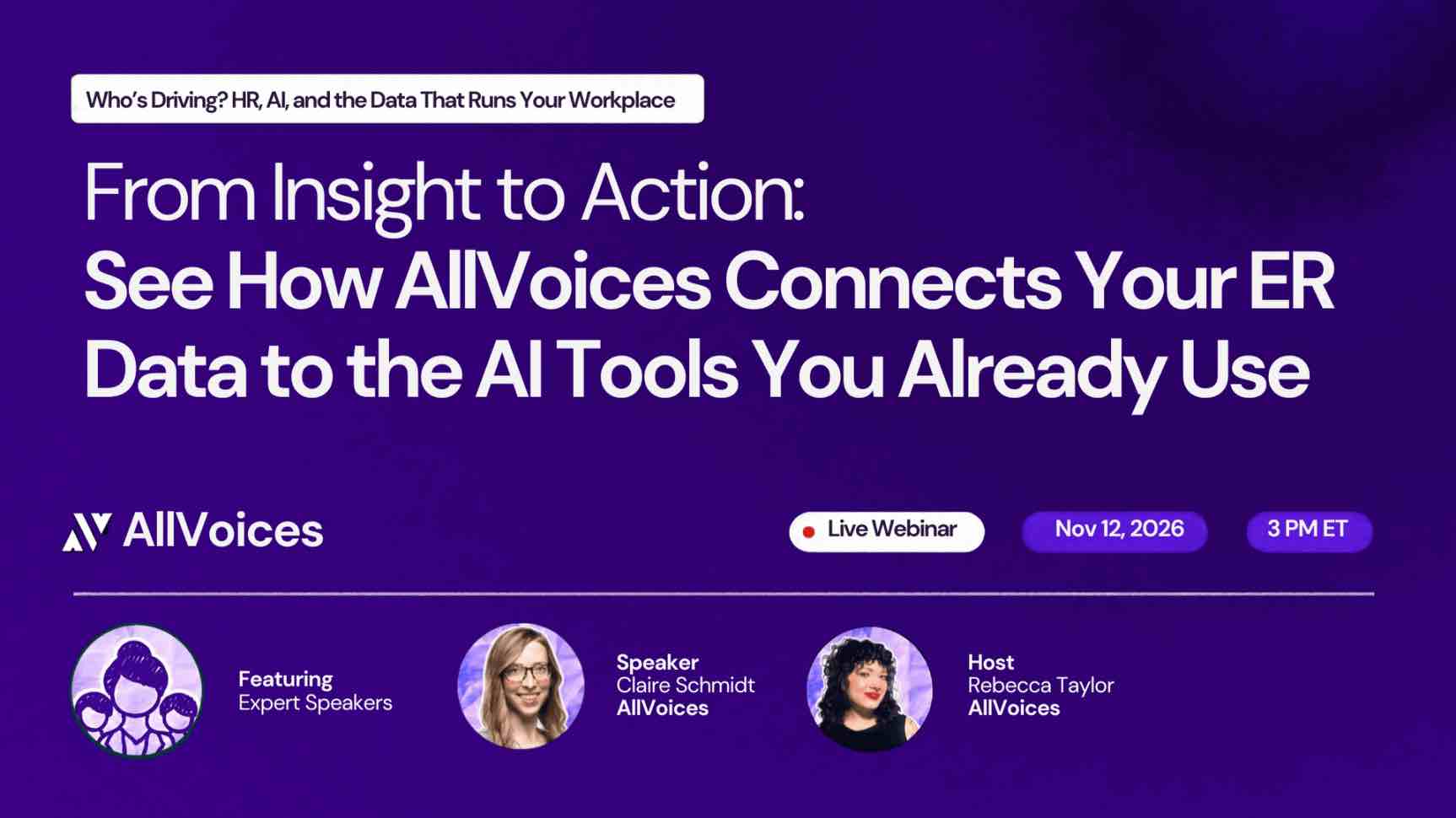
Our next webinar
Frequently asked questions

Got more questions? Email us at support@allvoices.co and we'll respond ASAP.

No items found.
Frequently asked questions

Got more questions? Email us at support@allvoices.co and we'll respond ASAP.

No items found.
Growing Sustainable Strategy with Erica Raphael, Vice President of People at Muck Rack
Episode 373
About This Episode
In this episode of Reimagining Company Culture, we’re chatting with Erica Raphael, Vice President of People at Muck Rack. Erica has held various positions at art businesses in business development and operations functions, and startup consulting, and was co-founder of Lofty, a venture-backed art and antiques marketplace. Tune in to learn Erica’s thoughts on measuring belongingness, redefining employee engagement, setting up employees for success in a hybrid world, and more!
About The Guest
Erica Raphael is the Vice President of People Operations at Muck Rack, the software platform that enables thousands of organizations to find the right journalists to pitch, report on media coverage and prove the value of their work. In this role, she leads Muck Rack’s talent acquisition, people operations and human resources teams, with a focus on hiring, retaining and growing top talent. She is responsible for building Muck Rack’s talent function from the ground up, more than tripling its headcount in three years. Previously, Erica was the Director of People Operations at Uppercase, a venture-backed marketplace for DC2 brands to launch physical stores. She has held various positions at art businesses in business development and operations functions, and startup consulting, and was co-founder of Lofty, a venture-backed art and antiques marketplace. Erica studied art history and French at Cornell University, and received a Master’s Degree in art business from Sotheby’s Institute of Art. She has certificates in human resources management and compensation studies. She lives with her husband and two children in New York City.
Episode Transcription

When we sat down with Erica Raphael, Vice President of People at Muck Rack, for this episode of Reimagining Company Culture, she described a job many People leaders will recognize: building a talent function from the ground up while the company tripled in size. Erica had to figure out which engagement metrics actually mattered, what belonging looked like in a hybrid environment, and how to set new hires up for success when the traditional in-office onboarding playbook was gone.

Her answer was practical. Stop treating engagement as a quarterly survey number. Stop treating belonging as an event. Build the operational habits that let a fast-growing company keep both, even as headcount, geography, and seniority levels change every quarter. The conversation kept circling one idea. People strategy is not a philosophy. It is a system that has to be redesigned every time the company does.

Why a Sustainable People Strategy Is Different From a Good HR Plan

Most HR plans focus on what to do this year. A sustainable people strategy focuses on what will still hold up three years from now, when the company has doubled and half the leaders are new. Erica described her approach at Muck Rack as designing for the next stage, not the current one. That mindset changes which programs get built first, which metrics get watched, and which feedback loops get wired into the manager workflow.

Globally, only 21% of employees are engaged at work, the sharpest drop since pandemic lockdowns according to Gallup. That number gets worse when people feel disconnected from purpose at work, with only 30% of employees reporting that their work feels meaningful in recent Gallup polling. Sustainable strategies address that gap by building purpose into the operating model rather than leaving it to chance.

That is why the People function at high-growth companies has shifted from event planning to systems design. Engagement scores, retention rates, and belonging metrics all become outputs of the same underlying machine. If the machine is built right, the outputs improve together. If it is not, no amount of culture programming will close the gap.

Measuring Belonging Without Turning It Into a Vanity Metric

What does belonging actually mean at work?

Belonging is the felt experience of being able to bring your full perspective into a team without paying a social tax for it. It is measurable in patterns. People speaking up in meetings. People raising concerns to managers. People staying after the first eighteen months. When those patterns hold across demographic groups and across tenure bands, belonging is real. When they only hold for a subset, belonging is selective and the data will eventually tell on the company.

How do you measure belonging without a single survey question?

The most useful belonging measurement combines three signals. The first is what people say in regular feedback collection, ideally through pulse surveys that capture sentiment in the moment rather than once a year. The second is behavioral data, including who is participating, who is getting promoted, and who is voluntarily leaving. The third is feedback that comes through informal channels, including whether managers actually hear concerns before they become exits. Triangulating those three is what separates real belonging measurement from a feel-good slide in the all-hands.

What Actually Works When You Build People Strategy at Scale

Principle 1: Anchor every program to a measurable behavior

People programs fail when their success metrics are vague. Sustainable strategies tie every initiative to a behavior change that managers and employees can name. If a manager training program is supposed to improve feedback, the behavior is the number of one-to-ones happening. If an inclusion program is supposed to reduce attrition among underrepresented groups, the behavior is whether those groups are still in their roles two years later. Pick the behavior, then build the program.

Principle 2: Build the feedback loop before the policy

Erica talked about the importance of designing the listening mechanism before rolling out a new program. A new benefit, a new manager training, a new return-to-office plan all need a way to capture how it is landing in week one, not month six. Without that loop, leaders end up defending decisions long after the people closest to the work have moved on. With the loop, they can adjust quickly. That feedback discipline is the difference between an employee survey tool being a yearly ritual and being an actual operating instrument.

Principle 3: Treat onboarding as the start of retention, not the end of recruiting

The first ninety days predict whether a new hire will still be engaged at month twelve. Strong onboarding programs are not orientation slide decks. They are structured rituals that introduce people to the team, the work, and the unwritten norms in a deliberate sequence. The companies with the best retention treat onboarding as a six-month investment that includes manager check-ins, peer connections, and a clear set of early wins so the new hire feels useful by week three.

Where Employee Relations Fits Into Sustainable People Strategy

Sustainable people strategy depends on hearing problems early, not late. That is why employee engagement programs only work when they are paired with a serious employee relations function. Engagement scores tell you the temperature of the room. Employee relations tells you what is actually happening underneath. The companies that combine both can intervene before a hot team becomes a turnover problem.

How employee relations supports a high-growth people function

A modern employee relations workflow gives managers a place to surface friction before it escalates, gives human resources teams a clean trail of patterns across the organization, and gives leaders the data they need to spend resources where they will move retention. When the operating model includes a confidential reporting channel, regular pulses, and a consistent investigation process, the People team can look at the system holistically. That is what allows a fast-growing company to scale without quietly accumulating risk inside the culture.

Frequently Asked Questions About Building a Sustainable People Strategy

What is a sustainable people strategy?

A sustainable people strategy is an operating model for hiring, developing, and retaining employees that is designed to hold up as the company grows in size, geography, and complexity. It pairs programs with feedback loops so leaders can adjust as conditions change.

How is sustainable people strategy different from regular HR planning?

Regular HR planning sets goals for the next twelve months. A sustainable people strategy plans for the operating model that will be needed three years out and starts building it now, including the manager habits, listening systems, and retention strategy components that take time to mature.

What metrics should a People team track to measure belonging?

Useful belonging metrics include engagement and pulse survey scores broken out by tenure and demographic group, voluntary attrition rates, manager feedback frequency, participation rates in development programs, and the presence of psychological safety indicators inside team-level feedback.

How does hybrid work change People strategy?

Hybrid work breaks the assumptions baked into in-office programs. Onboarding, performance management, recognition, and informal learning all need explicit redesign. People teams who treat hybrid as a presence policy will struggle. Those who redesign rituals around hybrid get better engagement and retention.

What role does company culture play in retention?

Strong organizational culture drives retention because it shapes the daily experience of work. Compensation gets people to say yes to the offer. Culture gets them to stay. People teams that invest in a transparent workplace culture consistently see lower attrition than those who treat culture as a perks budget.

The Bottom Line for HR Leaders

Erica Raphael's playbook at Muck Rack is a useful reminder that fast-growing companies do not get to choose between speed and sustainability. They have to build both into the same operating model. Engagement, belonging, and retention are not three separate programs. They are three views of the same system, and the system gets stronger when the People team treats it that way.

The HR leaders who will retain their senior talent through the next three years are the ones building feedback loops into every new program, tying every initiative to a measurable behavior change, and treating onboarding as a strategic investment rather than an administrative checklist. That is how a People function moves from reactive to durable.

See how AllVoices helps People teams build the listening systems behind sustainable strategy.

Want to learn more?
See the power of AllVoices today
Thank you! We look forward to meeting you soon
Oops! Something went wrong while submitting the form.
Frequently asked questions

Got more questions? Email us at support@allvoices.co and we'll respond ASAP.

No items found.
Frequently asked questions

Got more questions? Email us at support@allvoices.co and we'll respond ASAP.

No items found.