About This Episode
In this episode of Reimagining Company Culture, we’re chatting with Yakiry Malena Adal, Global Head of Diversity, Equity + Inclusion at Goodwin. Yakiry is a results-driven leader with an aptitude for advancing cultural change initiatives who’s worked in attorney recruiting, professional development, and inclusion for over 18 years. Tune in to learn Yakiry’s thoughts on qualitative and quantitative ways we can measure company culture, how to make sponsorship or mentorship more intentional, hidden dangers, and more!
About The Guest
Yakiry Adal is the Director of Diversity, Equity + Inclusion at Goodwin. In this role, she focuses on partnering with leadership on the firm’s Black antiracism work, building out a new DEI firmwide education strategy, enhancing the DEI pipeline strategy and sponsorship efforts, advising the on the firm’s affinity group structure and approach, and consulting with the Life Sciences and Business Law Department Specialties groups. Ms. Adal joined the firm in 2021. Prior to joining Goodwin, she was the Director of Talent & Inclusion at Stroock, where she headed the firm’s Diversity, Professional Development, and Student Recruiting functions. Yakiry is a results-driven leader with an aptitude for advancing cultural change initiatives who’s worked in attorney recruiting, professional development, and inclusion for over 18 years.
Episode Breakdown

When Yakiry Malena Adal joined us on Reimagining Company Culture, the conversation focused on a problem most People teams know but rarely fix. Engagement scores summarize a workforce in a single number. The story behind that number lives in the open text comments that almost no one reads carefully. Yakiry's argument was that qualitative data is where the real work begins, and the People teams that ignore it are leaving the most important signal on the table.

Her thesis was direct. A 7.4 engagement score on a five-point scale tells you nothing actionable. Three patterns in the comments about a specific manager, a specific team, or a specific policy tell you what to fix. Quantitative and qualitative are not competing methodologies. They are different tools for different questions, and the People teams that win at listening run both with discipline.

Why Engagement Scores Alone Mislead Almost Every Leadership Team

The risk of engagement scores is that they are too easy to act on without thinking. A score moves up or down two points. Leadership wants to know why. The People team writes a narrative that sounds plausible. Nothing actually changes because no one ever read the comments closely enough to spot the cause.

Gallup's most recent State of the Global Workplace reported global employee engagement falling from 23 percent to 21 percent, the first annual fall since the pandemic. The number is the headline. The action is in the qualitative data behind it. Companies tracking only the headline are diagnosing without listening.

What Real Qualitative Listening Looks Like

How Often Should You Read the Comments?

Every cycle. The People teams getting real value from employee feedback read the open text comments after every pulse, code them by theme, and build a small backlog of issues to investigate. The teams that look only at the score are using a fraction of the signal they paid for.

What Themes Should You Code For?

Manager behavior, workload, policy clarity, and recognition show up in almost every employee comment set. The deeper themes that matter are the ones specific to your moment. A return-to-office policy. A reorg. A new performance review system. A change in benefits. The companies running listening well treat the qualitative coding as ongoing analysis, not a one-time exercise.

What Actually Works for Modern Employee Listening

Pair the Annual Engagement Survey With Smaller Pulses

Annual surveys are too slow. Continuous pulses are too noisy without structure. The pattern that works is one annual deep survey for benchmarking, paired with shorter pulses on a six- to eight-week cadence focused on specific themes. Pulse surveys built around a single question are more useful than long instruments because employees actually finish them.

Run a Real 360 for People Managers

The single most useful qualitative dataset in most companies is the manager 360 survey. Employees know what their manager does well and where they fail. The companies running 360s with discipline pair the data with coaching, follow-up surveys, and clear escalation paths when patterns appear across multiple raters. Manager calibration based on 360 data is one of the highest-use practices on most People teams.

Make Anonymity Real, Not Theoretical

Anonymous feedback only works when employees believe it. The People teams that run trustworthy listening publish the cell-size threshold below which results are suppressed, never share open-text quotes verbatim with managers, and route any concerning comments through a structured intake rather than back to the manager being discussed. Trust in the channel is a precondition for honest data.

Where Employee Relations Fits in Listening Strategy

Listening data and case data should sit on the same dashboard. When pulse comments cluster around a specific manager, the case management system should be where that signal escalates to. When case data shows a spike in a region, the pulse should be the tool that probes for the cause. Companies that keep these systems separate end up reactive on both sides.

Employee engagement is downstream of trust, and trust is downstream of how the company responds when employees raise issues. The fastest way to lose engagement is to ask people what they think and never act on the answer. The fastest way to build it is to close the loop publicly and consistently.

How Does Connected Listening Change Manager Behavior?

It changes behavior by making manager performance on people issues visible in the same dashboard as their business performance. Engagement in the HR context is not a separate scorecard. It is part of the manager's job, and managers behave differently when they know the data is being read alongside their team's KPIs.

Frequently Asked Questions About Qualitative Employee Data

How much qualitative data is too much for a small People team?

It is not the volume that is the problem. It is the lack of a coding structure. A team of one or two can handle a thousand comments per cycle if they have a clean theme taxonomy and a tool that does first-pass categorization. The teams that get overwhelmed are the ones that read comments without a coding plan.

What is the right pulse cadence?

Six to eight weeks for short, themed pulses. One deep annual engagement survey for benchmarking. The cadence should be predictable so employees know when to expect the next one and so the People team can plan analysis time.

How do you protect anonymity in a small team?

Set a clear cell-size threshold below which results are suppressed. Five is common. Never share verbatim quotes with managers. Aggregate to themes, then use the themes to drive coaching conversations rather than confronting any individual response.

What is the relationship between qualitative data and case management?

Qualitative pulse data shows you patterns. Case management shows you incidents. The two together let the People team intervene before patterns become incidents and respond to incidents with full context about the underlying patterns. Employee feedback is most useful when the listening and the response are connected.

How does AllVoices help with employee listening?

Through employee survey tools connected to a structured case workflow, so the listening data and the action data live in the same system. People team efficiency goes up sharply when listening and case work are not in separate tools.

Yakiry's argument also extended to a measurement habit most People teams need to adopt. Tag every theme that emerges in qualitative data with a clear owner and a follow-up date. Without those, the theme stays in a slide deck and never reaches the manager training, the policy update, or the case workflow that should respond to it. The mark of a serious listening practice is the visible loop between what employees said and what changed because of it.

The Bottom Line for HR Leaders

Yakiry's frame from that conversation has aged into a working playbook. Run the surveys, but read the comments. Code the themes, not just the scores. Connect listening data to case data so patterns and incidents inform each other. Make anonymity real so the data you collect is honest. Close the loop publicly so employees see that speaking up changes something.

SHRM's research on workplace culture found that workers in positive cultures are nearly four times more likely to stay with their current employer. The People teams that listen well are the ones building those cultures, one cycle at a time.

See how AllVoices brings listening and case management into one connected system.
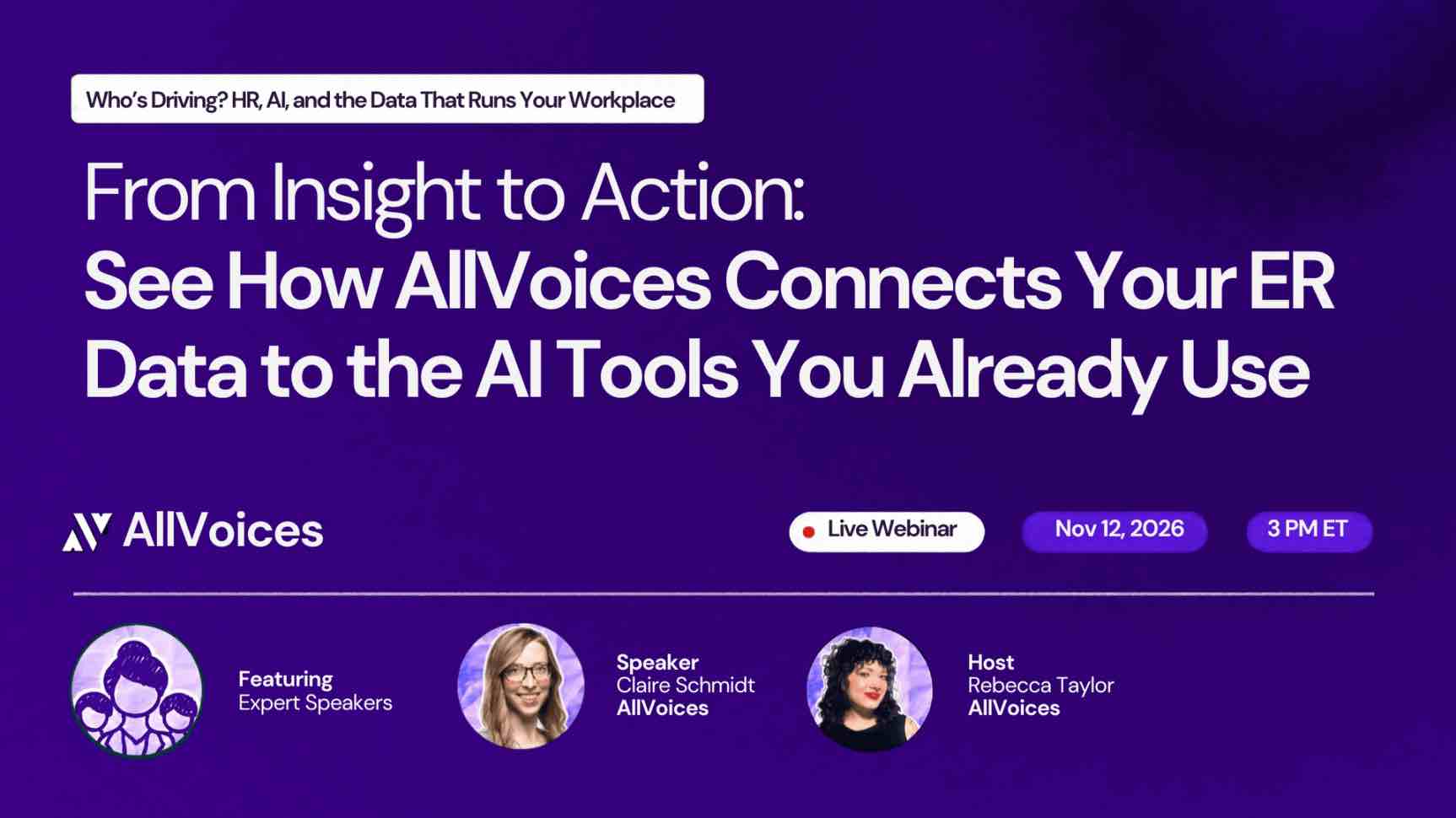
Our next webinar
Frequently asked questions

Got more questions? Email us at support@allvoices.co and we'll respond ASAP.

No items found.
Frequently asked questions

Got more questions? Email us at support@allvoices.co and we'll respond ASAP.

No items found.
Global Head of Diversity, Equity + Inclusion at Goodwin, Yakiry Malena Adal - Qualitative Data for the Whole Story
Episode 214
About This Episode
In this episode of Reimagining Company Culture, we’re chatting with Yakiry Malena Adal, Global Head of Diversity, Equity + Inclusion at Goodwin. Yakiry is a results-driven leader with an aptitude for advancing cultural change initiatives who’s worked in attorney recruiting, professional development, and inclusion for over 18 years. Tune in to learn Yakiry’s thoughts on qualitative and quantitative ways we can measure company culture, how to make sponsorship or mentorship more intentional, hidden dangers, and more!
About The Guest
Yakiry Adal is the Director of Diversity, Equity + Inclusion at Goodwin. In this role, she focuses on partnering with leadership on the firm’s Black antiracism work, building out a new DEI firmwide education strategy, enhancing the DEI pipeline strategy and sponsorship efforts, advising the on the firm’s affinity group structure and approach, and consulting with the Life Sciences and Business Law Department Specialties groups. Ms. Adal joined the firm in 2021. Prior to joining Goodwin, she was the Director of Talent & Inclusion at Stroock, where she headed the firm’s Diversity, Professional Development, and Student Recruiting functions. Yakiry is a results-driven leader with an aptitude for advancing cultural change initiatives who’s worked in attorney recruiting, professional development, and inclusion for over 18 years.
Episode Transcription

When Yakiry Malena Adal joined us on Reimagining Company Culture, the conversation focused on a problem most People teams know but rarely fix. Engagement scores summarize a workforce in a single number. The story behind that number lives in the open text comments that almost no one reads carefully. Yakiry's argument was that qualitative data is where the real work begins, and the People teams that ignore it are leaving the most important signal on the table.

Her thesis was direct. A 7.4 engagement score on a five-point scale tells you nothing actionable. Three patterns in the comments about a specific manager, a specific team, or a specific policy tell you what to fix. Quantitative and qualitative are not competing methodologies. They are different tools for different questions, and the People teams that win at listening run both with discipline.

Why Engagement Scores Alone Mislead Almost Every Leadership Team

The risk of engagement scores is that they are too easy to act on without thinking. A score moves up or down two points. Leadership wants to know why. The People team writes a narrative that sounds plausible. Nothing actually changes because no one ever read the comments closely enough to spot the cause.

Gallup's most recent State of the Global Workplace reported global employee engagement falling from 23 percent to 21 percent, the first annual fall since the pandemic. The number is the headline. The action is in the qualitative data behind it. Companies tracking only the headline are diagnosing without listening.

What Real Qualitative Listening Looks Like

How Often Should You Read the Comments?

Every cycle. The People teams getting real value from employee feedback read the open text comments after every pulse, code them by theme, and build a small backlog of issues to investigate. The teams that look only at the score are using a fraction of the signal they paid for.

What Themes Should You Code For?

Manager behavior, workload, policy clarity, and recognition show up in almost every employee comment set. The deeper themes that matter are the ones specific to your moment. A return-to-office policy. A reorg. A new performance review system. A change in benefits. The companies running listening well treat the qualitative coding as ongoing analysis, not a one-time exercise.

What Actually Works for Modern Employee Listening

Pair the Annual Engagement Survey With Smaller Pulses

Annual surveys are too slow. Continuous pulses are too noisy without structure. The pattern that works is one annual deep survey for benchmarking, paired with shorter pulses on a six- to eight-week cadence focused on specific themes. Pulse surveys built around a single question are more useful than long instruments because employees actually finish them.

Run a Real 360 for People Managers

The single most useful qualitative dataset in most companies is the manager 360 survey. Employees know what their manager does well and where they fail. The companies running 360s with discipline pair the data with coaching, follow-up surveys, and clear escalation paths when patterns appear across multiple raters. Manager calibration based on 360 data is one of the highest-use practices on most People teams.

Make Anonymity Real, Not Theoretical

Anonymous feedback only works when employees believe it. The People teams that run trustworthy listening publish the cell-size threshold below which results are suppressed, never share open-text quotes verbatim with managers, and route any concerning comments through a structured intake rather than back to the manager being discussed. Trust in the channel is a precondition for honest data.

Where Employee Relations Fits in Listening Strategy

Listening data and case data should sit on the same dashboard. When pulse comments cluster around a specific manager, the case management system should be where that signal escalates to. When case data shows a spike in a region, the pulse should be the tool that probes for the cause. Companies that keep these systems separate end up reactive on both sides.

Employee engagement is downstream of trust, and trust is downstream of how the company responds when employees raise issues. The fastest way to lose engagement is to ask people what they think and never act on the answer. The fastest way to build it is to close the loop publicly and consistently.

How Does Connected Listening Change Manager Behavior?

It changes behavior by making manager performance on people issues visible in the same dashboard as their business performance. Engagement in the HR context is not a separate scorecard. It is part of the manager's job, and managers behave differently when they know the data is being read alongside their team's KPIs.

Frequently Asked Questions About Qualitative Employee Data

How much qualitative data is too much for a small People team?

It is not the volume that is the problem. It is the lack of a coding structure. A team of one or two can handle a thousand comments per cycle if they have a clean theme taxonomy and a tool that does first-pass categorization. The teams that get overwhelmed are the ones that read comments without a coding plan.

What is the right pulse cadence?

Six to eight weeks for short, themed pulses. One deep annual engagement survey for benchmarking. The cadence should be predictable so employees know when to expect the next one and so the People team can plan analysis time.

How do you protect anonymity in a small team?

Set a clear cell-size threshold below which results are suppressed. Five is common. Never share verbatim quotes with managers. Aggregate to themes, then use the themes to drive coaching conversations rather than confronting any individual response.

What is the relationship between qualitative data and case management?

Qualitative pulse data shows you patterns. Case management shows you incidents. The two together let the People team intervene before patterns become incidents and respond to incidents with full context about the underlying patterns. Employee feedback is most useful when the listening and the response are connected.

How does AllVoices help with employee listening?

Through employee survey tools connected to a structured case workflow, so the listening data and the action data live in the same system. People team efficiency goes up sharply when listening and case work are not in separate tools.

Yakiry's argument also extended to a measurement habit most People teams need to adopt. Tag every theme that emerges in qualitative data with a clear owner and a follow-up date. Without those, the theme stays in a slide deck and never reaches the manager training, the policy update, or the case workflow that should respond to it. The mark of a serious listening practice is the visible loop between what employees said and what changed because of it.

The Bottom Line for HR Leaders

Yakiry's frame from that conversation has aged into a working playbook. Run the surveys, but read the comments. Code the themes, not just the scores. Connect listening data to case data so patterns and incidents inform each other. Make anonymity real so the data you collect is honest. Close the loop publicly so employees see that speaking up changes something.

SHRM's research on workplace culture found that workers in positive cultures are nearly four times more likely to stay with their current employer. The People teams that listen well are the ones building those cultures, one cycle at a time.

See how AllVoices brings listening and case management into one connected system.

Want to learn more?
See the power of AllVoices today
Thank you! We look forward to meeting you soon
Oops! Something went wrong while submitting the form.
Frequently asked questions

Got more questions? Email us at support@allvoices.co and we'll respond ASAP.

No items found.
Frequently asked questions

Got more questions? Email us at support@allvoices.co and we'll respond ASAP.

No items found.