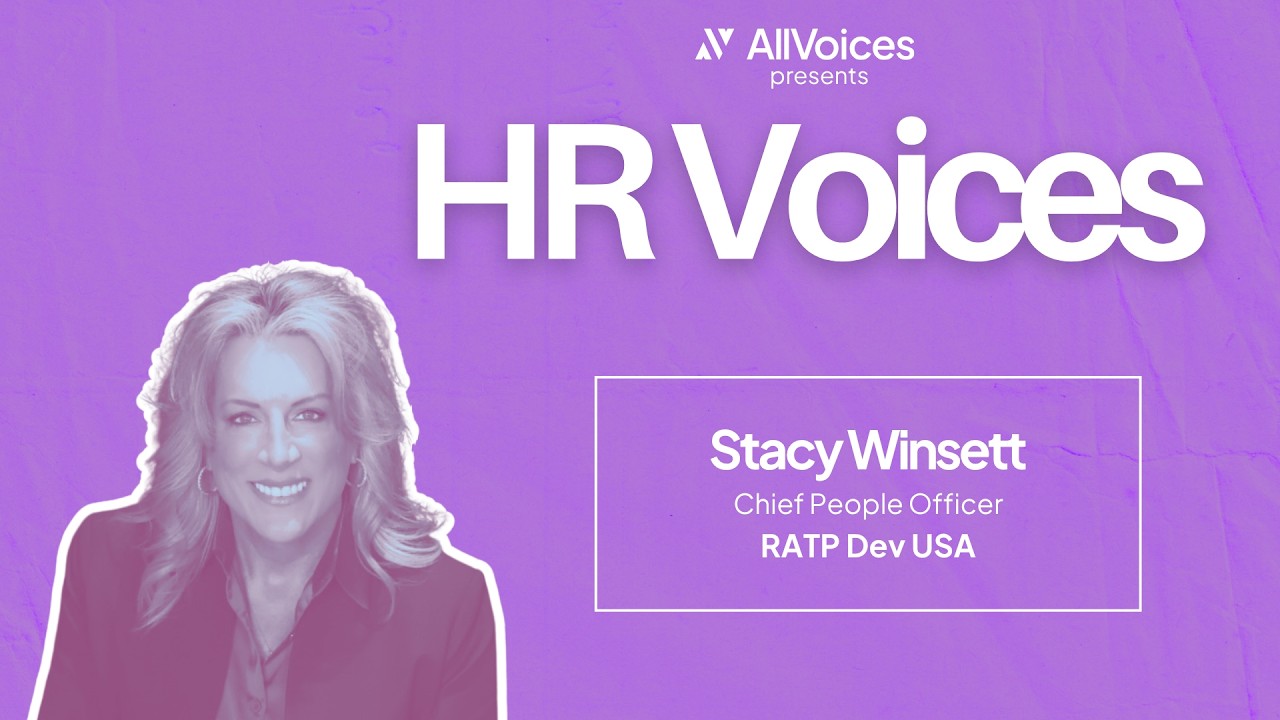

A customer support manager carrying two open headcount gaps and fourteen direct reports fires an employee on the spot after a heated escalation call. There is no warning on file and no call to HR. The next day he backdates performance notes written from memory. Six months later the employee, a Filipino woman, files a discrimination complaint, and metadata shows the notes were created after the firing. Stacy Winsett, Chief People Officer at RATP Dev USA, joined HR Voices in the middle of a book tour to work the case with host Rebecca Taylor.
What might have been a defensible termination became a six-figure settlement. The scenario ends on a harder question: why nobody flagged a manager with an unsustainable workload. Stacy traced it back from the settlement to the call, and from the call to the staffing.
Why the Missing Paper Trail Is the Real Risk
Stacy went to the paper before the workload. Her rule is blunt: from a legal perspective, whatever is not documented did not happen.
The scenario skipped a documented improvement plan, the step that could have made the firing defensible. Notes written after the fact may even be accurate, Rebecca pointed out, but once the timestamps are wrong, the credibility is gone. Missing documentation was also the red flag in another HR Voices case, a PIP issued a week after an ethics complaint.
Metadata turned a weak file into a lost case. Stacy recalls a time when nobody could forensically date a note to file. That window has closed. Since a 2006 amendment, federal discovery rules have confirmed that electronically stored information stands on equal footing with paper.
How an Overloaded Manager Became a Liability
On why nobody flagged the manager, Stacy starts with HR’s own priorities. The workforce planning process is “always one of the last things” on HR’s plate, she said. Yet it decides whether a manager has room to lead.
Rebecca tied the scenario to a wider trend. As AI gets sold as a way to create super workers, some companies widen spans and hand player-coaches a team on top of their own work. Gallup’s research on span of control and team size shows average direct reports rising from 10.9 in 2024 to 12.1 in 2025, and 97 percent of managers report individual contributor duties too.
The warning signs are visible. Stacy, whose book covers over-functioning, watches for email sent at 4 or 5 a.m., at midnight, and through the weekend. The trap is that “being able to handle a big workload is generally rewarded as a leader.” The cost stays hidden until it comes due in performance or health.
What Actually Works
Make Managers Prove Up Every Claim
Stacy prepares for an arbitration, a board of adjustment, or an EEOC case the same way. She asks who, what, when, where, and why, and treats the manager’s account as a claim to prove. She checks whether the employee knew and signed the policy, and whether anyone witnessed the incident. Her instruction to managers borrows from Law and Order: picture a courtroom and “prove up everything that comes out of your mouth.”
When there is no documentation, the questions turn to the gap. She asks whether the manager was trained, where things broke down with his own boss, and whether HR failed to train him. The backdating gets its own inquiry, measured against values her company leads with every day.
Hold the Decision Until the Heat Passes
Stacy handled a similar termination the week before we recorded, when the employee reacted strongly. Her approach is the core of de-escalating a tense conversation. “Sometimes people just need to feel heard,” she said, and “the worst thing you can do is do tit for tat.” Once the pressure drops, the talk can resume the next day.
Before any termination, she wants to know what is happening in the person’s life. An employee may be dealing with a family member on hospice, and some of hers are borderline homeless. Cultural differences at work matter too. People close to her have told her that everyday sayings she used carried meanings in other cultures she never knew. At a company that works hard to hire CDL drivers, mechanics, and technicians, losing a good employee over one misread moment is expensive.
Treat Every Open Role as a Span of Control Review
Stacy’s company reviews its structure about twice a year, sometimes quarterly. A salary grade exercise about a year ago went through every role, each manager’s span of control included, and led to a lot of changes. The review also belongs at every departure, when a role is about to be replaced or eliminated.
She ran the same test on her own team. Filling an open HR director role with two people would take her to ten or eleven direct reports, “not going to be sustainable long term.” If a stretch is unavoidable, she chooses it on purpose and adjusts the load, such as moving some weekly one-on-ones to every two weeks.
Where Employee Relations Fits
The scenario treats the fired employee as the case. Stacy’s answers turn the manager into a second employee relations matter, because he needed help and never asked for it. She borrows Olivia Pope, the fixer from Scandal, to explain HR’s role: a manager in trouble calls, and HR helps get them out. It is not “the hatchet department.”
Asking for help takes the kind of team psychological safety Stacy builds with her own people. They can stop her with a code word, “whoa, hang on a minute, Stacy.” She credits the habit with “a ton more productivity” from people who are not working from fear.
Rebecca noted that a manager’s history is hard to see without anonymous reporting or a structured record. Teams that log performance conversations as they happen, in a structured performance improvement workflow, hold the dated evidence this scenario never had.
Frequently Asked Questions About Backdated Performance Documentation
They destroy credibility. Once metadata shows notes were written after a termination, even accurate observations read as a cover story, and a firing that might have been defensible becomes hard to defend.
Start with proof. Stacy asks who, what, when, where, and why, whether the employee knew and signed the policy, and who witnessed it. Then she asks why nothing was written down.
Let the employee be heard, then slow down. Stacy advises against answering heat with heat, and suggests resuming the conversation the next day instead of deciding on a termination in the moment.
Timestamps are the easiest sign. Stacy watches for email sent at 4 or 5 a.m., at midnight, and across the weekend, and treats the pattern as a reason to check in on the leader.
Both operations and HR. Stacy calls workload a joint responsibility, and warns that when each side assumes the other is watching, nobody raises the flag until a case like this one forces it.
The Bottom Line for HR Leaders
Stacy Winsett’s framing puts the settlement on a shared assumption. The manager assumed HR could not help him, and operations may have assumed HR would handle the workload. In her words, “everybody was assuming it was the other person.” Her fix is plain: “It should be a joint responsibility.”
The backdated note was not the cause. It was the symptom that surfaced in discovery, while the cause sat upstream in two unfilled roles and fourteen direct reports nobody flagged.
See how AllVoices helps HR teams keep performance documentation timely, consistent, and ready for scrutiny.