About This Episode
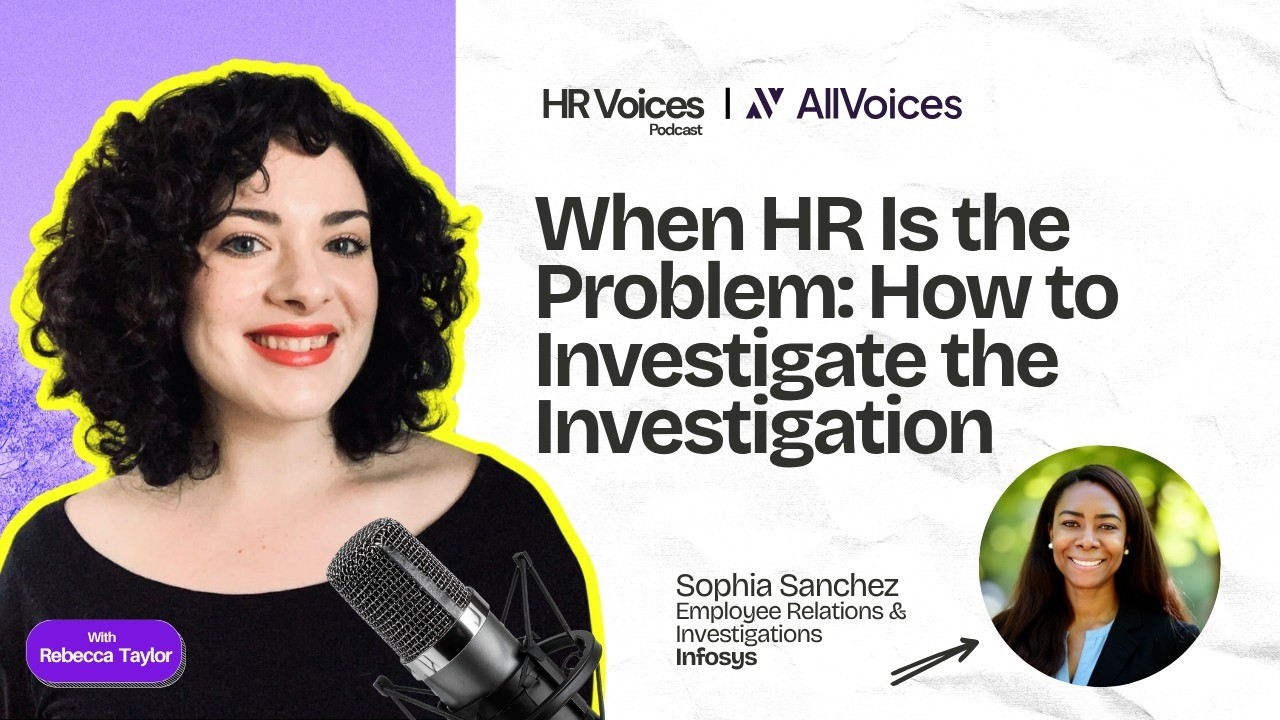
An employee says HR botched her harassment complaint: too slow, no updates, and a decision that sided with her manager without explanation. She's not wrong about the process, and now the team accused of dropping the ball has to investigate itself credibly. Sophia Sanchez, Employee Relations Leader at Infosys, covers why "it's confidential" does the most damage, how fast HR should respond, who should review the original call, and the bias check every re-investigation needs.
About The Guest
Sophia Sanchez is an Employee Relations Leader at Infosys, where she manages complex workplace investigations and builds the processes that hold up when they are scrutinized from the inside. Her career has been spent where "we followed the process" has to be demonstrably true rather than simply claimed, and she applies the same rigor to how HR teams should investigate themselves: independent reviewers, prompt and honest communication, and no assumption either way about whether the manager was right.
Episode Breakdown

An employee files a complaint about a complaint. The second one is about the handling. HR took too long, never updated her, and sided with her manager without explaining why. She is right on all three counts, even though the original finding held. Sophia Sanchez, Employee Relations Leader at Infosys, walked us through what happens when the team accused of mishandling a case has to review its own work.

Sophia manages complex workplace investigations and builds the processes that hold up under internal scrutiny. Her opening question was not what the investigator concluded. It was what the process had promised the employee, and whether anyone kept it. By then the complaint had stopped being about harassment. It had become a complaint about HR.

Why the Real Risk Sits in the Process

Sophia’s first instinct was to ask what process HR had in place before any of this started. She meant the published one, the turnaround employees are told to expect, communicated to the whole population.

Procedures themselves are where organizational risk collects. That is truest for a team investigating allegations as serious as harassment. A documented process also removes the question of special treatment. When every complaint moves through identical steps, no case can later be called the one that got handled differently.

A written grievance procedure does work no individual investigator can do alone. It is the foundation of any credible employee relations practice. It is also what makes a file hold up when someone audits it.

The employee who complains at all is the exception. EEOC research on workplace harassment found that roughly 70 percent of people who experienced harassment never talked with a supervisor, manager, or union representative about it. What she meets after she speaks decides whether the matter stays inside the company.

How Confidentiality Became the Most Damaging Excuse

The misconception has a shape: the matter was confidential, so we cannot discuss what happened. In Sophia’s experience that is rarely true. It is the excuse that does the most damage.

HR can confirm that an investigation happened. It can state that facts came from a number of witnesses, and whether there was enough to substantiate the allegation. Training can be named. What stays closed is who was interviewed and what discipline followed.

That distinction matters most when the finding does not change. An unsubstantiated harassment complaint rarely means the review found nothing worth correcting. Sophia describes cases where the conduct fell short of a policy violation and the investigation still surfaced behaviors that needed addressing.

Employees who hear nothing take the matter outside. Gallup research on speaking up about ethical concerns found that 31 percent of workers stayed silent about a serious concern at least once in a year. The figure rose to 47 percent among employees whose manager treated them as a subordinate.

Once a complaint becomes an external charge, a workplace retaliation claim tends to follow the original allegation.

What Actually Works

Build the Acknowledgment Into the First 48 Hours

Sophia’s baseline is an acknowledgment inside 24 to 48 hours. That message can be automated. It confirms receipt, states that an investigator will be assigned, and promises follow-up.

The investigator then makes contact within a few days to a week. They introduce themselves, collect the facts, and set out what happens next. That includes who will be interviewed and when the matter should close, whether in two weeks or 30 days.

If the timeline slips because a witness is traveling or on leave, Sophia goes back with a new date. The aim is to stop the employee filling the silence with her own conclusions. Silence is the failure mode most workplace investigation processes share.

Make the Reviewer Someone Who Was Not in the First Investigation

On this Sophia is unambiguous. The team that ran the original investigation should never review its own work. Doing so compromises the credibility of the entire process. The realistic options are the CHRO, compliance, or an outside investigator.

Seniority drives the choice. A complaint involving a senior vice president carries enough exposure that Sophia would push for an external reviewer. The EEOC’s promising practices for preventing harassment ask that the people resolving complaints hold the authority, independence, and resources to do it properly.

No team meets that standard while reviewing itself. Deciding the escalation path before a case arrives is what separates a defensible review from an improvised one. It is the argument for running these matters through purpose-built investigations software rather than a shared inbox.

Train Investigators to Interview, Not Email

Sophia has seen investigations completed without anyone speaking to the complainant. The investigator emailed a list of questions, the employee answered in writing, and the file closed. A conversation allows clarifying questions and produces the full picture.

A written exchange captures only what the employee thought to include. Being interviewed and being surveyed are not the same experience, and employees can tell the difference. Teams that want structure for that conversation can work from an interview credibility checklist.

Where Employee Relations Fits

A re-investigation is an employee relations problem before it becomes a legal one. The bias check Sophia insists on runs both ways. Reviewers should not assume the manager was right. They should not assume a manager with 10 complaints in a year is guilty this time.

Bias that a reviewer never notices works as readily in the complainant’s favor as the manager’s. A review that corrects for one and not the other is not a review.

Sophia keeps one question in view throughout. If the matter leaves the organization, the case files, the interview notes, and the conclusion have to stand alone. That standard is the whole purpose of documenting the investigation properly.

Many organizations have no formal appeal process after an investigation closes. Every decision to reopen a case becomes a judgment call. Consistent HR case management keeps those judgment calls comparable.

Frequently Asked Questions About Re-Investigating an HR Complaint

How Fast Should HR Respond to a Complaint?

Within 24 to 48 hours. Sophia recommends an automated acknowledgment no later than two days, followed by an investigator making personal contact within a few days to a week.

Can the Same HR Team Re-Investigate Its Own Investigation?

No. The team that made the original call should not review it, because that compromises the credibility of the entire process. A CHRO, a compliance function, or an outside investigator takes it instead.

What Can HR Say Without Breaking Confidentiality?

More than most teams assume. You can confirm that an investigation happened, that facts came from a number of witnesses, whether there was enough to substantiate, and that corrective action followed.

What If the Re-Investigation Reaches the Same Outcome?

You say so plainly. Sophia treats an unchanged outcome as a normal result worth communicating, delivered by someone senior to the original team, with an honest account of where communication failed.

When Should a Company Bring In an External Investigator?

Seniority is the trigger. Risk rises with the subject’s level, so a complaint involving a senior vice president, or one naming the employee relations team itself, makes an outside reviewer the safer choice.

The Bottom Line for HR Leaders

Sophia’s framing is unusually forgiving of the thing HR fears most. It is acceptable to review a process and conclude that a mistake was made. The department that presents itself as infallible is the one employees stop trusting first.

Sometimes a review does not change the outcome, and Sophia Sanchez treats saying so as part of the work. Teams that name a process failure and fix it keep the trust they have left; teams that defend a spotless record lose it over a delay they could have explained.

See how AllVoices helps employee relations teams run investigations that hold up when someone reviews them.
Our next webinar
Frequently asked questions

Got more questions? Email us at support@allvoices.co and we'll respond ASAP.

No items found.
Frequently asked questions

Got more questions? Email us at support@allvoices.co and we'll respond ASAP.

No items found.

When the Complaint Is About HR: Re-Investigating an Investigation

About the guest

Sophia Sanchez is an Employee Relations Leader at Infosys, where she manages complex workplace investigations and builds the processes that hold up when they are scrutinized from the inside. Her career has been spent where "we followed the process" has to be demonstrably true rather than simply claimed, and she applies the same rigor to how HR teams should investigate themselves: independent reviewers, prompt and honest communication, and no assumption either way about whether the manager was right.

Episode Breakdown

An employee files a complaint about a complaint. The second one is about the handling. HR took too long, never updated her, and sided with her manager without explaining why. She is right on all three counts, even though the original finding held. Sophia Sanchez, Employee Relations Leader at Infosys, walked us through what happens when the team accused of mishandling a case has to review its own work.

Sophia manages complex workplace investigations and builds the processes that hold up under internal scrutiny. Her opening question was not what the investigator concluded. It was what the process had promised the employee, and whether anyone kept it. By then the complaint had stopped being about harassment. It had become a complaint about HR.

Why the Real Risk Sits in the Process

Sophia’s first instinct was to ask what process HR had in place before any of this started. She meant the published one, the turnaround employees are told to expect, communicated to the whole population.

Procedures themselves are where organizational risk collects. That is truest for a team investigating allegations as serious as harassment. A documented process also removes the question of special treatment. When every complaint moves through identical steps, no case can later be called the one that got handled differently.

A written grievance procedure does work no individual investigator can do alone. It is the foundation of any credible employee relations practice. It is also what makes a file hold up when someone audits it.

The employee who complains at all is the exception. EEOC research on workplace harassment found that roughly 70 percent of people who experienced harassment never talked with a supervisor, manager, or union representative about it. What she meets after she speaks decides whether the matter stays inside the company.

How Confidentiality Became the Most Damaging Excuse

The misconception has a shape: the matter was confidential, so we cannot discuss what happened. In Sophia’s experience that is rarely true. It is the excuse that does the most damage.

HR can confirm that an investigation happened. It can state that facts came from a number of witnesses, and whether there was enough to substantiate the allegation. Training can be named. What stays closed is who was interviewed and what discipline followed.

That distinction matters most when the finding does not change. An unsubstantiated harassment complaint rarely means the review found nothing worth correcting. Sophia describes cases where the conduct fell short of a policy violation and the investigation still surfaced behaviors that needed addressing.

Employees who hear nothing take the matter outside. Gallup research on speaking up about ethical concerns found that 31 percent of workers stayed silent about a serious concern at least once in a year. The figure rose to 47 percent among employees whose manager treated them as a subordinate.

Once a complaint becomes an external charge, a workplace retaliation claim tends to follow the original allegation.

What Actually Works

Build the Acknowledgment Into the First 48 Hours

Sophia’s baseline is an acknowledgment inside 24 to 48 hours. That message can be automated. It confirms receipt, states that an investigator will be assigned, and promises follow-up.

The investigator then makes contact within a few days to a week. They introduce themselves, collect the facts, and set out what happens next. That includes who will be interviewed and when the matter should close, whether in two weeks or 30 days.

If the timeline slips because a witness is traveling or on leave, Sophia goes back with a new date. The aim is to stop the employee filling the silence with her own conclusions. Silence is the failure mode most workplace investigation processes share.

Make the Reviewer Someone Who Was Not in the First Investigation

On this Sophia is unambiguous. The team that ran the original investigation should never review its own work. Doing so compromises the credibility of the entire process. The realistic options are the CHRO, compliance, or an outside investigator.

Seniority drives the choice. A complaint involving a senior vice president carries enough exposure that Sophia would push for an external reviewer. The EEOC’s promising practices for preventing harassment ask that the people resolving complaints hold the authority, independence, and resources to do it properly.

No team meets that standard while reviewing itself. Deciding the escalation path before a case arrives is what separates a defensible review from an improvised one. It is the argument for running these matters through purpose-built investigations software rather than a shared inbox.

Train Investigators to Interview, Not Email

Sophia has seen investigations completed without anyone speaking to the complainant. The investigator emailed a list of questions, the employee answered in writing, and the file closed. A conversation allows clarifying questions and produces the full picture.

A written exchange captures only what the employee thought to include. Being interviewed and being surveyed are not the same experience, and employees can tell the difference. Teams that want structure for that conversation can work from an interview credibility checklist.

Where Employee Relations Fits

A re-investigation is an employee relations problem before it becomes a legal one. The bias check Sophia insists on runs both ways. Reviewers should not assume the manager was right. They should not assume a manager with 10 complaints in a year is guilty this time.

Bias that a reviewer never notices works as readily in the complainant’s favor as the manager’s. A review that corrects for one and not the other is not a review.

Sophia keeps one question in view throughout. If the matter leaves the organization, the case files, the interview notes, and the conclusion have to stand alone. That standard is the whole purpose of documenting the investigation properly.

Many organizations have no formal appeal process after an investigation closes. Every decision to reopen a case becomes a judgment call. Consistent HR case management keeps those judgment calls comparable.

Frequently Asked Questions About Re-Investigating an HR Complaint

How Fast Should HR Respond to a Complaint?

Within 24 to 48 hours. Sophia recommends an automated acknowledgment no later than two days, followed by an investigator making personal contact within a few days to a week.

Can the Same HR Team Re-Investigate Its Own Investigation?

No. The team that made the original call should not review it, because that compromises the credibility of the entire process. A CHRO, a compliance function, or an outside investigator takes it instead.

What Can HR Say Without Breaking Confidentiality?

More than most teams assume. You can confirm that an investigation happened, that facts came from a number of witnesses, whether there was enough to substantiate, and that corrective action followed.

What If the Re-Investigation Reaches the Same Outcome?

You say so plainly. Sophia treats an unchanged outcome as a normal result worth communicating, delivered by someone senior to the original team, with an honest account of where communication failed.

When Should a Company Bring In an External Investigator?

Seniority is the trigger. Risk rises with the subject’s level, so a complaint involving a senior vice president, or one naming the employee relations team itself, makes an outside reviewer the safer choice.

The Bottom Line for HR Leaders

Sophia’s framing is unusually forgiving of the thing HR fears most. It is acceptable to review a process and conclude that a mistake was made. The department that presents itself as infallible is the one employees stop trusting first.

Sometimes a review does not change the outcome, and Sophia Sanchez treats saying so as part of the work. Teams that name a process failure and fix it keep the trust they have left; teams that defend a spotless record lose it over a delay they could have explained.

See how AllVoices helps employee relations teams run investigations that hold up when someone reviews them.