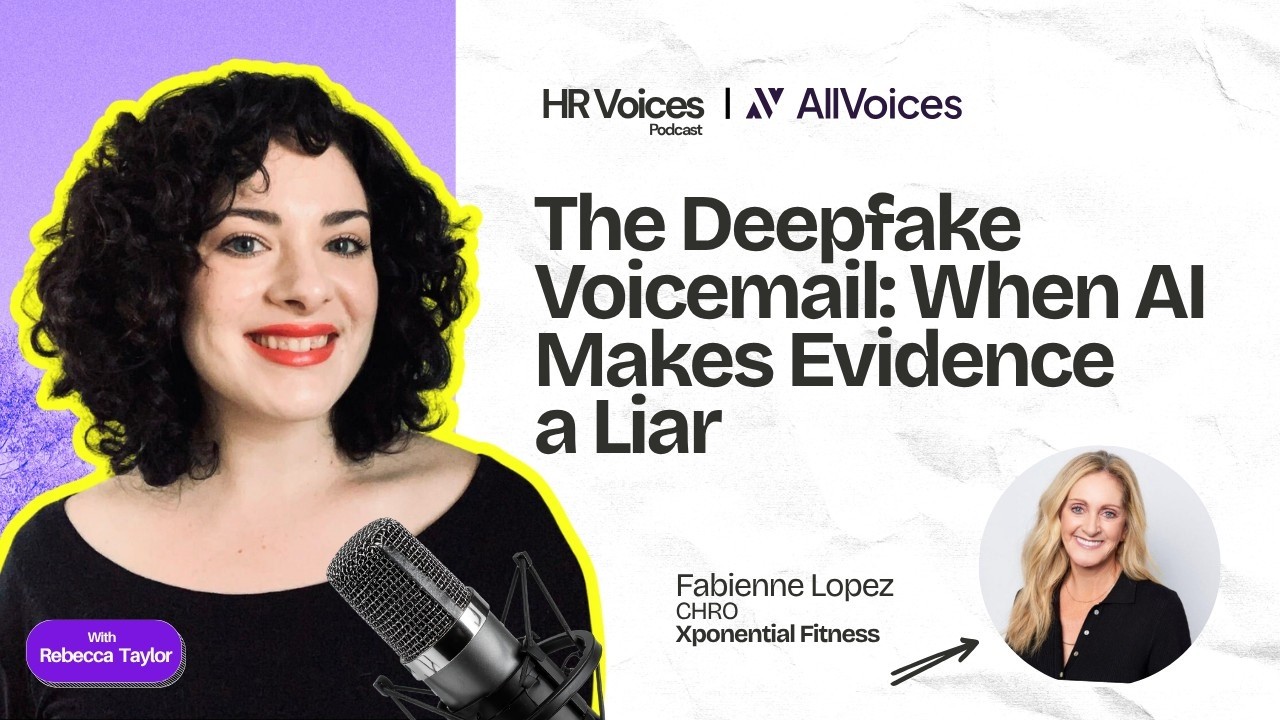
About This Episode
An employee submits a voicemail as proof her manager threatened her job over a weekend shift. It sounds exactly like him, he swears he never left it, forensic voice analysis can't settle it, and both sides have lawyered up. Fabienne Lopez, Chief People Officer at Xponential Fitness, walks through building the investigation in real time: bringing IT in for carrier records and file history, treating AI-generated evidence as one more data point, and what HR does when the truth never resolves.
About The Guest
Fabienne Lopez is Chief People Officer at Xponential Fitness, appointed in May 2025 to lead people strategy across the company's portfolio of fitness brands. She brings more than 30 years of HR experience across consumer goods, life sciences, manufacturing and healthcare, including roles at Arbonne, Allergan, Fluor, Comfort Keepers and Bausch + Lomb. She specializes in employee relations, investigations and building HR functions that act as true business partners rather than compliance gatekeepers.
Episode Breakdown

An employee submits a voicemail as proof that her manager threatened her job if she refused a weekend shift. The voice is his. The manager swears he never left it and says the file must be AI generated. Forensic voice analysis comes back inconclusive, both parties have already retained counsel, and HR has no protocol for evidence that might not be real. Fabienne Lopez, Chief People Officer at Xponential Fitness, worked the scenario through on HR Voices.

The episode builds on an AllVoices webinar on AI-generated evidence, and Fabienne starts somewhere other than the audio. Her first move is to widen the list of people who could have made it. Her second is to demote the recording from verdict to data point. A defensible outcome comes from process, not from forensics.

Why Jumping to Whether He Left It Is the Riskiest Move

Asked what stood out as riskiest, Fabienne did not name the deepfake. The risk is not the fake audio. It is the assumption behind it, because deciding on day one that the manager is the question narrows a wide field to two people.

That field is wider than the scenario admits. Fabienne holds open the alternatives: a vindictive coworker building the file to set the manager up, neither party having sent it, an outside actor with a grievance against the company, or a security breach. Each one stays live until the data closes it.

Holding them open also protects the employee. Her complaint about a threatened schedule change sits close to the legal standard for retaliation, and the EEOC treats participation in a complaint process as protected under all circumstances.

How IT Turns a Voicemail Into a Data Trail

Fabienne’s first call is to IT, and not only for AI detection. She wants the team running its own investigation concurrently, on the separate question of whether the company was breached.

The precedent she reaches for is older than synthetic audio. Emails could always be forwarded with the history altered, and a text thread can be pruned to keep some messages and delete others. Faked audio is that problem in a newer medium, which is why HR teams verifying AI-generated evidence can work from the method they have.

What IT adds is provenance. IP data, file history and carrier records sit alongside the statements, schedule messages and chat logs that make up the types of evidence a workplace investigation collects. The tooling is cheap: the FTC ran a public challenge on voice cloning misuse, noting that scammers have used it to impersonate business executives.

What Actually Works

Run the IT Investigation Alongside the Interviews

Fabienne treats the technical workstream and the employee relations workstream as concurrent, not sequential. IT works the file and the carrier while she builds the witness list, protects the recording and takes statements. She asks both parties for patience, since both have gone to counsel.

Her image for the sequencing is painting a house. The preparation takes longer than the part everyone wants to get to, and skipping it is what makes the result impossible to defend.

Ask for the Phone Records, and Plan for a No

Host Rebecca Taylor put the obvious move to her: ask both people for timestamps, and ask to see the phones. Fabienne’s answer turns on who owns the device.

On a company-issued phone, the carrier record settles the call log and neither party can edit it. On a personal phone covered by a stipend, which is the arrangement at her own company, the request stays a request. Bring Your Own Device policies decide how far HR can go, and a screenshot is easy to curate.

Fabienne would ask anyway, framed as helping both sides get to the bottom of it together. A refusal becomes something she remembers. It is not proof, and holding those two apart is the work.

Keep the Witness List Small and Let the Data Widen It

She starts small on purpose, to keep the case contained and the rumors down. The list grows only when the allegation grows. If the employee describes a pattern rather than one voicemail, the manager’s direct reports come into scope.

The stopping rule is practical. Of ten direct reports, three consistent interviews saying there is nothing there end the sampling. Past engagement scores and prior 360 results are fair data points; running a new 360 mid-investigation is not.

Where Employee Relations Fits

Two cases live inside this one. The first is whether the voicemail is real. The second is the relationship, and it outlasts whatever the first concludes.

The tell is that the employee never called her manager. She went to HR and then to legal, which means the trust was gone before the recording existed. Rebecca’s read is that the case splits in two, and Fabienne agrees that the second half has to be worked regardless of the verdict on the audio. Employee relations case work owns that half.

It is also why an unused open door is a finding rather than a footnote, and why most open door policies fail quietly. Fabienne would go looking for the earlier conversations: the messages about the schedule change, the history on both sides, prior cases naming this manager. Teams holding that history in one structured case file answer the pattern question in minutes.

Her documentation standard is the court test. She writes notes as though she has left the company, someone sues two years later, and a stranger is reading the file cold. The federal Advisory Committee on Evidence Rules has tentatively approved a proposed rule for evidence claimed to be AI-fabricated, a fair signal of where the bar is heading.

Frequently Asked Questions About AI-Generated Evidence in HR Investigations

Can HR Ask an Employee to Show a Personal Phone During an Investigation?

Yes, as a request rather than a requirement. On a company-issued device the employer can pull carrier records directly. On a personal phone under a stipend, the employee can decline, and the refusal is a data point rather than proof.

What Should HR Do When Forensic Analysis of a Recording Is Inconclusive?

Treat the recording as one data point and work the rest of the case. Statements, schedule messages, carrier logs and the history between the parties often settle what the audio cannot. The absence of a forensic answer is not the absence of an answer.

Does AI-Generated Evidence Need a Separate Investigation Process?

No. Fabienne’s view is that faked audio is the newest version of an edited email thread or a curated screenshot. The steps hold: preserve the evidence, build the witness list, take statements, and bring IT in for provenance.

How Small Should the Witness List Be in a Sensitive Investigation?

Small enough to stay contained, then widened by what the first interviews return. Three consistent answers from a manager’s direct reports usually end the sampling. Interviewing all ten after the first three agree reads as a witch hunt and buys nothing.

What Happens When an Investigation Cannot Prove What Occurred?

The case moves from proof to repair. Fabienne names the fracture, asks both people whether they are willing to work forward, and sets expectations on each side. Workplace mediation is one route, and a transfer or an exit is another.

The Bottom Line for HR Leaders

Fabienne Lopez keeps returning to one line: sometimes it is he said, she said, and nobody ever knows. What remains is a fractured relationship and a company that has to decide what to do about it. She would name the fracture, get a commitment from both people, and keep the file clean enough for a courtroom.

The AI did not change the method. It changed how much confidence anyone can place in one artifact, which is an argument for running the investigation the same way every time. Consistency is what stays defensible when the evidence refuses to resolve.

See how AllVoices helps employee relations teams run consistent, defensible investigations when the evidence is contested: book a demo.
Our next webinar
Frequently asked questions

Got more questions? Email us at support@allvoices.co and we'll respond ASAP.

No items found.
Frequently asked questions

Got more questions? Email us at support@allvoices.co and we'll respond ASAP.

No items found.

Investigating Deepfake Evidence: When a Voicemail Can't Be Trusted

About the guest

Fabienne Lopez is Chief People Officer at Xponential Fitness, appointed in May 2025 to lead people strategy across the company's portfolio of fitness brands. She brings more than 30 years of HR experience across consumer goods, life sciences, manufacturing and healthcare, including roles at Arbonne, Allergan, Fluor, Comfort Keepers and Bausch + Lomb. She specializes in employee relations, investigations and building HR functions that act as true business partners rather than compliance gatekeepers.

Episode Breakdown

An employee submits a voicemail as proof that her manager threatened her job if she refused a weekend shift. The voice is his. The manager swears he never left it and says the file must be AI generated. Forensic voice analysis comes back inconclusive, both parties have already retained counsel, and HR has no protocol for evidence that might not be real. Fabienne Lopez, Chief People Officer at Xponential Fitness, worked the scenario through on HR Voices.

The episode builds on an AllVoices webinar on AI-generated evidence, and Fabienne starts somewhere other than the audio. Her first move is to widen the list of people who could have made it. Her second is to demote the recording from verdict to data point. A defensible outcome comes from process, not from forensics.

Why Jumping to Whether He Left It Is the Riskiest Move

Asked what stood out as riskiest, Fabienne did not name the deepfake. The risk is not the fake audio. It is the assumption behind it, because deciding on day one that the manager is the question narrows a wide field to two people.

That field is wider than the scenario admits. Fabienne holds open the alternatives: a vindictive coworker building the file to set the manager up, neither party having sent it, an outside actor with a grievance against the company, or a security breach. Each one stays live until the data closes it.

Holding them open also protects the employee. Her complaint about a threatened schedule change sits close to the legal standard for retaliation, and the EEOC treats participation in a complaint process as protected under all circumstances.

How IT Turns a Voicemail Into a Data Trail

Fabienne’s first call is to IT, and not only for AI detection. She wants the team running its own investigation concurrently, on the separate question of whether the company was breached.

The precedent she reaches for is older than synthetic audio. Emails could always be forwarded with the history altered, and a text thread can be pruned to keep some messages and delete others. Faked audio is that problem in a newer medium, which is why HR teams verifying AI-generated evidence can work from the method they have.

What IT adds is provenance. IP data, file history and carrier records sit alongside the statements, schedule messages and chat logs that make up the types of evidence a workplace investigation collects. The tooling is cheap: the FTC ran a public challenge on voice cloning misuse, noting that scammers have used it to impersonate business executives.

What Actually Works

Run the IT Investigation Alongside the Interviews

Fabienne treats the technical workstream and the employee relations workstream as concurrent, not sequential. IT works the file and the carrier while she builds the witness list, protects the recording and takes statements. She asks both parties for patience, since both have gone to counsel.

Her image for the sequencing is painting a house. The preparation takes longer than the part everyone wants to get to, and skipping it is what makes the result impossible to defend.

Ask for the Phone Records, and Plan for a No

Host Rebecca Taylor put the obvious move to her: ask both people for timestamps, and ask to see the phones. Fabienne’s answer turns on who owns the device.

On a company-issued phone, the carrier record settles the call log and neither party can edit it. On a personal phone covered by a stipend, which is the arrangement at her own company, the request stays a request. Bring Your Own Device policies decide how far HR can go, and a screenshot is easy to curate.

Fabienne would ask anyway, framed as helping both sides get to the bottom of it together. A refusal becomes something she remembers. It is not proof, and holding those two apart is the work.

Keep the Witness List Small and Let the Data Widen It

She starts small on purpose, to keep the case contained and the rumors down. The list grows only when the allegation grows. If the employee describes a pattern rather than one voicemail, the manager’s direct reports come into scope.

The stopping rule is practical. Of ten direct reports, three consistent interviews saying there is nothing there end the sampling. Past engagement scores and prior 360 results are fair data points; running a new 360 mid-investigation is not.

Where Employee Relations Fits

Two cases live inside this one. The first is whether the voicemail is real. The second is the relationship, and it outlasts whatever the first concludes.

The tell is that the employee never called her manager. She went to HR and then to legal, which means the trust was gone before the recording existed. Rebecca’s read is that the case splits in two, and Fabienne agrees that the second half has to be worked regardless of the verdict on the audio. Employee relations case work owns that half.

It is also why an unused open door is a finding rather than a footnote, and why most open door policies fail quietly. Fabienne would go looking for the earlier conversations: the messages about the schedule change, the history on both sides, prior cases naming this manager. Teams holding that history in one structured case file answer the pattern question in minutes.

Her documentation standard is the court test. She writes notes as though she has left the company, someone sues two years later, and a stranger is reading the file cold. The federal Advisory Committee on Evidence Rules has tentatively approved a proposed rule for evidence claimed to be AI-fabricated, a fair signal of where the bar is heading.

Frequently Asked Questions About AI-Generated Evidence in HR Investigations

Can HR Ask an Employee to Show a Personal Phone During an Investigation?

Yes, as a request rather than a requirement. On a company-issued device the employer can pull carrier records directly. On a personal phone under a stipend, the employee can decline, and the refusal is a data point rather than proof.

What Should HR Do When Forensic Analysis of a Recording Is Inconclusive?

Treat the recording as one data point and work the rest of the case. Statements, schedule messages, carrier logs and the history between the parties often settle what the audio cannot. The absence of a forensic answer is not the absence of an answer.

Does AI-Generated Evidence Need a Separate Investigation Process?

No. Fabienne’s view is that faked audio is the newest version of an edited email thread or a curated screenshot. The steps hold: preserve the evidence, build the witness list, take statements, and bring IT in for provenance.

How Small Should the Witness List Be in a Sensitive Investigation?

Small enough to stay contained, then widened by what the first interviews return. Three consistent answers from a manager’s direct reports usually end the sampling. Interviewing all ten after the first three agree reads as a witch hunt and buys nothing.

What Happens When an Investigation Cannot Prove What Occurred?

The case moves from proof to repair. Fabienne names the fracture, asks both people whether they are willing to work forward, and sets expectations on each side. Workplace mediation is one route, and a transfer or an exit is another.

The Bottom Line for HR Leaders

Fabienne Lopez keeps returning to one line: sometimes it is he said, she said, and nobody ever knows. What remains is a fractured relationship and a company that has to decide what to do about it. She would name the fracture, get a commitment from both people, and keep the file clean enough for a courtroom.

The AI did not change the method. It changed how much confidence anyone can place in one artifact, which is an argument for running the investigation the same way every time. Consistency is what stays defensible when the evidence refuses to resolve.

See how AllVoices helps employee relations teams run consistent, defensible investigations when the evidence is contested: book a demo.